How to Tailor a Resume to a Job Description in 10 Minutes
Relevance is a 10-minute edit. Here is the five-step method for tailoring your resume to any job description: keywords, exact language, bullet reordering.
Here's a number worth sitting with: when a hiring manager opens your resume, they're not reading it to discover how great you are. They're scanning it to check one question — does this person fit this specific role?
Applicant tracking systems and recruiter filters answer that question before most humans get a chance. In Jobscan's 2025 State of the Job Search report, built from more than 2.5 million applications, candidates whose resume carried the listing's exact job title were interviewed at 10.6 times the rate of those who didn't.
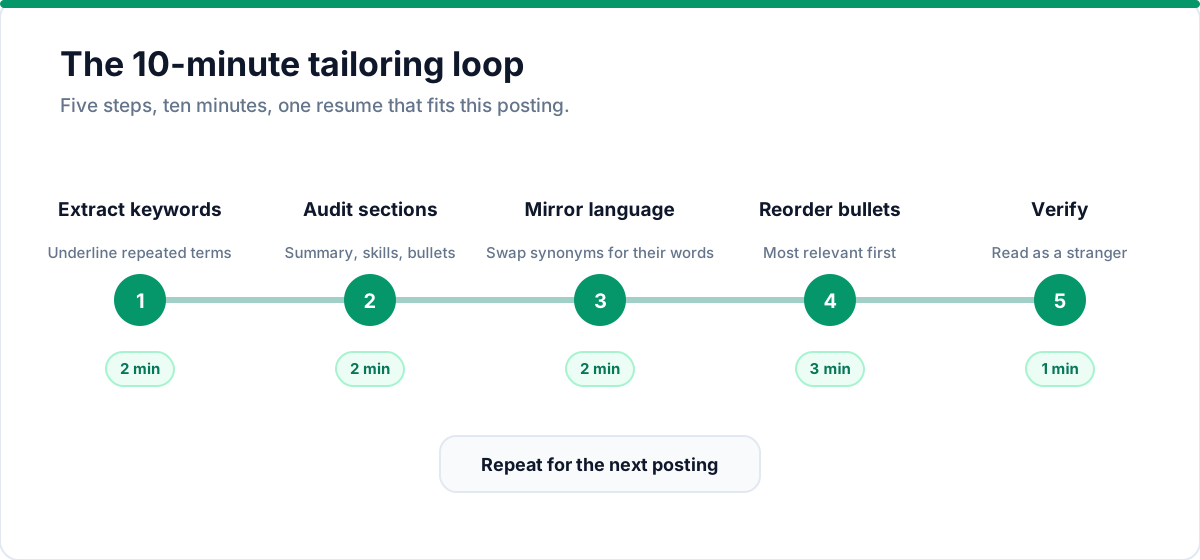
That gap is fixable, and fixing it doesn't take an hour of agonizing. It takes a ten-minute, five-step method. Here it is.
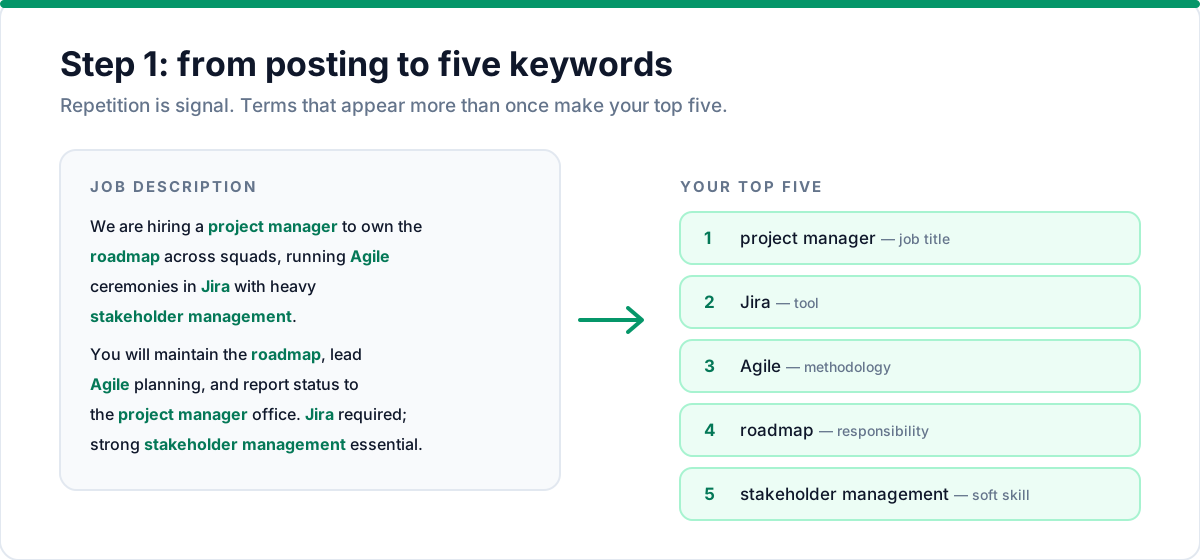
Step 1: Pull the five keywords that matter (2 minutes)
Read the job description once, looking specifically for repeated terms. Repetition isn't an accident — it's the description telling you what the role ranks for.
Underline every term that appears more than once: job titles, tools, methodologies, and responsibilities. Then pick the top five. If the description says "project manager," "Stakeholder management," "Jira," "Agile," and "roadmap" repeatedly, those are your five.
Soft skills count when the posting repeats them. If "stakeholder management" or "client communication" shows up three times, treat it like any other keyword.
This is the same skill as choosing resume keywords — the difference is that here, the job description hands you the list. You just have to use it. Our how to write a resume guide covers the full process if you're building from scratch.
Step 2: Check your top sections against them (2 minutes)
Open your resume and check three places for each of the five keywords:
- Professional summary — do at least 2–3 appear?
- Skills / core competencies — do the tools and methodologies appear?
- Experience bullets — does the most important one appear in context?
For each missing keyword, you have two moves: add it if it's genuinely true for you, or note that you need to reframe. Never add a skill you don't have — that's how interviews go sideways.
Step 3: Mirror their language, not your synonyms (2 minutes)
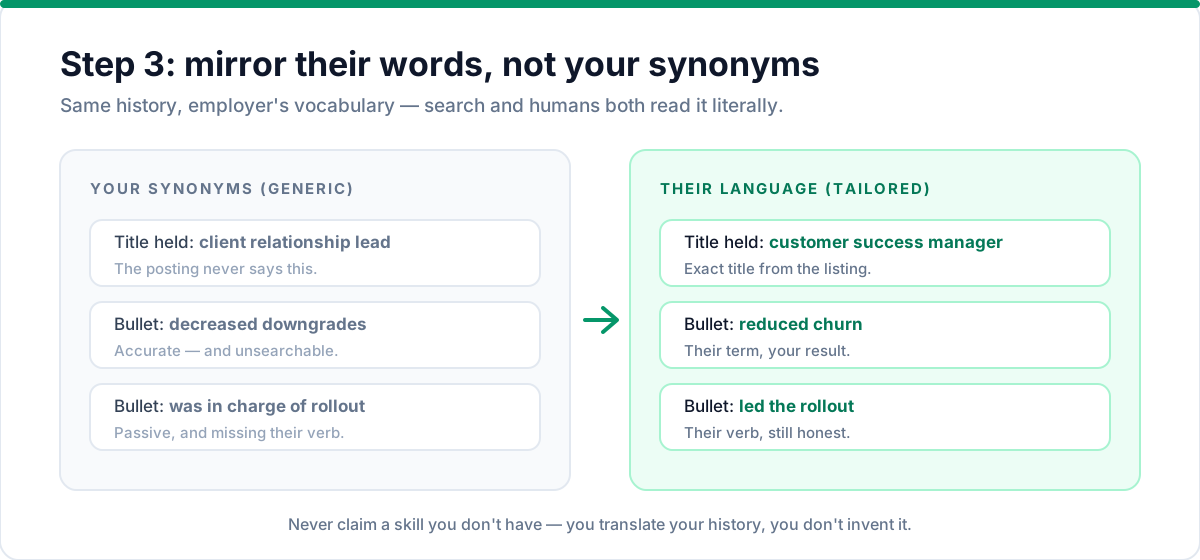
This is the highest-leverage edit you'll make. Where the posting says "customer success manager," your resume must say "customer success manager" — not "client relationship lead," however accurate your title was.
The same goes for skills and verbs:
- Their "led" → your bullets should lead with "led," not "was in charge of"
- Their "reduce churn" → your "decreased downgrades" becomes "reduced churn"
- Their "Agile" → keep "Agile," even if you also use "Scrum"
You're not rewriting your history; you're translating it into the language the reader (and the ATS) searches with. Strong resume bullets with the right keywords parse best. If it feels mechanical, good — search is literal.
Step 4: Re-order bullets for relevance (3 minutes)
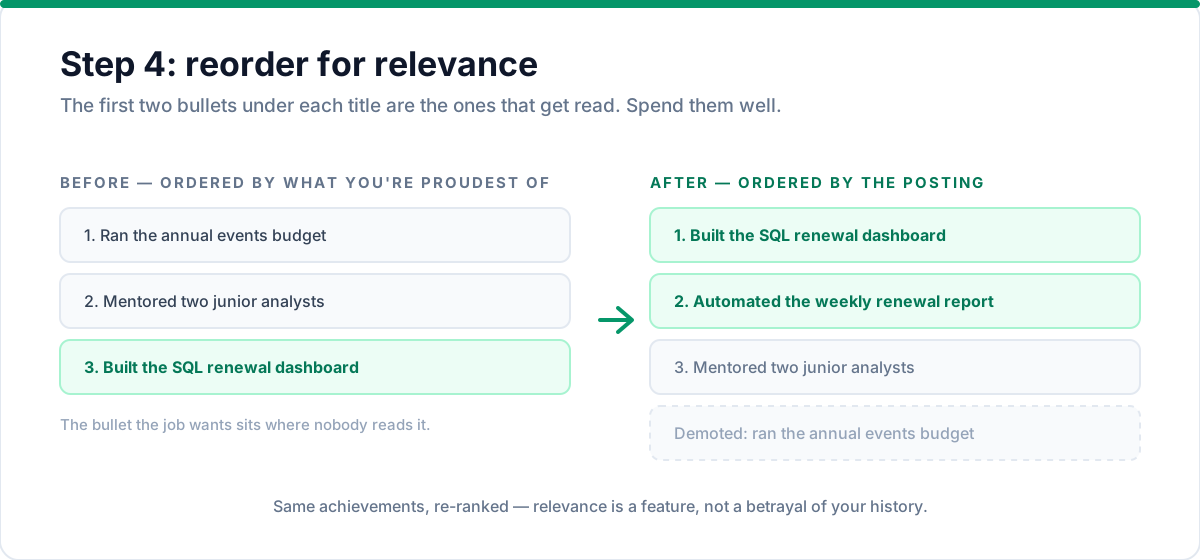
Order within each role is a ranking signal. The first two bullets under each job title are the ones that get read — so they should be the ones that match this role, not the ones that match your best year.
For each role on your resume:
- Identify which bullets connect most directly to the job description's five keywords
- Move those to the top
- Cut or demote anything that's irrelevant to this specific role
If an old bullet about event logistics does nothing for a data-analyst application, it goes — relevance is a feature, not a betrayal of your history. If you're also explaining a career gap, keep dates honest and brief. And if your resume simply has too much history for the role, our guide on resume length helps you decide what earns a page.
Step 5: Read the result as a stranger (1 minute)
After the edits, read the tailored resume top-to-bottom as if you were the hiring manager. Does the first page clearly say "this person does this job"? Does the summary position you for this role, not for "any role"?
If a stranger couldn't tell what job you're applying for, tailor harder. If they could — done. Save that version, apply, and repeat for the next posting.
The 10-minute loop, condensed
| Step | Time | Action |
|---|---|---|
| 1. Extract | 2 min | Underline repeated terms; pick top 5 |
| 2. Audit | 2 min | Check summary, skills, and bullets for each |
| 3. Mirror | 2 min | Replace synonyms with the posting's exact language |
| 4. Re-order | 3 min | Rank bullets by relevance; cut dead weight |
| 5. Verify | 1 min | Read as a stranger; confirm it targets this job |
When tailoring isn't worth it
Not every application deserves ten minutes, and that's fine:
- Mass applications (5+ per day, generic roles): keep one strong base resume and at least mirror the job title in your summary. Two minutes, not ten.
- Referral applications: still tailor. A referral gets your resume read, but relevance still gets it taken seriously.
- Your dream role: take the full ten, then run the 15-point ATS checklist before submitting — it covers the formatting details too.
The goal isn't to tailor perfectly every time — it's to never send a version that was written for someone else's job.
A before-and-after walkthrough
See the method in action on a single role. The job description repeats: account management, renewals, upsell, CRM, quarterly business reviews (QBRs).
Before (generic):
"Account executive managing a book of existing customers. Handled client relationships and worked with the sales team to grow accounts."
After (tailored):
"Account manager owning a 90-account renewal book. Led quarterly business reviews with key accounts, used Salesforce to track health scores, and grew renewal revenue 22% through structured upsell motions."
The after version mirrors the posting's exact terms — "account manager," "renewals," "upsell," "QBRs," "CRM" — and re-orders the bullet to lead with the most relevant work. Same person, different emphasis, dramatically stronger match.
That's the whole point of tailoring: you're not inventing anything, you're re-ranking your own history so the most relevant parts sit where they'll be read.
Common tailoring mistakes (and how to avoid them)
- Rewriting everything every time. If you're changing your entire resume per application, you've lost the plot. Ten minutes means targeted edits — the summary and the top bullets — not a full rewrite.
- Adding skills you don't have. Mirroring language is good; claiming Salesforce fluency when you've touched it once is an interview trap. Only mirror what you can defend. Our resume action verbs list helps you phrase experience honestly.
- Copying the posting verbatim. Tailoring means using the same language, not pasting the entire listing into your resume. Recruiters notice, and it reads as lazy rather than tailored. Use their terms inside your own sentences.
- Chasing twenty keywords at once. Five keywords, hit properly, beat twenty mentioned in passing. Spread yourself across every repeated term and none of them land.
- Forgetting to verify. After you mirror their terms, re-read for accuracy. A tailored resume that misstates your title or dates is worse than a generic one.
- Touching only the summary. The summary matters, but bullets carry the evidence. Re-order the bullets under each recent role too.
- Keeping irrelevant history at the top. If your most relevant recent role is buried, lead with relevance — even if it means trimming older, less relevant roles.
What if the job description is vague?
Some postings are three sentences. When the description gives you almost nothing to work with, build your five keywords from the three or four similar postings for the same role — the market's consensus vocabulary for that job. You'll rarely need to tailor as deeply, but you'll never send an untargeted resume.
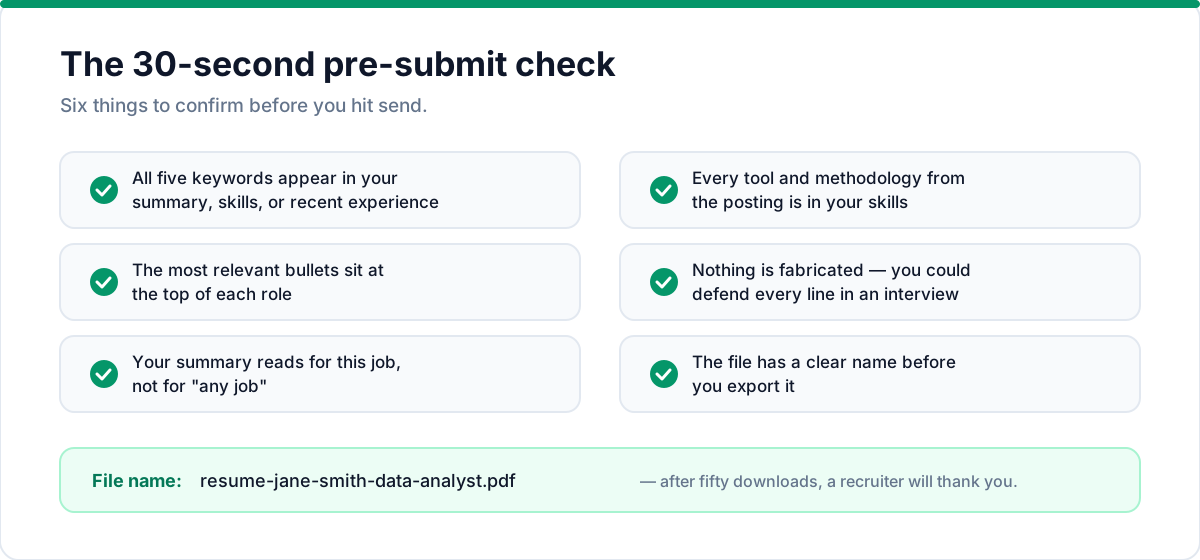
The pre-submit checklist
Run this thirty-second check before you hit send:
- The posting's top five keywords appear in your summary, skills, or recent experience
- The most relevant bullets sit at the top of each role
- Your summary reads for this job, not for "any job"
- Every tool and methodology from the posting is in your skills — if you actually know it
- Nothing is fabricated; you could defend every line of it in an interview
- The file has a clear name, such as
resume-jane-smith-data-analyst.pdf— after fifty downloads, a recruiter will thank you
Frequently asked questions
How often should I tailor my resume? For every serious application — the ones where you'd accept an interview. That usually means five to ten minutes per role. For mass applications, at minimum mirror the job title in your summary.
Can I tailor my resume without changing the whole document? Yes — the ten-minute method targets only your summary, skills section, and the top two bullets under each role. You're not rewriting; you're re-ranking and swapping keywords.
What if I don't have the exact skills listed? Don't fake it. Focus on transferable skills and adjacent experience. If the job requires "Salesforce" and you've used HubSpot, mention HubSpot and note your CRM experience — interviewers value honesty over keyword matching.
Should I tailor my cover letter too? Absolutely — and it's even easier. One paragraph connecting your experience to their specific challenge. Our cover letter guide shows you how.
Is tailoring worth it for entry-level roles? Yes — especially at entry level, where many applicants send the same generic resume. Tailoring signals effort and attention, which stand out when experience is thin.
Do ATS systems reward tailoring? Yes — the ATS ranks by keyword match. A tailored resume with the job's exact language ranks higher than a generic one with synonyms. That's the whole point.
The bottom line
Tailoring is the cheapest competitive advantage in the job search. Ten minutes — extract the five keywords, audit your top sections, mirror their language, re-order your bullets, verify — and your resume goes from "a candidate" to "a candidate for this role." It's the difference between being scanned and being read.
You don't have to do the keyword audit by hand. Paste any resume and job description into the free Keyword Matcher and it runs a side-by-side comparison in your browser — which terms match, which are missing, no signup and nothing uploaded. In Talent & Story, the Job Match tool goes further: paste any job description and it scores your resume against it, surfaces the missing keywords, and tells you which sections need the most work — then you make the ten-minute edits where they matter. If you haven't started yet, our how to write a resume guide walks through the full process — start free.
Put this into practice with Talent & Story
Build an ATS-friendly resume, get an instant compatibility score, and manage your entire job search in one workspace.
Written by
Talent & Story Team · Career Workspace
We build Talent & Story — the career workspace for building ATS-friendly resumes, writing cover letters, tracking applications, and preparing for interviews. Every guide is written to be practical enough to use the same day.