12 Resume Mistakes That Get Your Application Rejected
Most rejections are silent — but the reasons are predictable. These 12 resume mistakes cause most dead applications, each with why it hurts and the fix.
Most rejections arrive as a silent non-response. The role closes, the email never comes, and you're left guessing what went wrong.
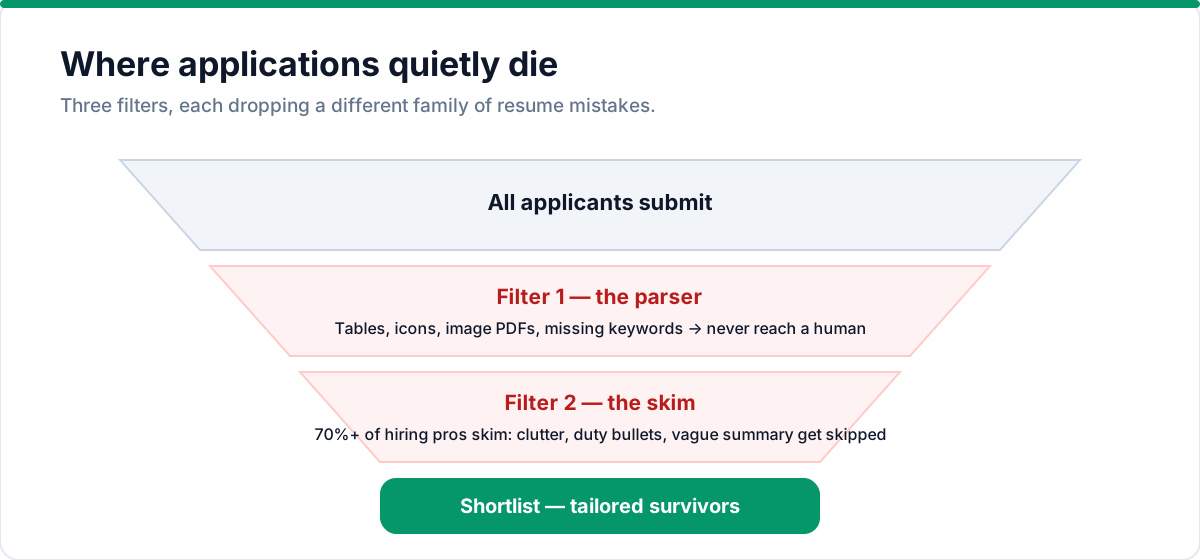
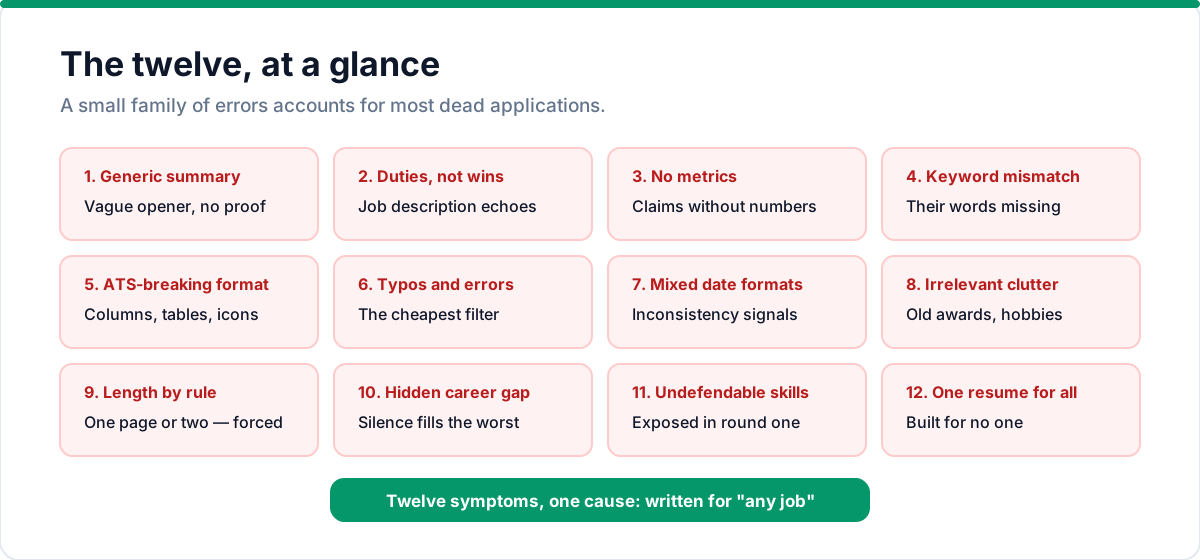
The frustrating part: in most cases, the reason was predictable — a mistake in the resume itself, one of a small family of errors that account for the majority of dead applications. And the reader you're losing to isn't reading closely: in ResumeGo's survey of 418 hiring professionals, more than 70% said they almost always or often skim resumes instead of reading them thoroughly. Skimming is where the mistakes below do their damage. Most resumes carry at least one of them. Here are the twelve biggest, each with why it hurts and the fix. Check your current resume against this list before your next application.
1. A generic summary
"Hardworking professional seeking a challenging position" is the resume equivalent of a hold message. It tells the reader nothing about what you do or why you're right for this role.
Why it hurts: It wastes the single most-read spot on the page, and it signals the resume wasn't written for this job. Fix: Write a summary that names your title, years, and one standout result — our summary vs. objective guide has the formula and examples.
2. Duties instead of accomplishments
"Responsible for managing the marketing budget." "Handled customer onboarding." These describe a job posting, not your performance of it.
Why it hurts: Every candidate at your level can claim the same duties. Accomplishments — with results — are what differentiate you. Fix: Recast each bullet as verb + task + result, quantified where possible. Our resume action verbs list has the right verb for every line, and the full method is in our bullet-point guide.
3. No metrics anywhere
"Improved customer satisfaction" reads as a claim. "Raised CSAT from 4.1 to 4.6 across 12,000 customers" reads as a fact.
Why it hurts: Numbers are the difference between trust and skepticism — for recruiters and for ranking systems alike. Fix: Add scale, time, percentage, or frequency to your biggest claims. If you don't have exact numbers, estimate honestly.
4. Keyword mismatch with the job description
The posting says "project manager"; your resume says "program lead." The ATS searches for the first phrase; your resume never contains it.
Why it hurts: Keywords are how recruiters and systems find you. Missing language means missing applications — no matter how strong you are. Fix: Mirror the job description's exact phrasing in your summary, skills, and top bullets. Tailoring takes ten minutes.
5. Formatting that breaks the ATS
Two columns, tables, text boxes, icons, a photo, text in footers, an image-based PDF. Any of these can scramble or erase your content in the parser.
Why it hurts: If the ATS can't read your text, you don't exist in the search — no human ever sees you. Fix: Single column, standard font, no tables or graphics, text-based PDF or DOCX. Run a 15-point ATS checklist before sending.
6. Typos and errors
One typo won't kill you. But a resume with two or three errors makes a recruiter wonder what else you were careless about.
Why it hurts: It's the cheapest filter there is, and with hundreds of applicants, cheap filters get used. Fix: Read aloud, read backwards, check your email address character by character, and get a second reader.
7. Inconsistent dates or formats
"MM YYYY – Present" in one entry, "YYYY – now" in the next. Mixed date formats are a parsing and reading hazard.
Why it hurts: Inconsistency reads as carelessness, and inconsistent dates can mislead parsers about your timeline. Fix: Pick one format — say, "Mon YYYY – Present" — and use it everywhere, including within each role.
8. Irrelevant or outdated content
Your old student award, the internship from a decade ago, the hobbies section. Every line costs attention that your relevant history deserves.
Why it hurts: Recruiters scan for relevance; clutter buries the signal. Fix: Cut anything that doesn't serve the role you're targeting. If your resume would change for a different job, the problem is missing tailoring, not missing content.
9. Length chosen by rule, not by substance
Forcing everything onto one page when you have real depth — or padding to two pages when one tight page holds the story.
Why it hurts: The reader either sees a cramped document or an obvious filler page. Fix: Decide length by content, not by the one-page rule.
10. Hiding a career gap
A long unexplained hole makes the reader's brain fill in the worst case. The gap itself is rarely the problem.
Why it hurts: Hidden gaps look worse than named ones, and the interview starts on the defensive. Fix: Name short gaps with clean dates, convert productive time into evidence, and neutralize long gaps with one summary sentence — the full approach is in our career gap guide.
11. Overselling skills you can't defend
Listing "Figma, Python, SQL" when you've touched each once. The resume gets you the interview; the interview exposes the gap.
Why it hurts: One "can you actually do this?" moment erodes trust in the entire document. Fix: Only list skills you can defend in a conversation within the first month of a job — and if you're unsure which ones lead, run the skills audit first.
12. Sending the same resume to every role
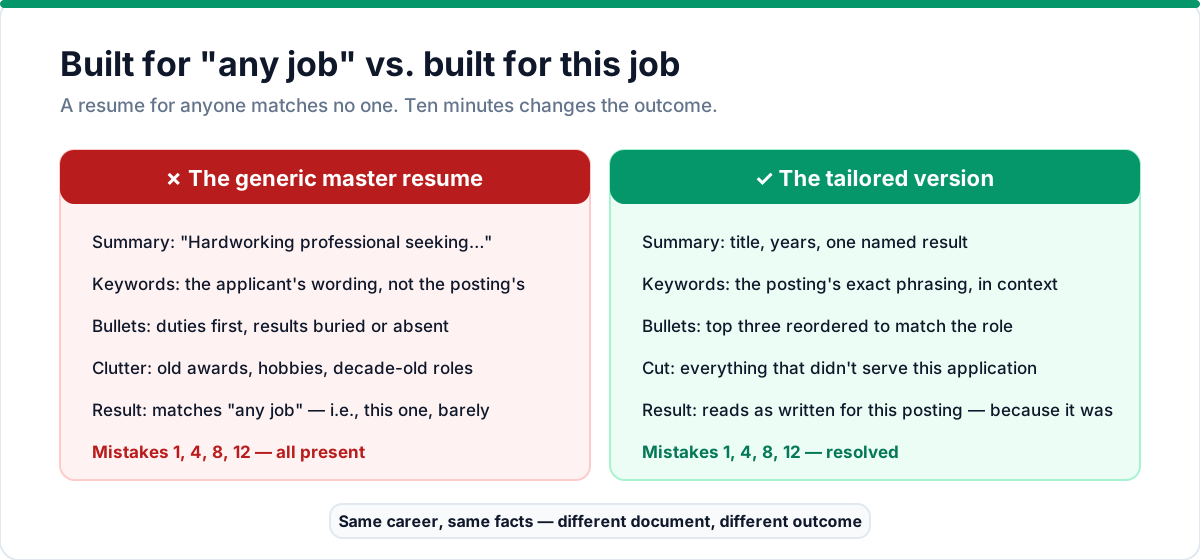
The "master resume" applied everywhere is the most common mistake of all, because it feels efficient.
Why it hurts: A resume for "any job" matches "any job" exactly as well as it matches "this job" — which is to say, it's built for no one. Fix: Keep one strong base, then spend ten minutes per application mirroring the role's language and re-ordering your bullets.
How to fix the whole list in one pass
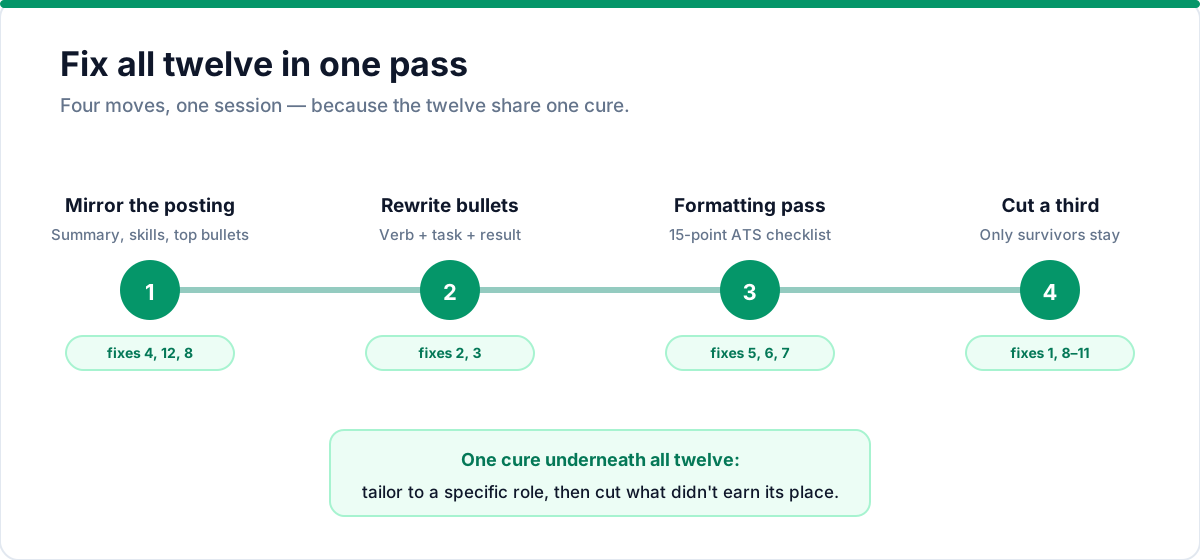
You don't need twelve separate rewrites — most of these mistakes share one cure: tailor the resume to a specific role, then cut everything that didn't earn its place.
The one-pass workflow:
- Open the job description and mirror its language in your summary, skills, and top bullets. This fixes mistake 4 in the same move as mistakes 12 and 8.
- Rewrite each bullet as verb + task + result. This fixes mistakes 2 and 3 together.
- Run a formatting pass against a 15-point ATS checklist — fixes mistakes 5, 6, and 7 at once.
- Cut a third of what's left. Whatever survives is your strongest, most relevant material. Fixes mistakes 1, 8, 9, 10, and 11 by forcing decisions.
One session, all twelve mistakes addressed — because they're symptoms of the same underlying failure: a resume written for "any job" instead of for this one.
Frequently asked questions
How many resume mistakes can I fix at once? Most of them share one cure: tailoring your resume to a specific role, then cutting everything that didn't earn its place. One focused session addresses most issues simultaneously.
What's the single most damaging mistake? Sending the same resume to every role. It sits beneath most of the others: a generic resume carries a generic summary, mismatched keywords, and irrelevant content by construction. Fix the tailoring and the family of errors below it resolves too.
How long does fixing all twelve take? A first pass over one resume takes about an hour using the one-pass workflow above. After that, each application is a ten-minute tailoring session — mirror the language, reorder three bullets, cut what no longer applies.
Should I hire a professional resume writer? Not necessarily — most mistakes are fixable on your own with the right checklist. A professional writer helps if you're stuck, switching careers, or at a senior level where the stakes are high. But the fundamentals are learnable.
Is a rejection ever actually about the resume? Sometimes. Recruiters screen on fit and budget too, and the right resume can still lose to the wrong match. But the mistakes above are the controllable factors — fixing them converts random losses into fair ones.
Do these rules apply to every industry? The spirit does. Creative and technical fields may relax format rules — portfolio-first fields trade formatting polish for work samples — but the substance, accomplishments, keywords, tailoring, and proof, is universal.
How do I catch my own typos? You can't reliably — your brain autocompletes. Read the resume backwards, print it, change the font and color temporarily, and have someone else read it. Every trick that makes the text unfamiliar works.
Should I keep a "master resume" with everything? Yes — as a source document, never as the file you send. Keep the master, then build a tailored version from it per application.
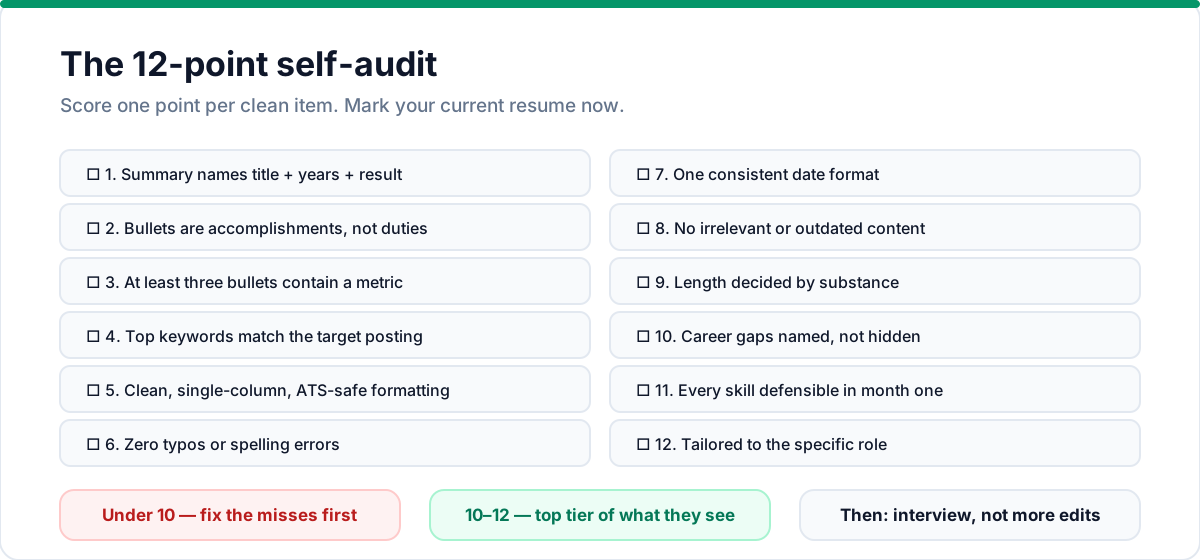
The 12-point self-audit
Grab your current resume and mark yourself on each item. Score one point per clean item:
- Summary names title + years + result
- Bullets are accomplishments, not duties
- At least three bullets contain a metric
- Top keywords match the target job description
- Clean, single-column, ATS-safe formatting
- Zero typos or spelling errors
- One consistent date format
- No irrelevant or outdated content
- Length decided by substance
- Career gaps named, not hidden
- Every skill defensible
- Tailored to the specific role
Score under 10? Fix the misses before you apply. Score 10–12? Your resume is in the top tier of what recruiters see — now let the interview stage do the rest.
The bottom line
Rejections feel random, but the causes rarely are. Twelve mistakes account for most silently-dead applications — and every single one of them is fixable in an afternoon. Format for the ATS, write accomplishments with metrics, mirror the job's language, and tailor per role. Do that and your resume stops losing to avoidable errors — and starts competing on merit alone.
Talent & Story's guided builder, ATS analyzer, and Job Match tool exist to catch these exact twelve mistakes before you submit. Build your resume free and run the audit before every application.
Put this into practice with Talent & Story
Build an ATS-friendly resume, get an instant compatibility score, and manage your entire job search in one workspace.
Written by
Talent & Story Team · Career Workspace
We build Talent & Story — the career workspace for building ATS-friendly resumes, writing cover letters, tracking applications, and preparing for interviews. Every guide is written to be practical enough to use the same day.