How to Identify Your Strongest Professional Skills
You have more skills than you list. Run this step-by-step skills audit to identify your strongest professional skills and back each one with evidence.
When someone asks "what are your skills?", most people answer with a job title and a tool list. "I'm a marketing manager. I use HubSpot, Google Analytics, and Excel." It's a start — and forgettable, because it describes a desk, not a capability.
Strong professionals can do more than name their position: they can name the repeatable abilities that make them effective and the results those produced — the difference between a list and a case for yourself.
A skills audit is the practical way to get there. It's a short, structured exercise — list everything you can do, make it specific, filter it down, attach proof. This guide walks through it in six steps, with examples, tables, and a copyable worksheet. At the end you'll have five to seven strongest skills, each evidence-backed and ready for a resume, an interview, or a career change.
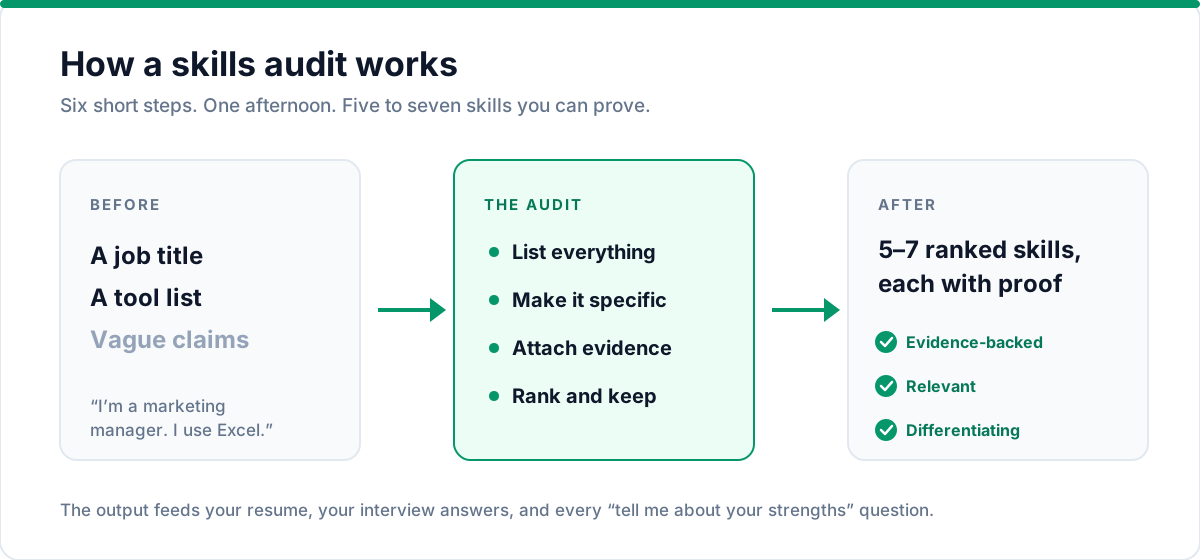
Why a skills audit beats guessing
Most people underestimate their skills for one reason: they only count what appears on their current job description. Your real skill set is much wider than your title. It includes technical abilities you picked up three jobs ago, interpersonal skills you use so often they feel like breathing, and process skills you never thought to write down.
A proper skills audit gives you four things:
- The full picture — technical, interpersonal, and process skills you never listed
- Transferable strengths — what travels with you into a different role or industry
- A development target — knowing where you're strong shows what to build next
- A sharper story — specific skills are what hiring managers remember after the interview
The market rewards precision: LinkedIn's 2019 Global Talent Trends report found that 92% of talent professionals and hiring managers say soft skills matter as much as — or more than — hard skills.
The World Economic Forum's Future of Jobs report ranks analytical thinking as the core skill employers look for first, with seven in ten companies calling it essential. Employers are asking for capabilities, not tool lists — an audit is how you answer in their language.
Step 1: List your hard skills — including the rusty ones
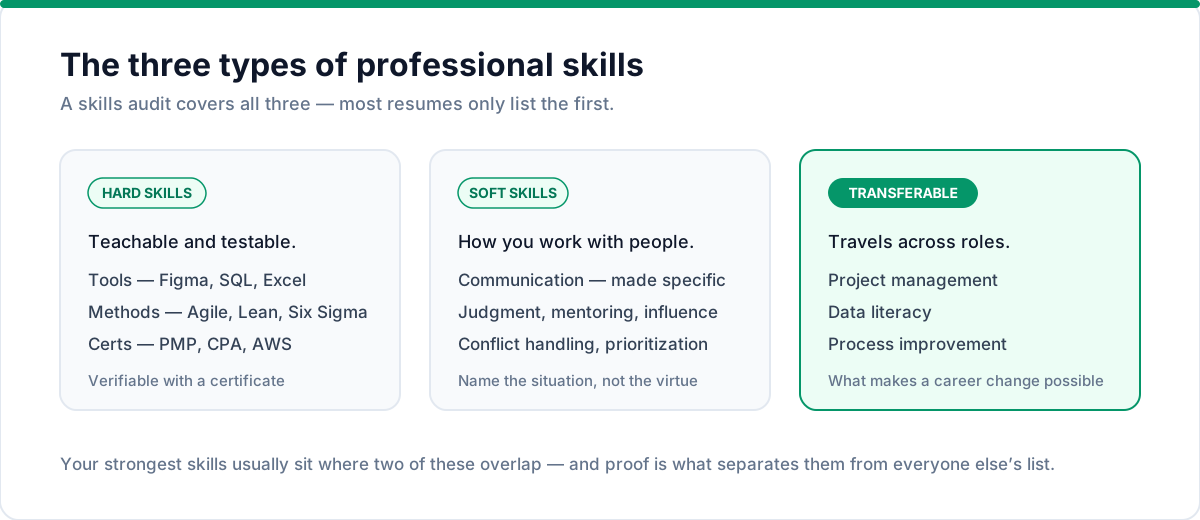
Hard skills are the concrete, teachable abilities someone could test you on — if it's taught in a course or certified by an exam, it belongs on this list:
- Tools and technologies — software, platforms, programming languages, frameworks
- Methodologies — Agile, Scrum, Six Sigma, design thinking, Lean
- Technical capabilities — data analysis, financial modeling, CAD, laboratory techniques
- Certifications and credentials — PMP, CPA, AWS, Google Analytics, nursing license
- Languages — spoken or programming
Don't filter yourself yet. Write down everything you've touched in the past two years, even if you're rusty. Assessment comes later — editing too early is how people end up with a five-item list.
Where to find skills you've forgotten
Check sources you wouldn't think to look at:
- Job descriptions from your current and previous roles — copy the skills line by line
- Tools you open every day — Excel, Slack, Figma, Jira all count
- Projects you led, or quietly rescued when they went sideways
- Training courses and certificates you've completed but never listed
Step 2: Turn vague soft skills into specific ones
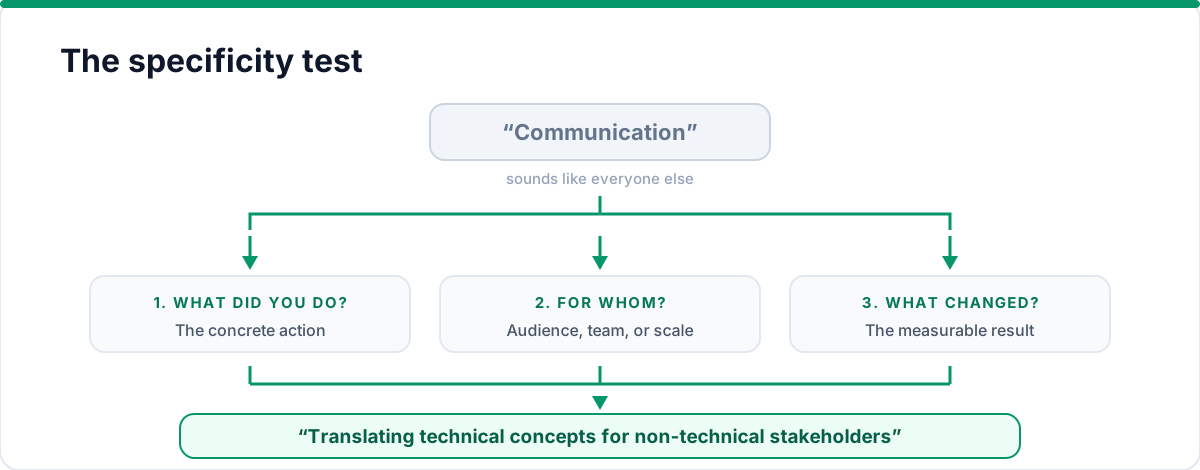
Soft skills are where most lists go to die. "Communication," "leadership," and "teamwork" are claims everyone makes, so they convince no one. The fix is specificity: name the situation you handled, not the virtue you claim.
Put every vague skill through the specificity test: what did you do, for whom, and what changed? Then write the answer down:
| Instead of | Write this instead |
|---|---|
| Communication | Translating technical concepts for non-technical stakeholders |
| Leadership | Onboarding and mentoring three junior team members |
| Teamwork | Coordinating across engineering, design, and product for a cross-functional launch |
| Problem-solving | Rebuilt a failing vendor handoff that was costing two days per cycle |
The more specific you are, the more believable you become — and specific phrasing is also what gets you past keyword screening. If your target role's posting keeps using a phrase like "stakeholder management," mirror it, then back it with an example. Our guide to tailoring a resume to a job description and our resume keywords guide show how to pull those phrases out of a posting.
Step 3: Identify your transferable skills
Transferable skills are the ones that survive a change of role, industry, or country. They're the most valuable items on your list because they don't lock you into one path — what makes a career change a pivot instead of a reset.
The most common ones:
- Project management — planning, executing, and delivering work on time and within scope
- Problem-solving — identifying root causes, evaluating options, implementing fixes
- Data literacy — reading, interpreting, and communicating with data
- Process improvement — finding friction and building better workflows
- Stakeholder management — managing expectations, navigating disagreement, earning trust
The test is simple: would this skill be valuable in a completely different job? A software engineer who writes project briefs and presents to executives is doing stakeholder management — that transfers to product management, consulting, or leadership.
How a skill renames itself in another field:
| Your skill looks like | Another field calls it |
|---|---|
| Running a project end to end | Program coordination, delivery management |
| Fixing a broken process | Operations, continuous improvement |
| Presenting to executives | Executive communication, influencing |
| Getting four teams aligned | Facilitation, influence without authority |
| Training new hires | Onboarding, enablement, coaching |
Step 4: Back your strongest skills with evidence
A skill without evidence is just a claim. Proof doesn't require a spreadsheet — just honest answers to three questions:
- When did I use this skill? A project, a quarter, a crisis.
- What changed? Revenue, time saved, errors reduced, people trained, churn avoided.
- What evidence exists? Metrics, project records, reviews, certifications, references.
Use this formula every time:
skill + context + action + result = proof
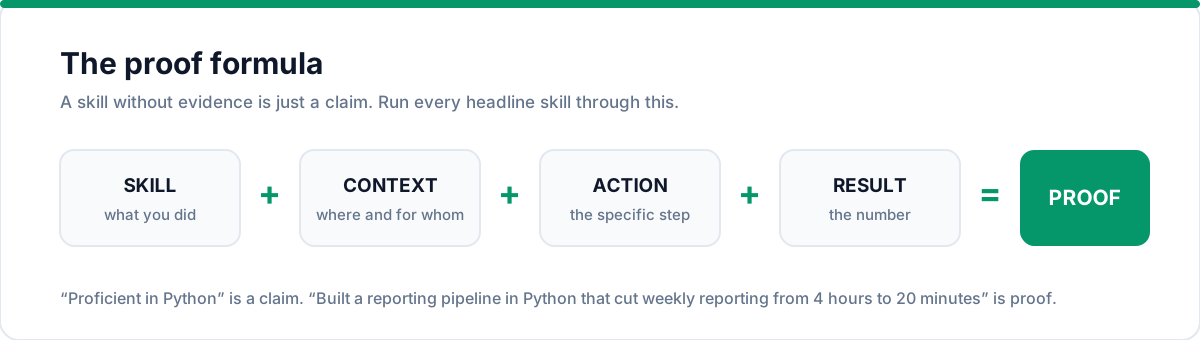
"Proficient in Python" is a claim. "Built an automated reporting pipeline in Python that cut weekly reporting time from 4 hours to 20 minutes" is proof.
This isn't about manufacturing numbers. Most people already have them — they've just never written them down. For a second pass at your raw material, paste project descriptions, performance reviews, or achievement notes into the Skills & Evidence Scanner. It highlights recognized skills and which sentences carry quantified impact.
For turning those results into resume language, the resume bullet points guide covers the structure. For interviews, the STAR method does the same job with a story format. And if you've documented work samples along the way, your career portfolio is where that proof lives.
Step 5: Rank them — pick your top 5–7
You can't be equally strong at everything, and a list of twenty skills communicates nothing. After the audit, keep the five to seven that pass all three tests:
- Evidence-backed — you can name a result, not just an activity
- Relevant — the roles you're targeting actually use them
- Differentiating — peers with similar titles don't all claim them
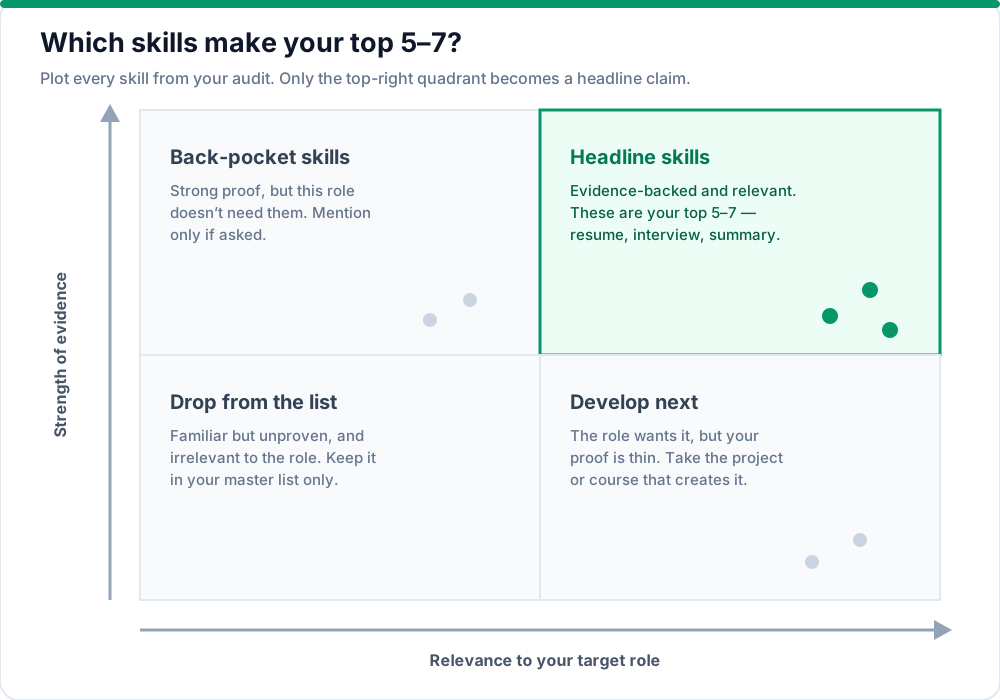
Skills that pass all three become your headline claims: they go on your resume, anchor your professional summary, and shape how you answer "what are you good at?" Skills that pass two of three stay in your back pocket.
One warning: don't invent strength. It's better to list five skills you're genuinely strong at than twenty you've merely touched — interviewers probe confident-sounding claims, and a weak answer costs more than an absent one.
Step 6: Keep the list alive
The best skills audit isn't a one-time exercise — it's a habit. Every time you accomplish something meaningful, capture the skills it demonstrates. Six months later, the "what are my strongest skills" question answers itself.
For each achievement, note three things:
- What skills did I use?
- What was the outcome?
- Can I quantify the impact?
Over time you build a library of evidence that makes every application and review easier. The Career Vault is built for exactly this: log achievements with their skills, then reuse them anywhere in your workspace. Capture once, reuse everywhere.
Skills audit worksheet
One table holds the whole audit — copy it into a document or spreadsheet and fill it as you work:
| Skill (specific phrasing) | Type | Evidence — what changed? | Where it applies |
|---|---|---|---|
| Translating technical concepts for non-technical stakeholders | Soft | Cut recurring clarification meetings; method adopted by two teams | Roles asking for stakeholder management |
| Built automated reporting pipelines in Python | Hard | Weekly reporting time down from 4 hours to 20 minutes | Data and analytics roles |
Steps 1–3 fill the first two columns, Step 4 the third, and Step 5 the last. Rows with an empty evidence cell stay in your master list.
Three worked examples
The store manager moving into operations. Her audit surfaced inventory scheduling, supplier negotiation, and staff onboarding. The transferable versions — demand planning, vendor management, team enablement — map directly onto operations roles. Each one got a number: scheduling changes cut stockouts, a renegotiated contract saved a percentage, onboarding time dropped from two weeks to four days.
The engineer aiming at product management. His list was full of languages and frameworks, which is what every other engineer lists. The differentiators were writing project briefs, presenting roadmaps to executives, and unblocking three teams during a launch. Those became his headline skills, and his resume bullets carried the outcomes rather than the tech stack.
The recent graduate with no job history. Coursework, internships, volunteering, and side projects still produce skills. A final-year capstone delivered on a deadline with a four-person team is project coordination. Running a university society's social accounts that grew the following is campaign management. The evidence is real even when the employer name isn't.
Common mistakes in a skills audit
- Listing tools, not capabilities. Knowing Salesforce is a skill; building a pipeline, training a team, and adapting it to your workflow is a much stronger one. Go past the tool name to what it lets you do.
- Skipping "invisible" skills. Process improvement, cross-team coordination, mentoring, writing clear documentation — these are high-value skills that go unlisted because they feel normal to you. If colleagues thank you for them, they're not normal.
- Confusing familiarity with proficiency. "I've used this" and "I'm strong at this" are different claims. Be honest about the difference; it's what keeps your headline skills defensible.
- Collecting skills with no evidence. If you can't answer "what changed because of this?", it's a duty, not a demonstrated strength. Park it and find the proof.
- Writing the list once and forgetting it. Skills grow. So should the list — that's what Step 6 is for.
Frequently asked questions
How many skills should I list?
Keep five to seven headline skills, then support them with specifics inside your bullet points. Fifteen undifferentiated items read as padding and invite scrutiny you can't answer.
What's the difference between hard skills and soft skills?
Hard skills are teachable and testable — a tool, a method, a certification, a language. Soft skills are how you work with people and ambiguity: communication, judgment, conflict handling. Both belong in your audit; only specific, evidence-backed versions belong on your resume.
What exactly counts as a transferable skill?
A skill that keeps its value when you change role or industry — project management, data literacy, stakeholder communication, process improvement. The test: would it still matter in a completely different job? If yes, it transfers.
How do I know whether a skill is really one of my strongest?
Ask for evidence. If you can name a result, a metric, or a pattern of people asking you for it, it's strong. If you can't, it's a familiarity — useful, but not a headline claim.
Should I include skills I'm only slightly familiar with?
Not as headline skills — keep them in a longer master list, then filter. An inflated skills section is easy for an interviewer to probe with one follow-up question.
How often should I redo a skills audit?
Every six to twelve months, or whenever you change roles — with an ongoing inventory like Step 6's, the audit shrinks to a five-minute review.
Do career changers need a different approach?
The process is the same, but the filter changes: weight transferable skills over role-specific ones, and translate your industry's vocabulary into your target field's. Our common interview questions show where that translation pays off.
The bottom line
Your professional skills are broader and more valuable than your job title suggests. A proper skills audit surfaces the technical abilities, interpersonal strengths, and transferable capabilities that make you effective — and gives you the proof.
Start with a blunt list. Make it specific. Attach numbers where you already have them. Keep the five to seven that are evidence-backed, relevant, and differentiating — then keep the list alive as you work.
Talent & Story keeps that material in one place: log each achievement with the skills it proves in your Career Vault, then build applications from it in the resume builder — start free.
Put this into practice with Talent & Story
Build an ATS-friendly resume, get an instant compatibility score, and manage your entire job search in one workspace.
Written by
Talent & Story Team · Career Workspace
We build Talent & Story — the career workspace for building ATS-friendly resumes, writing cover letters, tracking applications, and preparing for interviews. Every guide is written to be practical enough to use the same day.