How to Build a Career Portfolio That Gets You Hired
A career portfolio turns 'trust me, I did great work' into proof. Here's what to include, how to structure it, and where it belongs in your job search.
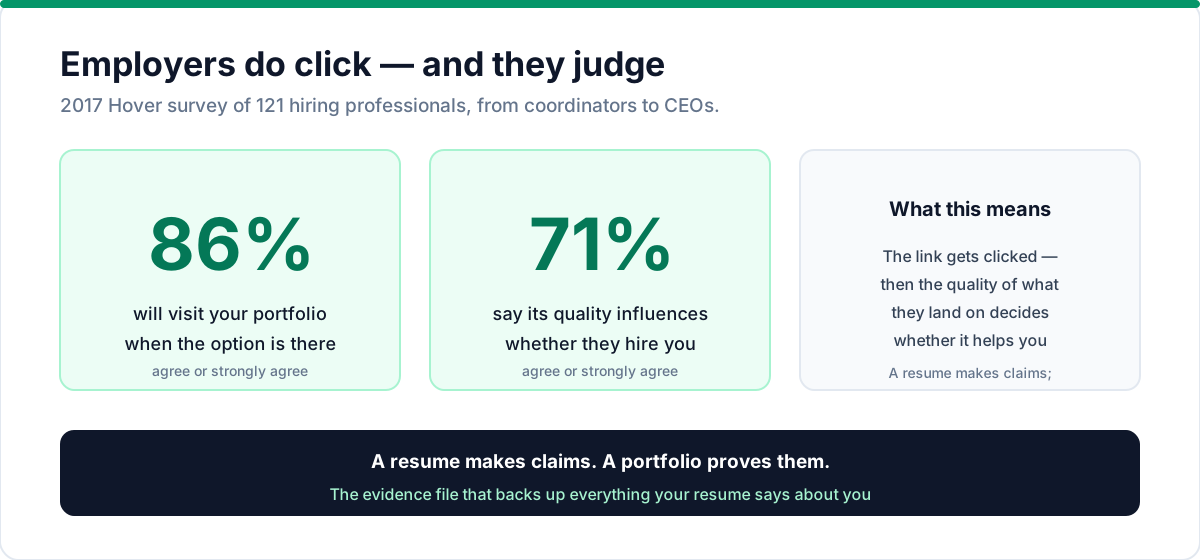
A resume makes claims. A portfolio proves them.
For many fields — design, writing, engineering, marketing, product, research, sales enablement — a strong portfolio is the difference between being one of a hundred "qualified" resumes and being the candidate the interviewer can picture. Employers back that up with behavior: in a 2017 Hover survey of 121 hiring professionals, 86% said they'll visit a portfolio when given the option, and 71% said its quality will influence whether they hire. It's the evidence file that backs up everything your resume says about you.
Here's how to build one that actually gets you hired.
Do you even need one?
Not everyone does. A portfolio matters most when your work is demonstrable — when you can show artifacts instead of just describing outcomes:
- Always: design, UI/UX, writing, content, photography, film, front-end engineering, data analysis
- Often: marketing campaigns, product management, sales, research, education, consulting
- Rarely: roles where evidence is confidential or abstract — accounting, operations, some management tracks
If you're in a "rarely" field, your portfolio is simply less central — but a lean version still helps. The rule: include a portfolio where work is visible; link to proof where it's not.
What belongs in it
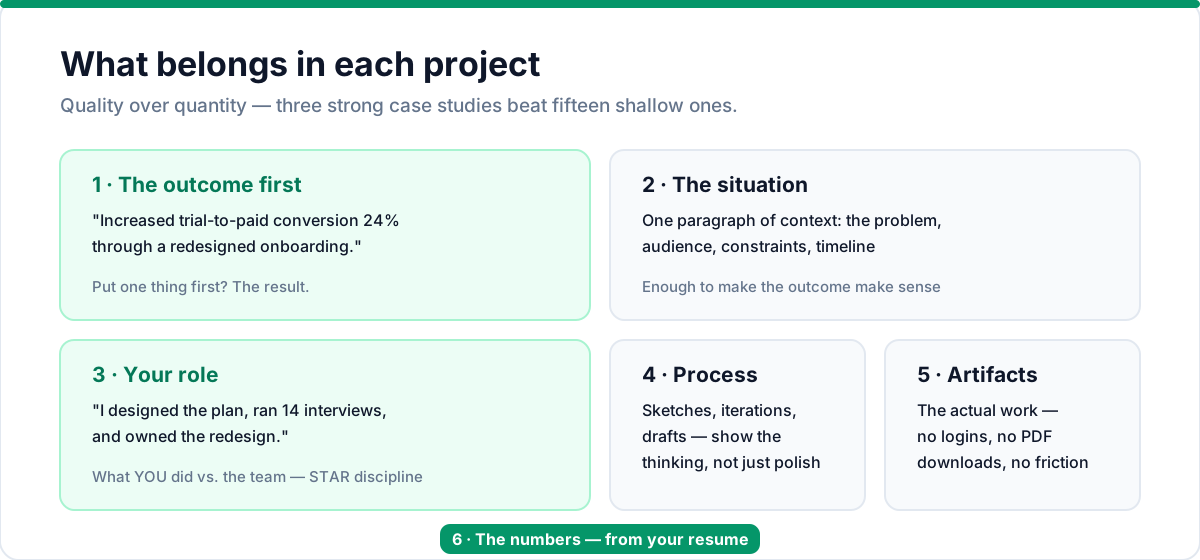
Quality over quantity — three strong case studies beat fifteen shallow ones. For each project include:
The outcome first. Lead with the result: "Increased trial-to-paid conversion 24% through a redesigned onboarding." If you put one thing on your portfolio, make it the outcome.
The situation. What problem were you solving? A paragraph of context — the audience, the constraints, the timeline.
Your role. Be explicit about what you did versus the team. "I designed the research plan, ran 14 user interviews, and owned the redesign" — the same "what did you do" discipline as STAR interview answers.
The process. Show work, not just polish: sketches, iterations, drafts, the moment a constraint changed your approach. Process is what makes you credible and coachable.
The artifacts. The actual work — designs, links, code, writing samples. Make artifacts easy to view with no logins, no PDF downloads, no friction.
The numbers. Tie the work to results whenever you can. Metrics from your resume carry straight into your portfolio.
How to structure it
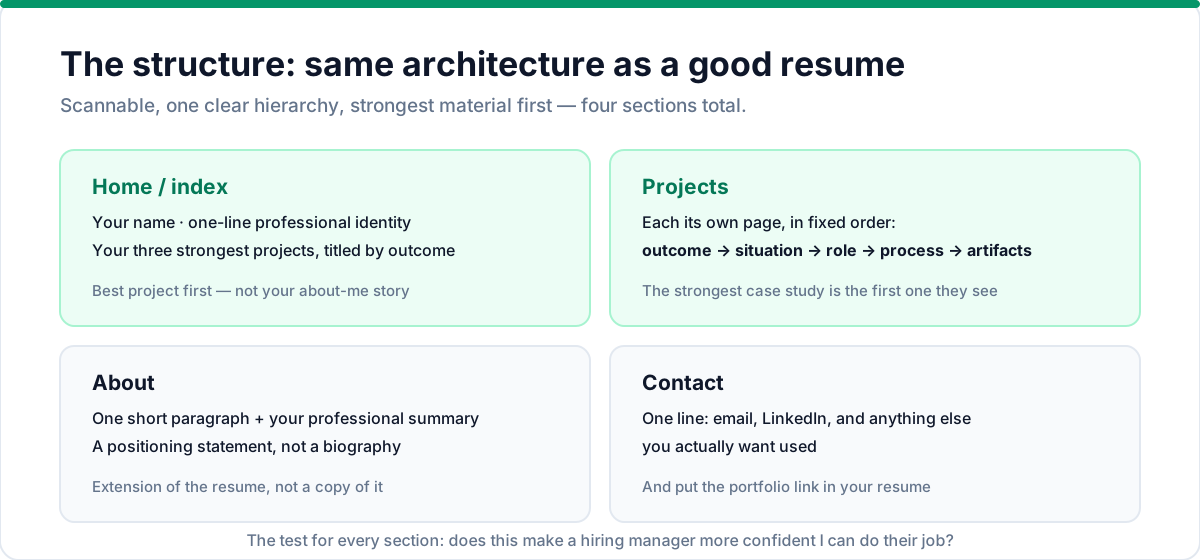
Keep the same architecture as a good resume: scannable, one clear hierarchy, the strongest material first.
Home / index. Your name, your one-line professional identity, and your three strongest projects with outcome-focused titles.
Projects. Each as its own page or section, in the outcome → situation → role → process → artifacts order above.
About. One short paragraph + your professional summary. Not a biography — a positioning statement.
Contact. One line. Email, LinkedIn, and anything else you actually want used.
That's it. A portfolio is not a life log. Every project you include should answer the same question: does this make a hiring manager more confident I can do their job?
Where it lives
- A dedicated site (yourname.com) — best for design, writing, and product work. One of the cheap site builders is fine; a clean template and fast load time beat custom code.
- A shareable doc or slides deck — perfectly acceptable for marketing, sales, or research portfolios. Structure it exactly like the site version.
- LinkedIn — your featured section is a free portfolio surface; use it for your top two or three projects.
- GitHub — for engineering, the repo history is portfolio material; keep your top projects documented and tidy.
Whatever platform you choose, put the link in your resume. The classic failure is building a portfolio and never linking it — it belongs in your contact block, your summary, and the cover letter for every role that cares.
How it fits your job search
Your portfolio works hardest in the places where your resume needs backup:
- Cover letters. "I've rebuilt onboarding like this before" is empty until you add "here's the case study." Our cover letter length guide covers how much space to dedicate to portfolio references.
- Applications. When a role asks for samples, they mean the portfolio. Send your best match for the role, not your full archive. Make sure the work you show aligns with the keywords in the job posting.
- Interviews. Before the behavioral questions, your portfolio has already shown work. In STAR answers, link the story to the artifact when you can. Our common interview questions guide covers how to weave portfolio references into answers.
- After a rejection. A good portfolio is a "keep in touch" asset — it's the thing that makes a hiring manager remember you when a different role opens.
Portfolio blueprints by field
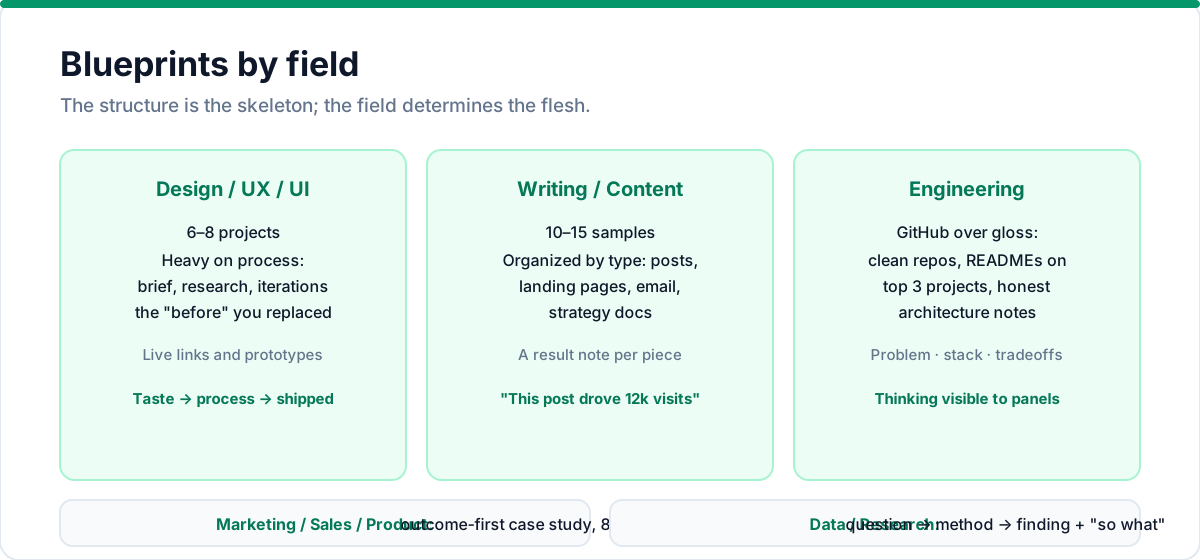
The structure above is the skeleton; the field determines the flesh:
Design / UX / UI. Six to eight projects, heavy on process: brief, research, iterations, and the "before" you replaced. Live links and interactive prototypes where you can. Recruiters in design are looking for taste, process, and shipped-work evidence in roughly that order.
Writing / Content. Ten to fifteen samples beats four long case studies. Organize by type (blog posts, landing pages, email, strategy docs) and lead with the pieces closest to the role you're targeting. A results note on each ("this post drove 12k visits") adds the proof writing rarely has.
Engineering. GitHub matters more than a polished site: clean repos, a clear README on your top three projects, and honest notes on architecture decisions. A short project page per repo (the problem, the stack, the tradeoffs) makes your thinking visible to non-engineers on the panel.
Marketing / Sales / Product. The outcome-first case study is your format — campaign or launch, your role, the channels, the numbers. A slides-deck portfolio works here: 8–12 slides per project, scannable in two minutes.
Data / Research. Show the question, the method, and the finding — with one chart that tells the story. Include a short "so what" section: what decision your analysis changed.
Whatever your field, the test stays the same: a stranger should finish your portfolio more confident you can do this job. Make sure your resume keywords and ATS-friendly formatting are solid before you link to the portfolio — the resume still gets you in the door.
Portfolio mistakes that quietly kill it
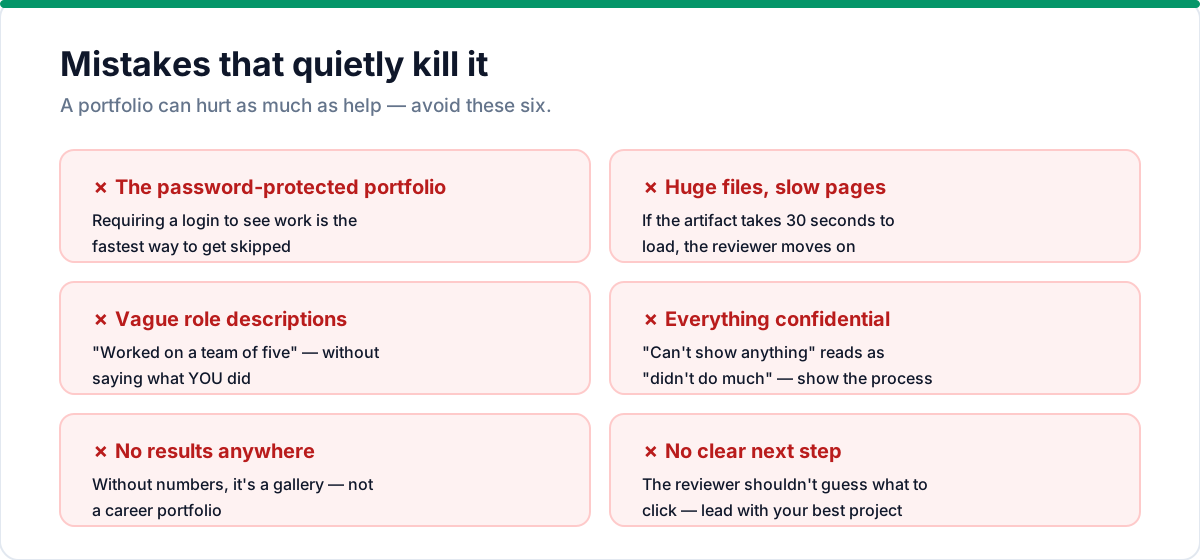
A portfolio can hurt as much as help. Avoid these:
- The password-protected portfolio. Requiring a login to see work is the fastest way to get skipped.
- Huge files and slow pages. If the artifact takes 30 seconds to load, the reviewer moves on.
- Vague role descriptions. "Worked on a team of five to redesign X" without saying what you did. The STAR discipline of "what did you do?" applies to portfolios too.
- Everything confidential, nothing shown. If every project is under NDA, show the process without the proprietary content — or mock up your contribution. "Can't show anything" reads as "didn't do much."
- No results anywhere. Outcomes (numbers, metrics, adoption) are what turn a gallery into a career portfolio. Pull them from your resume's metrics.
- A home page with no clear next step. The reviewer shouldn't have to guess what to click. Lead with your best project, not your about-me story.
Keeping it current without drowning
The portfolio that gets you hired is maintained, not endlessly overhauled. Set a lightweight rhythm: when you finish a meaningful project, spend an hour adding it and trimming the weakest existing one. That "one in, one out" rule keeps the portfolio at a strong, current size forever — and it's exactly the sort of recurring task you can slot into your weekly job search routine.
The truth about perfection
The most common portfolio excuse is "it's not ready." The reality: a live, imperfect portfolio beats a perfect idea of one that doesn't exist. Recruiters know work evolves; what they can't evaluate is the portfolio you never published.
Start with two case studies. Publish. Improve monthly. The version you launch will get you more interviews than the version you've been polishing in your head. If you're returning from a career gap, a portfolio is especially powerful — it shows what you've been building even when your resume timeline has whitespace.
Frequently asked questions
How many projects should I include? Three to five strong projects beat fifteen shallow ones. Quality over quantity — each project should demonstrate a different skill or strength. If you have more, keep the archive accessible but lead with your best.
Should I include personal projects? Yes, if they're relevant to the role you're targeting. Personal projects show initiative, technical skill, and genuine interest — they're especially valuable for career changers or early-career candidates who need to demonstrate capability beyond formal work.
Do I need a custom domain? Not necessarily. A clean Substack, Notion, or GitHub profile works fine for most roles. A custom domain helps for design and product roles where personal branding matters, but the content beats the URL every time.
How often should I update my portfolio? Add a new project when you finish something meaningful, and trim the weakest existing one. The "one in, one out" rule keeps it current without becoming a second job. Check it monthly — dead links and outdated projects hurt more than having a smaller, current portfolio.
What if all my work is under NDA? Show the process without the proprietary content: the problem, your approach, the constraints, and the type of outcome. You can mock up contributions or use anonymized versions. "Can't show anything" reads as "didn't do much" — find a way to demonstrate thinking.
Should my portfolio match my resume's branding? Not exactly — the portfolio should feel like an extension of your resume, not a copy. Use similar language and metrics, but let the portfolio show depth that a resume can't. The resume is the summary; the portfolio is the evidence.
The bottom line
A career portfolio converts your claims into evidence: outcome first, your role made explicit, process shown, results quantified. Three strong projects beat fifteen weak ones, and a live portfolio beats a perfect idea of one. Link it in your resume, feature it in cover letters, and use it in interviews — and your search stops asking hiring managers to take your word for it.
Talent & Story keeps the whole package together — resume, cover letter, and the metrics that feed your case studies in one workspace. Build your resume free and turn every claim into proof — start free.
Put this into practice with Talent & Story
Build an ATS-friendly resume, get an instant compatibility score, and manage your entire job search in one workspace.
Written by
Talent & Story Team · Career Workspace
We build Talent & Story — the career workspace for building ATS-friendly resumes, writing cover letters, tracking applications, and preparing for interviews. Every guide is written to be practical enough to use the same day.