The Referral Playbook: How to Get Referred and Make It Count
Referrals are the fastest path to an interview - and they're not about knowing someone. Here's the playbook: find the right person, ask well, follow up.
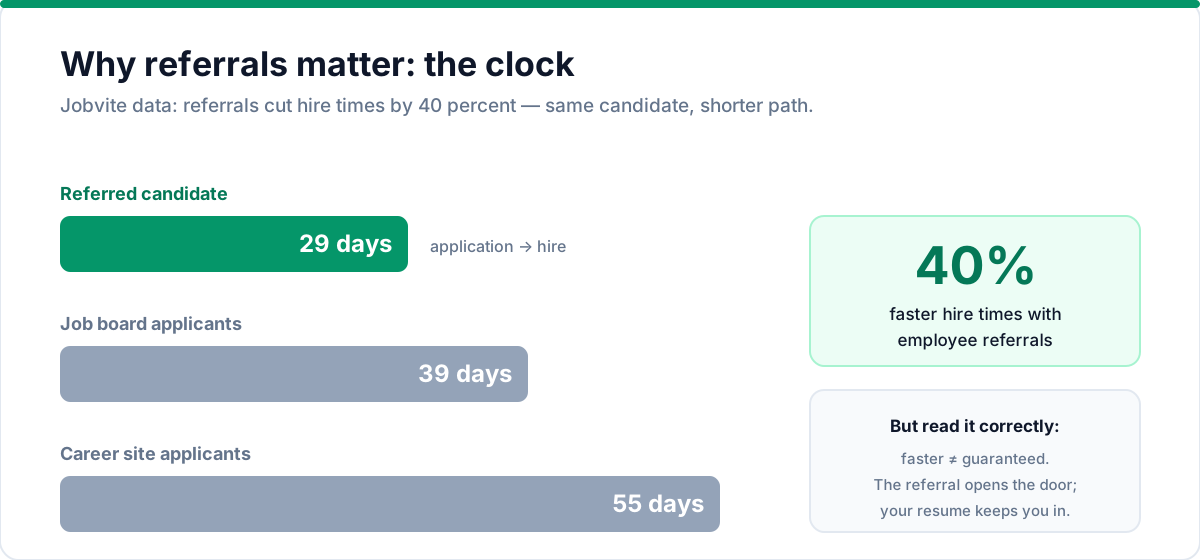
You've heard the stat: referred candidates get hired faster than cold applicants. Jobvite's data puts numbers on it — employee referrals can cut hire times by 40 percent, with referred candidates averaging 29 days from application to hire versus 39 to 55 days for job board and career site applicants. It's true, and it's also the most misread fact in the job search. People hear "referrals work" and conclude it's about knowing someone. It isn't.
A referral is a shortcut to trust. A stranger inside the company vouches that you're a real, sane, qualified person — and that single signal gets your resume actually read instead of scanned. The good news is that referrals aren't limited to your best friends. They're a skill, and like any skill, they can be built. Just make sure you're interview-ready before you ask for the introduction.
Here's the playbook.
Step 1: Find the right person (not just "anyone who works there")
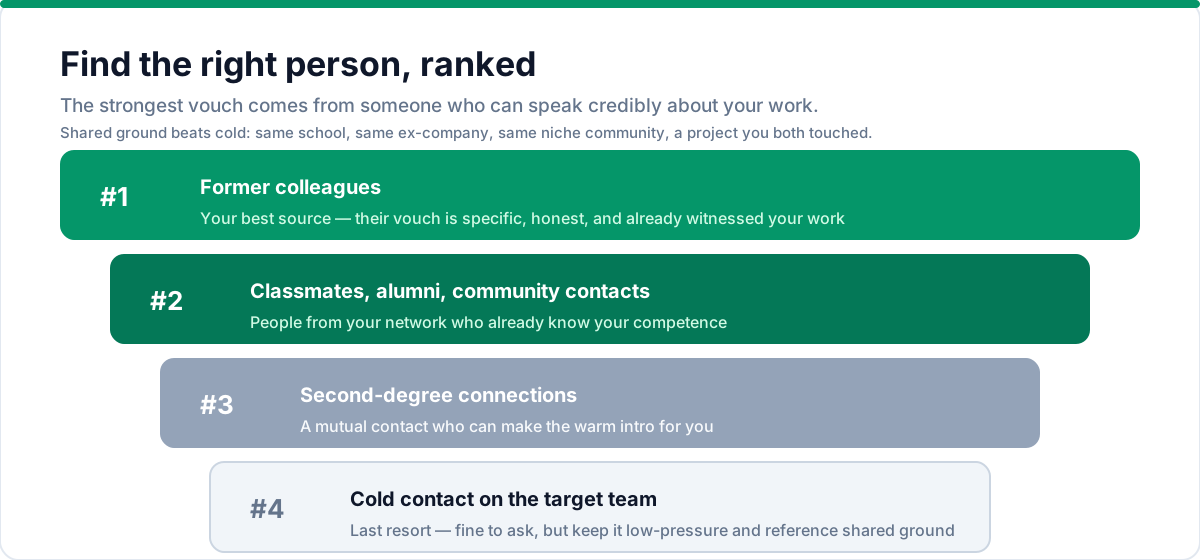
Not all referrals are equal. The strongest referrals come from people who can speak credibly about your work:
- Former colleagues. Your best source — they've worked with you, and their vouch is specific and honest.
- Classmates, alumni, and community contacts. People from your network who already know your competence.
- Second-degree connections. A mutual contact who can make a warm intro.
- Active employees in the role or team you want (last resort, cold). It's fine to ask — but keep it low-pressure.
A cold LinkedIn message to a stranger works far less often than a message that references shared ground: same school, same ex-company, same niche community, a project you both contributed to. Find the connection point before you reach out.
Step 2: Do the work before you ask
The cardinal sin of referral requests is asking someone to risk their reputation on an application you haven't even tailored. Before you ask anyone for anything:
- Tailor your resume to the specific role — a referral surfaces your application, but relevance is still what gets it taken seriously. Start with a strong resume and the right keywords.
- Know exactly which job you want. "Do you know anyone at [Company]?" is a lazy ask. "I'm applying for the Senior PM role in your payments team — would you be open to referring me?" is specific and easy to answer. Keep your resume length tight so the referrer sees a focused candidate.
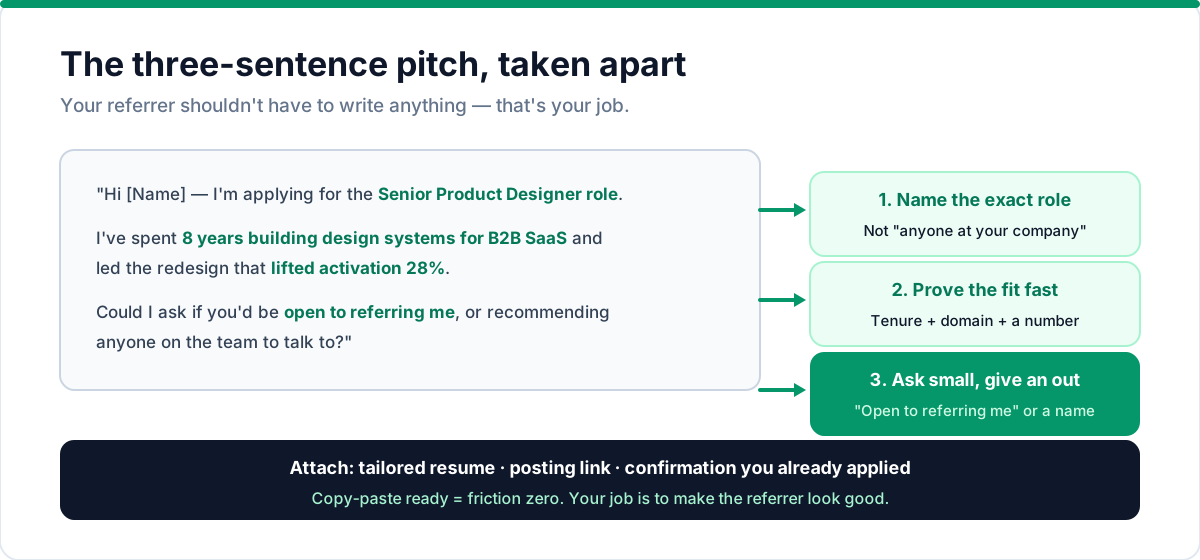
- Prepare a 3-sentence pitch they can forward: who you are, what you've done, why you fit. Your referrer shouldn't have to write anything — that's your job.
The pitch matters more than people think. A good one looks like this:
"Hi [Name] — I'm applying for the Senior Product Designer role. I've spent 8 years building design systems for B2B SaaS and led the redesign that lifted activation 28%. Could I ask if you'd be open to referring me, or recommending anyone on the team to talk to?"
Step 3: Ask the right way
How you ask determines whether the answer is yes — and whether they mean it. The rules:
- Ask specifically, not generally. Name the role. (Above.)
- Ask for the smallest thing that helps. "Would you be open to referring me?" beats "Can you get me an interview?"
- Give them an out. "No pressure at all — totally understand if this isn't the right kind of ask." An easy no invites an easier yes.
- Make it a two-way street. If you can help them in return — a connection, feedback, a recommendation — offer it. Referrals are currency; don't spend it one-way.
If you can't find any connection at all, one legitimate alternative: apply formally and mention in your cover letter any shared community or admiration for their work. It's not a referral, but it's a step toward the same warmth.
Step 4: Make the referral easy to say yes to
Here's the secret most people miss: your job is to make the referrer look good. They're staking their name on you. Give them a script:
- Your tailored resume, already matching the posting
- A one-paragraph summary of why you fit (they forward this or use it in their note)
- The job posting link so they don't have to hunt for it
- Confirmation that you've already applied formally, if the company requires it
When a referrer can literally copy-paste your pitch, the friction drops to zero — and the yes rate goes up accordingly. Make sure your resume is polished so they're forwarding something strong.
Step 5: Follow up and close the loop
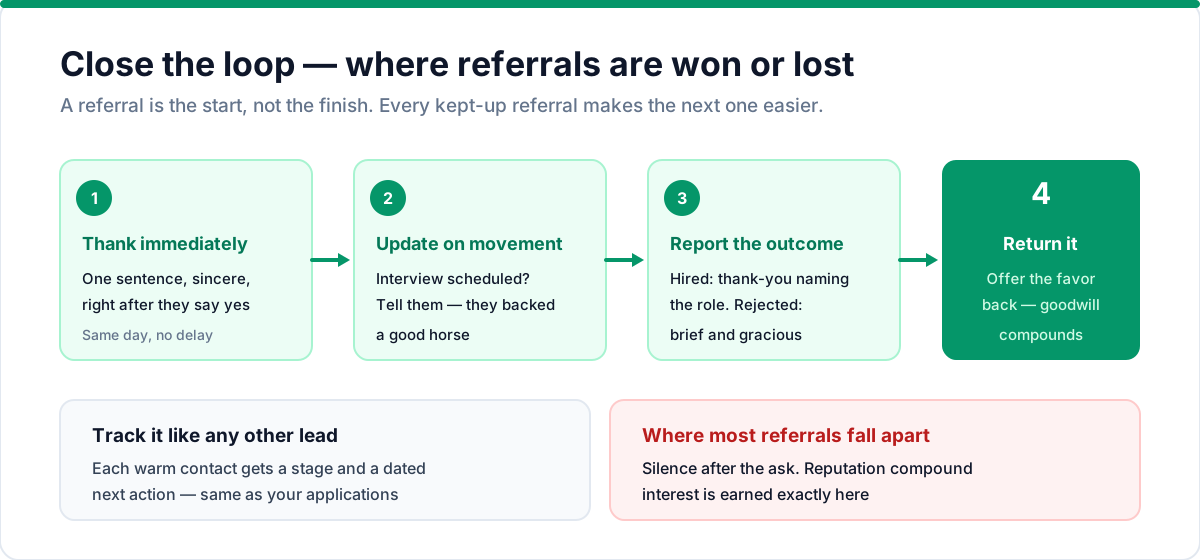
A referral is the start, not the finish:
- Thank them immediately. One sentence, sincere.
- Update them as it moves. If you get an interview, tell them — they'll want to know they backed a good horse.
- Keep them posted on outcomes. Got the job? Send a thank-you that mentions the role, and offer to return the favor. Rejected? Brief, gracious note — you may need them again. Either way, you'll want to ace the interview when it comes.
This is where most referrals fall apart, and it's also where your reputation compound interest is earned. Every kept-up referral makes the next one easier. If you're organizing a referral-heavy search, track it like any other lead — including a next action for each warm contact.
The reality check
Some honest expectations:
- Referred ≠ guaranteed interview. It increases the odds and the warmth; it doesn't skip the process.
- Your resume still matters. The referrer opens the door; the resume keeps you in the room.
- Some companies have weak referral pipelines. Small startups often act on referrals fast; huge companies sometimes lose them in the process. Don't hinge your whole search on it.
Where to find referral-worthy roles
Referrals aren't just for the jobs already on your radar. A good referral conversation often creates opportunities:
- Company career pages — roles posted there are more likely to have an internal referral pipeline behind them.
- Your current and former employers' open roles — alumni networks are referral gold, and companies often prioritize internal referrals over public postings.
- Job boards with referral features — some platforms let you apply with a note naming a connection, which routes your application through the referral flow automatically.
- Companies in your niche, not just your city — with remote and hybrid work, a referral in another location is often completely fine. Don't filter yourself out before asking.
The playbook is the same everywhere: find the person, do the prep, ask specifically, hand them a script.
Referrals from people you don't know well
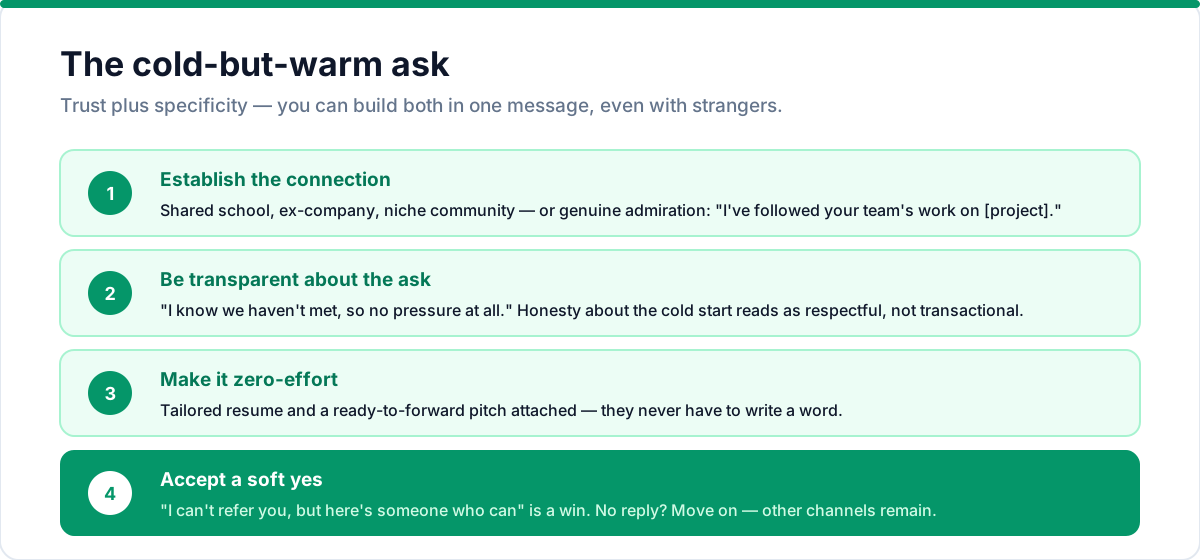
Most people assume a referral requires a close relationship. It doesn't — it requires trust plus specificity, and you can build both in one message.
The formula for a cold-but-warm ask:
- Establish the connection — shared school, ex-company, niche community, or genuine admiration for their work ("I've followed your design team's work on [project]").
- Be transparent about the ask — "I know we haven't met, so no pressure at all."
- Make it zero-effort for them — your tailored resume and a ready-to-forward pitch attached.
- Accept a soft yes — even "I can't refer you, but here's someone who can" is a win.
A message like that gets answered more often than you'd expect, because it's rare, respectful, and does all the work. If it doesn't, move on — the search has other channels to feed.
Referral myths worth dropping
- "Referrals only work for people with big networks." Networks are built, not inherited. Alumni groups, former teammates, and niche communities are open to anyone.
- "One referral is enough." The best searches have several in play — a referral pipeline, not a single chip.
- "Referred candidates don't need a good resume." They still get screened by the same ATS and recruiters; the referral just makes the screen friendlier.
The bottom line
Referrals are the highest-leverage move in the job search, and they're 90% preparation. Find someone who can speak to your work, tailor your application first, ask specifically and low-pressure, hand them a script they can forward, and follow up so the goodwill compounds. Do that and referrals stop being luck — they become a repeatable part of your search.
Frequently asked questions
What if I don't know anyone at the company? Start with second-degree connections — ask a mutual contact for an introduction, or find someone on LinkedIn who shares your school, ex-company, or niche community. A warm intro through a mutual contact is almost as good as a direct referral.
Should I ask for a referral before or after applying? Before, if possible. The referral carries more weight when it surfaces your application for the first time. If you've already applied, mention it in your ask — "I applied last week and wanted to see if you'd be open to referring me" still works.
How long should I wait before following up with my referrer? Update them as soon as you get movement — an interview scheduled, a positive response. They want to know their referral led somewhere. If nothing moves for two weeks, a brief update ("Still waiting to hear back — will keep you posted") shows you're organized.
Can I ask the same person for multiple referrals? Yes, but space them out and always give them an easy out. "I know this is a lot to ask — totally understand if it's not the right time" keeps the relationship healthy. One referral per company is the standard.
What if my referrer says no? Thank them and move on. A "no" often means they don't feel confident vouching for the specific role, not that they don't value you. Ask if they know someone who might be better positioned — that turns a no into a potential intro.
Do referrals work for senior-level roles? They work even better at senior levels, where trust and reputation matter more. A referral from a peer or former manager carries significant weight — and the network you've built over your career is exactly the asset that makes it possible.
Keep your resume ready so every warm intro has something strong to open. Build yours in Talent & Story's resume builder, tailor it in minutes, and track the whole search from one workspace — start free.
Put this into practice with Talent & Story
Build an ATS-friendly resume, get an instant compatibility score, and manage your entire job search in one workspace.
Written by
Talent & Story Team · Career Workspace
We build Talent & Story — the career workspace for building ATS-friendly resumes, writing cover letters, tracking applications, and preparing for interviews. Every guide is written to be practical enough to use the same day.