How to Follow Up on a Job Application Without Being Annoying
Most applicants never follow up - or they do it wrong. Here's when to reach out, what to say, and the two-sentence template that actually gets replies.
Here's a strange fact about the job market: most applicants never follow up after submitting — and a large share of those who do follow up wrong — too fast, too pushy, or too generic. That means most applicants are leaving a real advantage on the table.
The result is that a single, well-timed, polite follow-up genuinely stands out. It's not a hack or a trick; it's basic professional courtesy that most people skip. This guide covers when to follow up, what to say, and the exact templates that won't annoy anyone.
Do follow-ups actually work?
Honestly, sometimes. What they reliably do is:
- Move you from "one of 200" to "a name I remember." Recruiters and hiring managers juggle dozens of candidates. A polite, specific message at the right time re-surfaces you.
- Answer your own uncertainty. Waiting in silence is demoralizing. A follow-up gets you information: it's still open, it's closed, or "we'll be in touch."
- Catch the edge cases. Maybe your application hit their spam folder, or the posting auto-received the email but your attachment didn't attach. A follow-up surfaces these.
What they don't do is rescue a bad application. Follow-up amplifies a strong one; it can't create one. If you've already landed interviews, our common interview questions guide will help you close.
The timing: three checkpoints
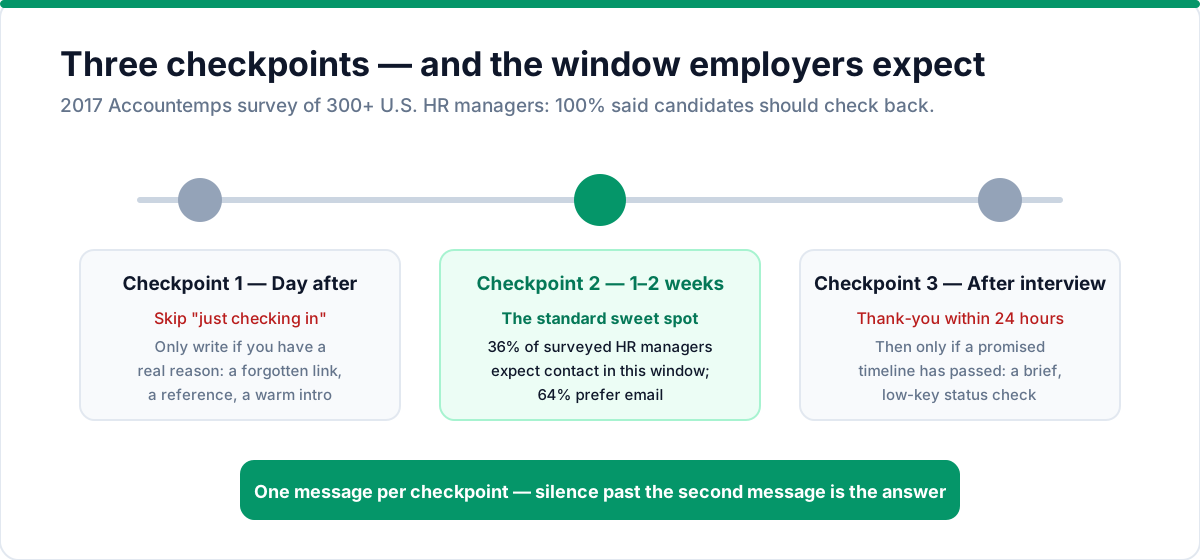
Checkpoint 1 — After applying (only if you have a real reason). Don't send "just checking in" the day after you apply. It signals impatience. The exception: you have a genuine reason to write — a reference you can mention, a portfolio link you forgot, a warm intro you've now secured.
Checkpoint 2 — One to two weeks after applying (the standard). If you haven't heard anything, this is the sweet spot. Most screening happens within that window, so a message at the two-week mark is perfectly reasonable, not pushy. Employers agree: in a 2017 Accountemps survey of more than 300 U.S. HR managers, every manager interviewed said candidates should check back after submitting a resume — and the most common answer, 36%, was one to two weeks. Email was their preferred channel, at 64%.
Checkpoint 3 — After an interview. Send a thank-you within 24 hours, always. Then, if you were promised a timeline ("we'll decide next week") and it passes, a brief status check at that point is fair game.
The rules that keep you polite
- One message per checkpoint. Two chases on the same application is the threshold where "persistent" becomes "annoying."
- Keep it short. Two to four sentences, maximum. Anything longer reads as an essay nobody asked for.
- Make it easy to answer. End with a yes/no question or a clear ask. "Any update on the timeline?" beats "Just checking in!"
- Be specific. Mention the role and date applied so they can find you in seconds.
- Never guilt-trip. "I haven't heard back" is fine; "I'm surprised you haven't responded" is not.
- Know when to stop. After your second message with no reply, take the silence as the answer and keep your search moving. Not every company responds — that's their failure, not a reflection on your message.
The two-sentence template
This is the workhorse. Copy, fill in the brackets, send.
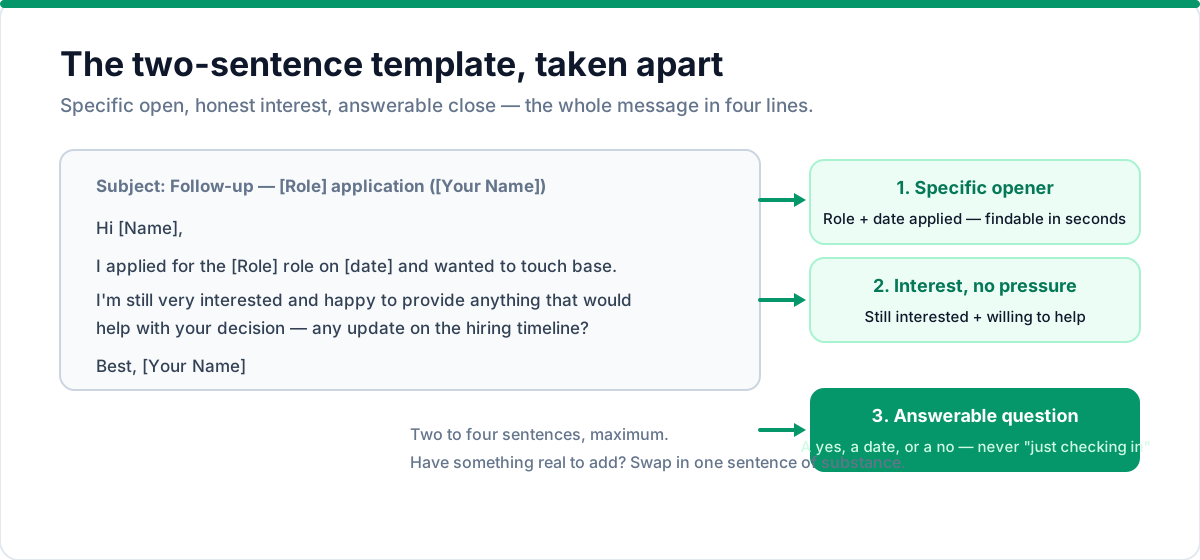
Subject: Follow-up — [Role] application ([Your Name])
Hi [Name],
I applied for the [Role] role on [date] and wanted to touch base. I'm still very interested and happy to provide anything that would help with your decision — any update on the hiring timeline?
Best, [Your Name]
That's it. Specific, short, and it ends with an answerable question. If you have a genuinely useful addition — a new portfolio piece, a certification you just finished, or a strong bullet point from a recent project — swap in one sentence of substance instead of "touching base."
The post-interview thank-you
This one's non-negotiable and has its own best practice:
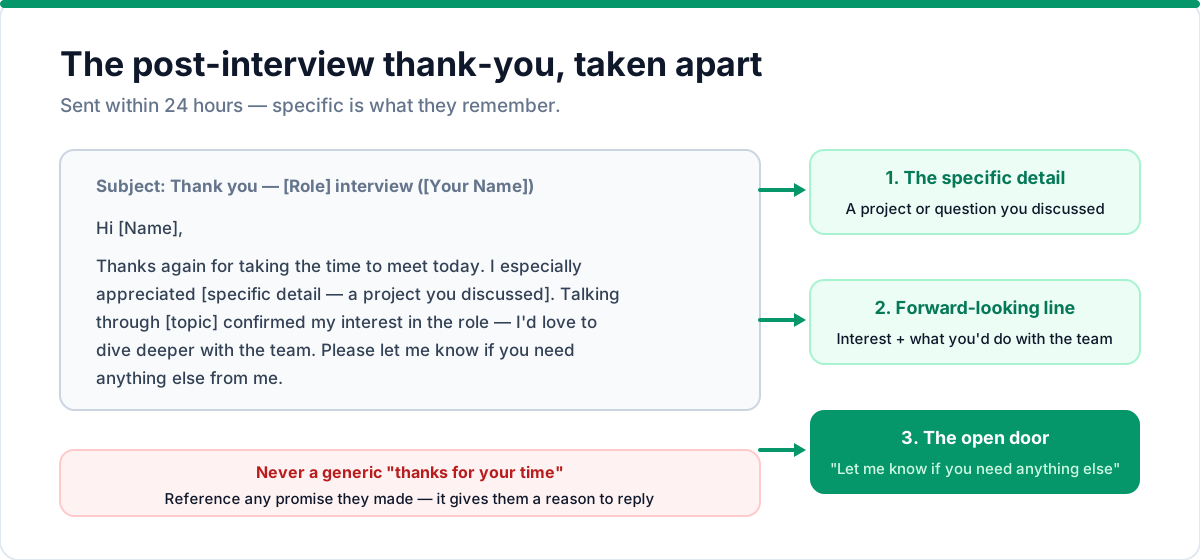
Subject: Thank you — [Role] interview ([Your Name])
Hi [Name],
Thanks again for taking the time to meet today. I especially appreciated [specific detail — a project you discussed, a question that challenged you]. Talking through [topic] confirmed my interest in the role — I'd love to dive deeper with the team using the STAR method we discussed.
Please let me know if you need anything else from me.
Best, [Your Name]
Sent within 24 hours. Specific — not a generic "thanks for your time" — because specific is what they remember. And if the interviewer mentioned sending you materials, introducing you to the team, or circling back with a timeline, reference that line directly: it gives them a concrete reason to reply instead of a vague obligation.
Following up as a relationship, not a transaction
The best follow-ups stop feeling like chases and start feeling like conversations. That happens when you bring value instead of requests:
- Forward a relevant resource. If you discussed a problem in the interview, email a link to something that speaks to it.
- Connect on LinkedIn. After an interview, a connection request with a one-line note ("great to meet you earlier today") keeps you in their orbit without asking for anything.
- Re-apply with intent. If a role reposts and you're genuinely a better fit now, a note referencing your original application shows persistence with substance.
Each of these is still one message. The pattern is always the same: brief, specific, and easy to respond to — tracking it in your job search so you never lose the thread.
What if they said "we'll be in touch"?
The hiring process is full of soft commitments: "we'll get back to you next week," "I'll update you by Friday," "keep an eye on your inbox." When a recruiter or interviewer sets an expectation, the follow-up rule changes slightly — you're not chasing, you're checking a promise.
- If they gave a timeline and it hasn't passed: don't write. Silence in the window is normal.
- If the timeline has passed by a few days: a brief, low-key note is completely fair. "You mentioned you'd have an update by last Friday — just checking in whenever you have a moment."
- If they said "we'll be in touch" with no timeline: treat it like the standard two-week checkpoint and apply the general template above.
The tone is always the same as everywhere else in this guide: brief, specific, and easy to answer. A follow-up framed as "you said you'd update me" is never pushy when the timeline has genuinely passed.
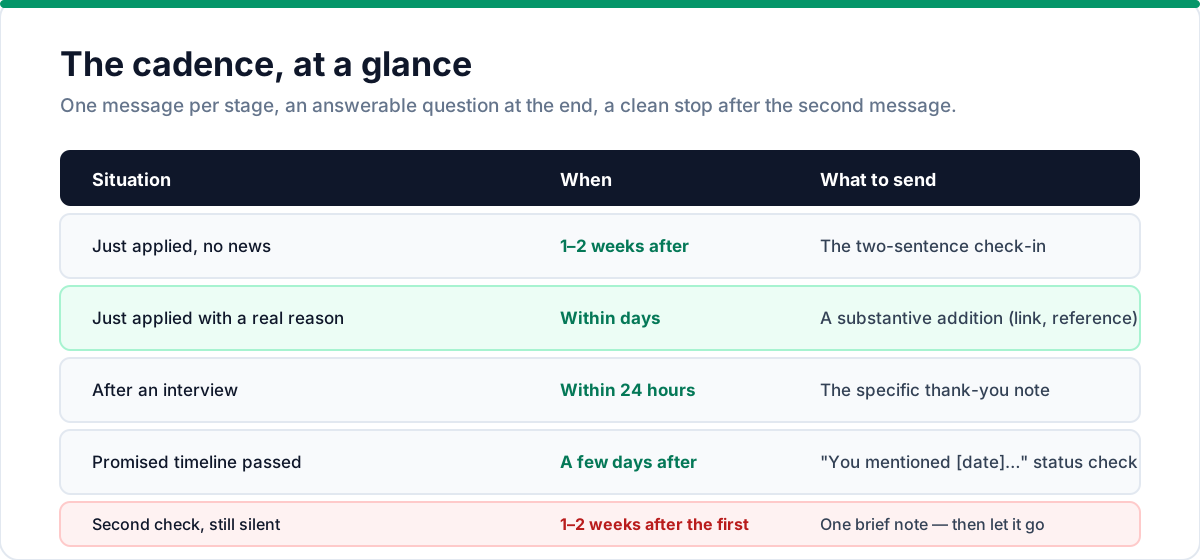
The follow-up cadence, at a glance
| Situation | When | What to send |
|---|---|---|
| Just applied (no news) | 1–2 weeks after | The two-sentence check-in |
| Just applied (real reason) | Within days | A substantive addition (portfolio link, reference) |
| After interview | Within 24 hours | The thank-you note |
| Timeline passed | A few days after | "You mentioned [date]…" status check |
| Second check, still silent | 1–2 weeks after first | Brief note — then let it go |
One message per stage, an answerable question at the end, and a clean stop after the second message. That cadence keeps you memorable without making you a headache.
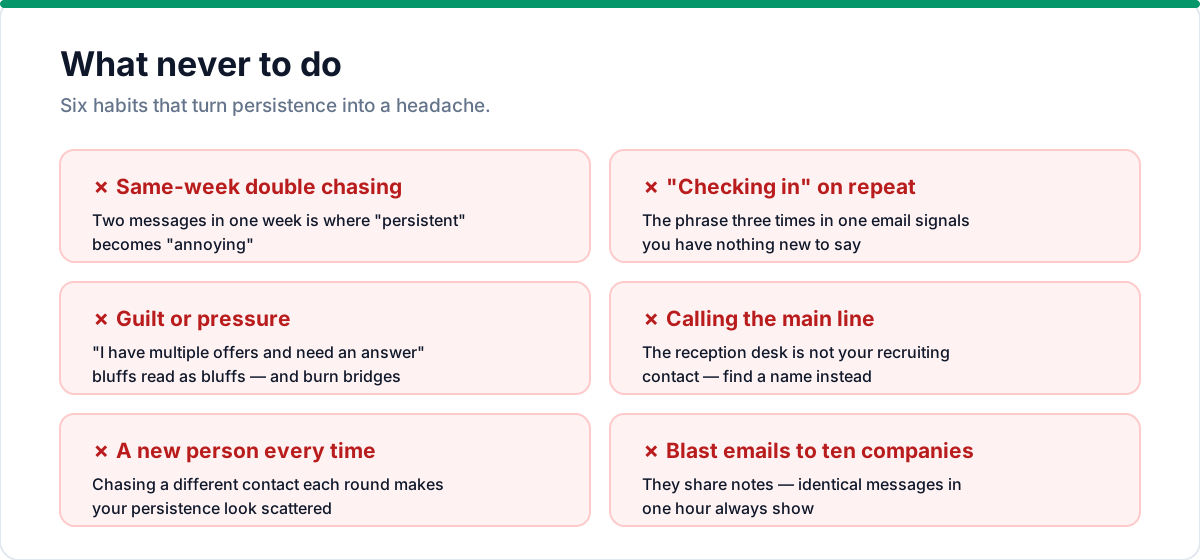
What never to do
- ❌ Follow up twice in one week
- ❌ Use "checking in" three times in one email
- ❌ Threaten or guilt — "I've received multiple offers and need to know soon"
- ❌ Call the main office line to ask about your application
- ❌ Follow up with a different person every time
- ❌ Send the same email to ten companies in an hour (they share, and it shows)
Frequently asked questions
How many times should I follow up on a job application? No more than twice. One check-in at the two-week mark, one brief follow-up if you still haven't heard back. After that, take the silence as the answer and move on. More than two messages crosses the line from persistent to annoying.
Should I follow up by email or LinkedIn? Email is always appropriate — it's professional and expected. LinkedIn works as a supplement (a connection request with a short note after an interview), but email is the primary channel for follow-ups.
What if the job posting says "no calls or emails"? Respect the instruction — don't follow up through that channel. You can still try a LinkedIn connection with a brief note, or wait until the stated timeline passes and then reach out once.
Can I follow up if I applied through a job board? Yes, but find a direct contact if possible. A follow-up to a generic "info@" address rarely works. Check the company website, LinkedIn, or the job posting for a recruiter or hiring manager name.
How do I follow up when someone referred me? Thank the referrer once, politely, and ask whether your application made it in front of the hiring team — after about a week. Referrers often know the status internally and can nudge it for you, which is worth more than any email you'd send yourself. If you're still building that relationship, our referral guide covers the ask itself.
What if I get no response after two follow-ups? Move on. Two non-responses is a clear signal. Don't burn the bridge — you may reapply later, and a gracious silence keeps that door open. Focus your energy on roles where you're getting traction.
Is it okay to follow up after a rejection? Yes, briefly. A gracious reply ("Thanks for letting me know — I'd love to be considered for future roles") keeps you on their radar and leaves a positive impression. It's a small move that pays off later.
The bottom line
Follow-up is a courtesy that most people skip — and the correct version of it is easy. One polite, short, specific message at the two-week mark, one post-interview thank-you within 24 hours, and an answerable question at the end. Anything more is noise; anything less is a missed opportunity.
Build the reminder into your process instead of trusting memory — a job tracker can hold each application's next action so no follow-up ever slips through. And make sure your resume keywords are current before you hit send. When you do get that reply, your tailored resume will be ready to make the case. Talent & Story's job tracker keeps the reminder on your dashboard — start free.
Put this into practice with Talent & Story
Build an ATS-friendly resume, get an instant compatibility score, and manage your entire job search in one workspace.
Written by
Talent & Story Team · Career Workspace
We build Talent & Story — the career workspace for building ATS-friendly resumes, writing cover letters, tracking applications, and preparing for interviews. Every guide is written to be practical enough to use the same day.