How to Write Resume Bullet Points That Beat the ATS
Resume bullet points carry your experience — and they're where the ATS looks hardest. Here's the structure, the verbs, and formatting that get them read.
Your resume is built on bullet points. They're the part that gets parsed most aggressively and scanned most quickly.
A bullet does three jobs at once: it gives the ATS structured, readable text to index; it gives a recruiter a reason to keep reading in seconds; and it gives an interviewer a question to ask. Write bullets that do all three, and your resume stops being a document and starts being an asset.
Here's the exact formula.
Quick stat: recruiters spend an average of 7.4 seconds scanning a resume, according to the Ladders' 2018 eye-tracking study — less time than it takes to read this section. Bullet structure is what they catch in that window.
The anatomy of a strong bullet
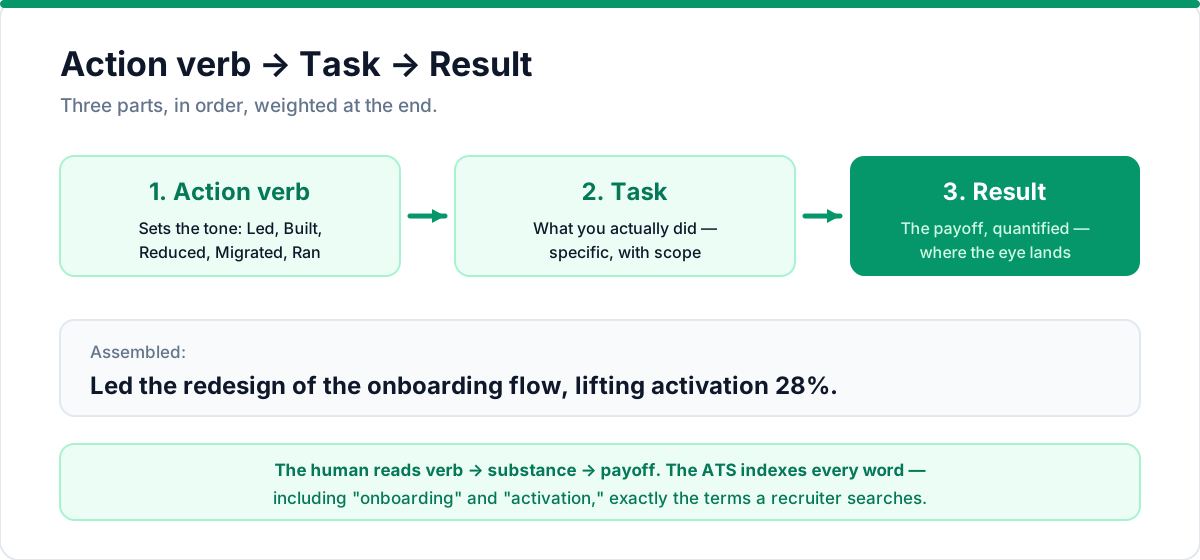
A strong bullet has three parts, in order:
Action verb → Task (what you did) → Result (impact, ideally quantified)
"Led" + "the redesign of the onboarding flow" + "which lifted activation 28%."
Led the redesign of the onboarding flow, lifting activation 28%.
That's it. Not clever, not decorative — clear, specific, and weighted at the end. The human eye reads the verb, the substance, and the payoff. The ATS indexes every word, including "onboarding" and "activation" — which are exactly the keywords a recruiter would search.
Start with a strong action verb
The first word of a bullet is prime real estate. It sets the tone for everything after. Passive, weak openings waste it:
- ❌ "Responsible for managing the marketing budget"
- ❌ "Was in charge of the customer database"
- ✅ "Managed a $1.2M marketing budget"
- ✅ "Migrated the customer database to AWS, cutting costs 34%"
"Responsible for" and "in charge of" announce responsibility without demonstrating anything. "Managed," "Migrated," "Built," "Reduced" demonstrate it. For a full arsenal, our list of 100+ resume action verbs covers verbs for every function — leadership, design, analysis, sales, engineering, and more.
Quantify wherever you can
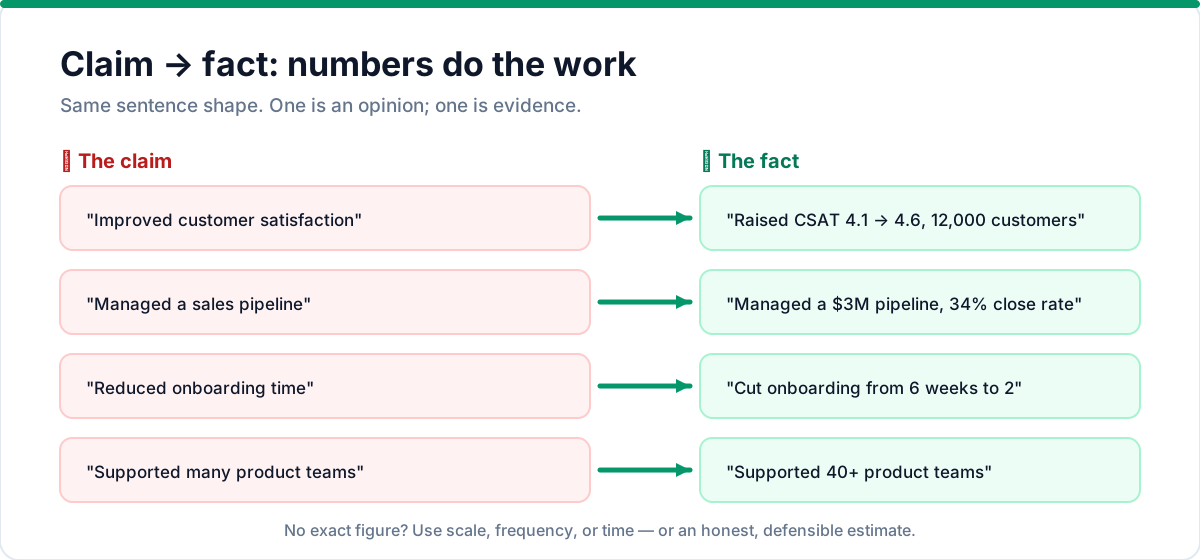
Numbers are the difference between a claim and a fact.
- ❌ "Improved customer satisfaction"
- ✅ "Raised CSAT from 4.1 to 4.6 across 12,000 customers"
- ❌ "Managed a sales pipeline"
- ✅ "Managed a $3M pipeline with a 34% close rate"
Don't have exact figures? Use scale, frequency, or time:
- "Reduced onboarding time from 6 weeks to 2"
- "Supported 40+ product teams"
- "Processed 200 tickets per week"
If you genuinely have no number, estimate honestly — "roughly," "~30%," "nearly half" — and keep it defensible. Anything beats a bare claim.
Keep bullets scannable
Recruiters skim, and parsers read literally. Both reward the same thing: short, focused bullets.
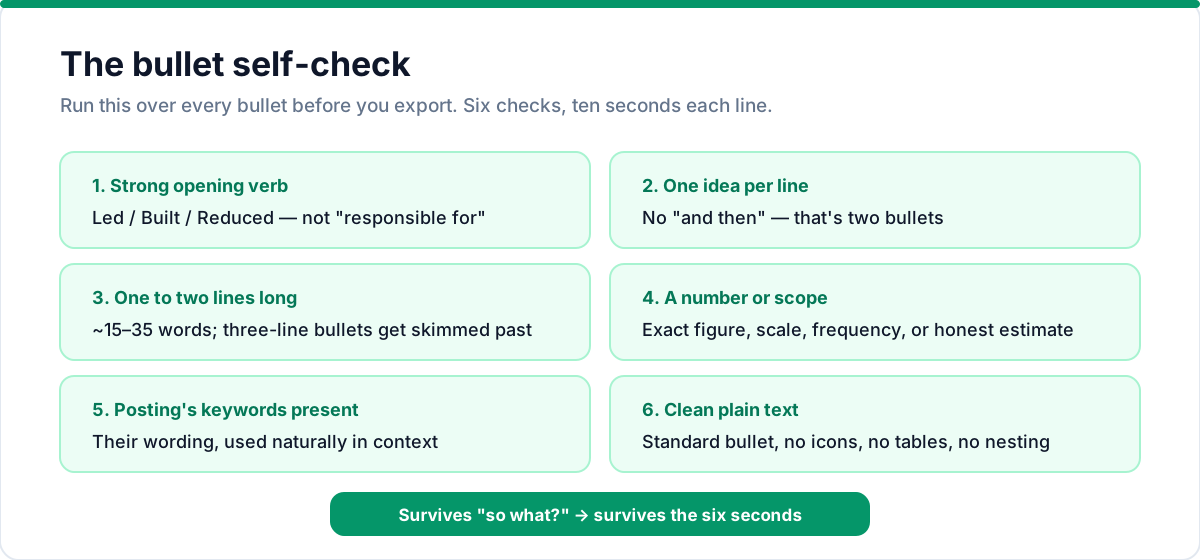
- One idea per bullet. If a bullet needs an "and then," it's two bullets.
- One to two lines each. Three-line bullets get skimmed past.
- Three to five bullets per role. Quality over volume — five strong bullets beat eight mediocre ones. This keeps you within resume length guidelines.
- Past tense for past roles, present for current. Small consistency signal that parsers and humans both notice.
Format bullets for the ATS
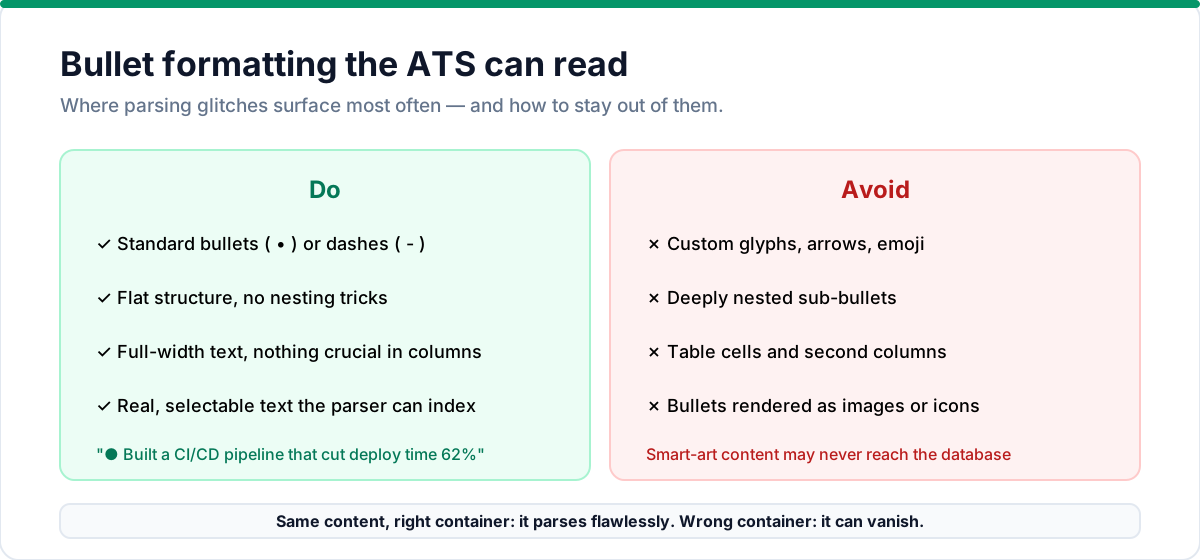
The formatting rules here are simple but non-negotiable, because bullets are where parsing glitches surface most often:
- Use standard bullet characters (
•) or dashes (-) — no custom glyphs, arrows, or emoji - Don't nest complex sub-bullets with indentation tricks — keep it flat and readable
- Avoid putting crucial information in a second column or in table cells — it may get dropped
- If your resume tool renders bullets as images or icons, it's a parsing risk
A bullet like "● Built a CI/CD pipeline that cut deploy time 62%" parses flawlessly. The same content inside a smart-art graphic or a two-column box might never reach the database.
Show what you did, not just what you were told to do
Passive, duty-list bullets are one of the most common resume mistakes:
- ❌ "Was responsible for team meetings"
- ❌ "Helped with customer onboarding"
- ✅ "Ran weekly sprint ceremonies for a 9-person team"
- ✅ "Onboarded 60+ new customers in the first quarter"
The difference is specificity plus ownership. "Helped with" and "was responsible for" tell the reader nothing about what you contributed. Name the work, name the scope, and own the outcome.
Bullets for every role: examples
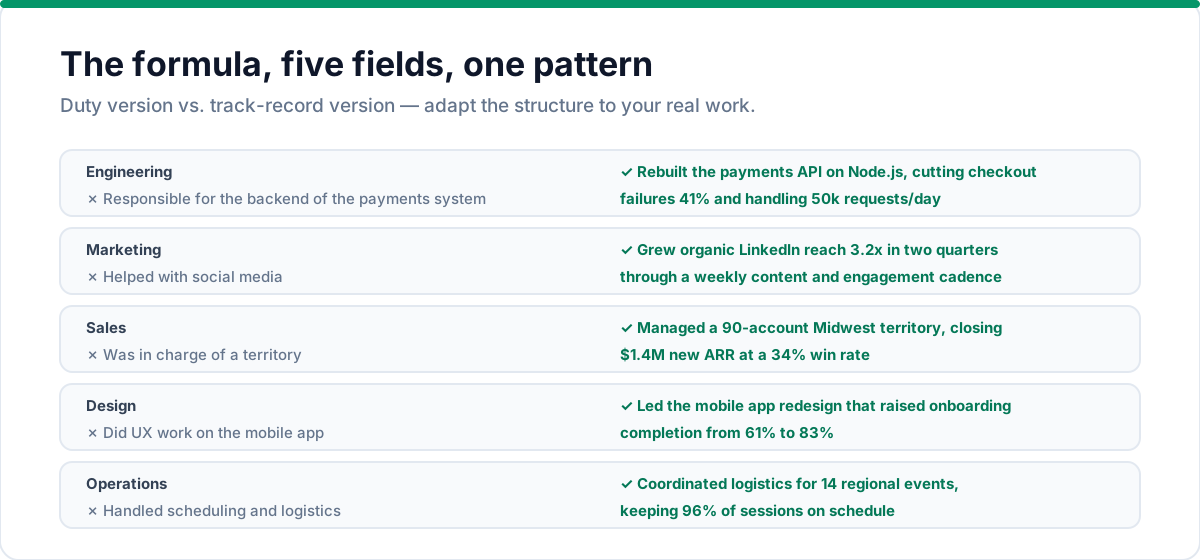
The formula is universal, but the specific verbs and metrics look different by field. Use these as templates, not finished lines — adapt the structure to your real work.
Engineering
- ❌ "Responsible for the backend of the payments system"
- ✅ "Rebuilt the payments API on Node.js, cutting checkout failures 41% and handling 50k requests/day"
Marketing
- ❌ "Helped with social media"
- ✅ "Grew organic LinkedIn reach 3.2x in two quarters through a weekly content and engagement cadence"
Sales
- ❌ "Was in charge of a territory"
- ✅ "Managed a 90-account territory in the Midwest, closing $1.4M in new ARR at a 34% win rate"
Design
- ❌ "Did UX work on the mobile app"
- ✅ "Led the mobile app redesign that raised onboarding completion from 61% to 83%"
Operations
- ❌ "Handled scheduling and logistics"
- ✅ "Coordinated logistics for 14 regional events, keeping 96% of sessions on schedule"
See the pattern? The weak version is a job description. The strong version is a track record.
Tailor bullets to each application
Your best bullets shouldn't be static. For every serious application, re-order and re-emphasize:
- Lead with what matches the job. If the role emphasizes growth marketing, your growth bullet goes first — even if your previous roles emphasized something else.
- Mirror the posting's vocabulary. The description's phrases belong in your bullets. This is where keywords earn their keep in context — covered in our resume keywords guide.
- Cut what's irrelevant. A bullet about a project from five years ago rarely helps a current application. Ruthless relevance is a feature. If you're returning from a break, our career gap guide shows which bullets to emphasize.
You don't need twenty variations of your resume — you need one strong base and a five-minute tweak per application. Keep your base resume sharp, then adjust the ordering and language of the top three bullets for each role. That targeted effort is what separates a real application from a carpet-bomb. Our tailoring guide walks through the five-minute version step by step.
A practical rewrite exercise
Take your current resume and do this for every role:
- Write down the three biggest wins in that role — outcomes you're proud of and can defend.
- Draft each as verb + task + result, quantified.
- Cut every bullet that doesn't survive the question, "So what?"
- Check that the surviving bullets contain the keywords from your target job description — place them naturally, using the same wording the posting uses.
Ten minutes of this converts a generic job history into a resume that reads like a track record.
Before and after: one role, fully rebuilt
Here's the whole article applied to a single section — same job, same facts, two very different documents.
Before (five duty bullets):
- "Responsible for managing the company blog"
- "Worked with the design team on various projects"
- "Helped improve website performance"
- "In charge of SEO reporting"
- "Assisted with email marketing campaigns"
After (five achievement bullets):
- "Grew organic blog traffic 64% year over year by rebuilding the keyword map across 120 published posts"
- "Partnered with design to ship 14 landing pages, lifting form completion 22%"
- "Cut median page load time from 4.1s to 1.6s through image and script cleanup"
- "Automated weekly SEO reporting in Looker Studio, saving three hours of manual work each week"
- "Ran lifecycle email tests that raised open rates from 18% to 27% across 40k subscribers"
Every bullet now has a verb, a scope, and a payoff — and every one survives the "so what?" test. Run this pass on your two most recent roles first; those are the bullets recruiters actually read.
Frequently asked questions
How many bullet points should each job have? Three to five. Quality over quantity — five strong, quantified bullets beat eight generic ones. If you can't think of five genuine accomplishments, three is fine. The goal is impact, not length.
How long should each bullet be? One to two lines — roughly 15 to 35 words, one idea each. If a bullet needs an "and then," it's two bullets. Parsers don't mind long lines; readers skim past them.
Should I use first person in resume bullets? No. Resume bullets are implied first person — "Led the redesign" not "I led the redesign." Drop the pronoun and start with the action verb. It saves space and reads more professionally.
How do I write bullets for a job I just started? Focus on what you've already delivered, not what you plan to do. Even a few months in, you've onboarded, contributed to a project, or improved a process. If the role is truly new, emphasize transferable accomplishments from your previous role that are most relevant.
Can I use bullet points for skills too? Your skills section should be a grouped list, not bullets. Reserve bullet points for your experience section where you describe accomplishments. Skills sections are scanned as keyword lists — clean, scannable formatting works better.
How do I quantify bullets without exact numbers? Use scale, frequency, or time. "Processed 200+ tickets per week," "Supported 40+ product teams," "Reduced onboarding time from 6 weeks to 2." If you genuinely have no number, use honest estimates: "roughly," "~30%," "nearly half."
Should bullet points be in past or present tense? Past tense for previous roles, present tense for your current job. "Led" for a role you've left, "Lead" for one you're in now. Consistency matters — mix-ups signal carelessness to recruiters.
The bottom line
Bullet points are where your experience becomes evidence. Start with a strong verb, describe the task with specifics, and close with a quantified result. Keep each bullet to one idea, formatted as plain text the ATS can index. Do that across every role and your resume will get parsed cleanly, searched successfully, and read with interest.
The whole resume rests on these bullets — so it's worth getting the overall ATS-friendly format right too. And before you send anything out, run one final check over the finished document: does every bullet on page one earn its line?
Ready to turn these bullets into a finished resume? Talent & Story's guided builder walks you through every section and renders clean, ATS-safe formatting — start free and export your polished PDF in minutes. Store your best bullets in the career vault so they're ready for every application.
Put this into practice with Talent & Story
Build an ATS-friendly resume, get an instant compatibility score, and manage your entire job search in one workspace.
Written by
Talent & Story Team · Career Workspace
We build Talent & Story — the career workspace for building ATS-friendly resumes, writing cover letters, tracking applications, and preparing for interviews. Every guide is written to be practical enough to use the same day.