How to Explain a Career Gap on Your Resume (No Apology)
Career gaps are more accepted than you fear. Here's how to present yours on your resume, when to address it in your summary, and what to say when asked.
You already know gaps are everywhere: layoffs, caregiving, a sabbatical, illness, a business that didn't work out, or simply time to figure out the next move.
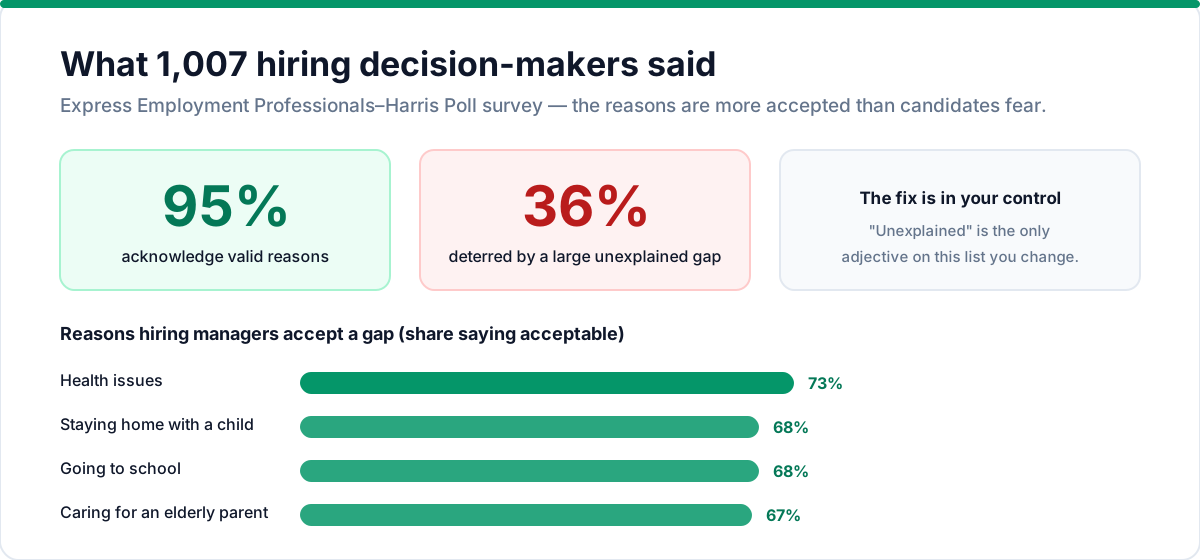
And hiring managers mostly agree those reasons are legitimate. In an Express Employment Professionals–Harris Poll survey of 1,007 U.S. hiring decision-makers, 95% acknowledged valid reasons for a career gap — health issues, staying home with a child, going to school, caring for an elderly parent. Only 36% said a large, unexplained gap would deter them from an interview.
Here's the part recruiters won't say out loud: a gap on a resume is normal, and it's nearly invisible. What separates candidates isn't the gap — it's what they do about it. Some candidates hide it and apologize; others handle it with one honest sentence and move on. The second group gets the interview.
This guide covers the resume rules, the summary strategy, and the interview answers. If you're building your resume from scratch, our how to write a resume guide walks through the full process.
The ground rule: never lie, and don't apologize
Two things sink more gap-havers than the gap itself — and they're among the most common resume mistakes:
- Fabricating a job to fill the space. Background checks and reference calls exist precisely for this, and it ends offers.
- Writing an apology. "Unfortunately, I was laid off" or "I regret the time away" frames your value around a negative. A gap is information, not a confession.
The honest middle ground: state the gap briefly where it belongs, then pivot to what you bring and what you did during it.
Does it even belong on the resume?
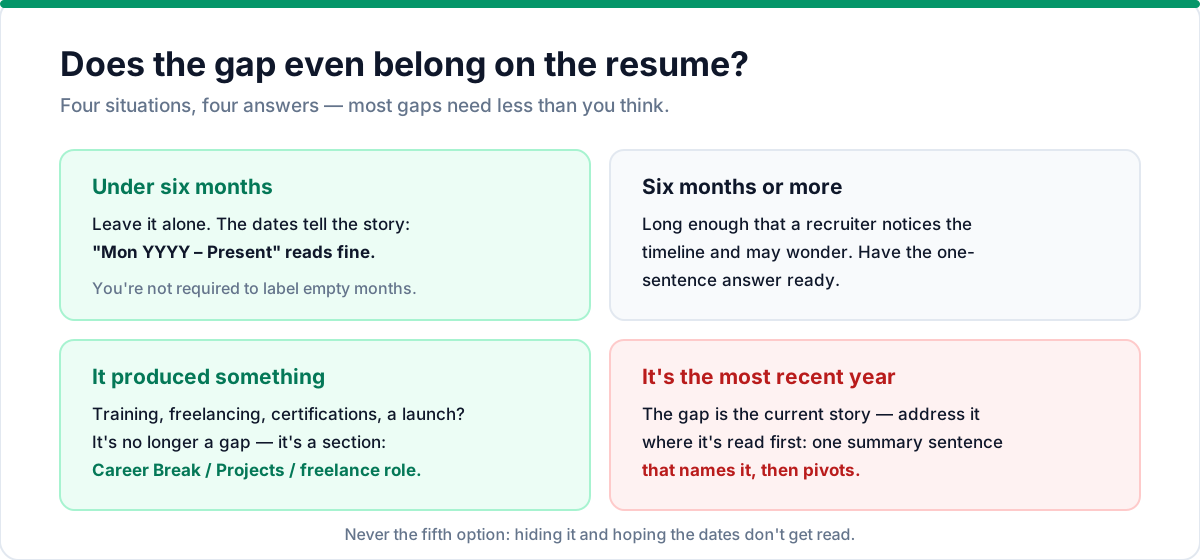
Here's a truth that saves a lot of worry: a short gap (under six months) doesn't need to be called out at all. Dates alone tell the story — "Mon YYYY – Present" with the gap behind it reads fine. You're not required to label the empty months.
Where a gap becomes resume-relevant:
- Six months or more. Long enough that a recruiter will notice the timeline and may wonder.
- It produced something worth showing. Career breaks increasingly include training, freelancing, certifications, volunteer work, or launching something. If it did, add it — it's no longer a "gap," it's a section.
- It's the most recent thing on your resume. If you've been out of work for a year, the gap is the current story. Address it in the summary.
The structure that handles most gaps
Most gaps don't need a dedicated "Career Break" section — but the ones that were productive deserve a line on the resume:
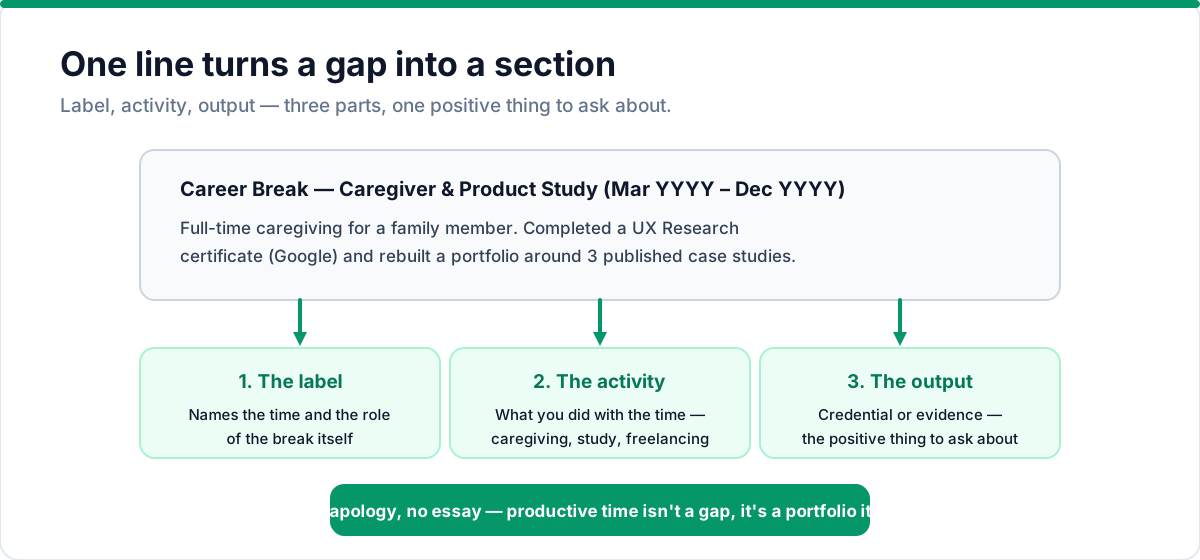
Career Break — Caregiver & Product Study (Mar YYYY – Dec YYYY) Full-time caregiving for a family member. Completed a UX Research certificate (Google) and rebuilt a portfolio around 3 published case studies.
A structured line like this accomplishes three things: it explains the time, it shows you were active, and it gives interviewers a positive thing to ask about. It also demonstrates exactly the quantified, action-verb discipline that makes the rest of your resume strong.
Even better, if that time produced a project, a certification, or freelance work, add it to your existing sections — Projects, Certifications, or as a freelance role under Experience. Productive time isn't a gap; it's a portfolio item.
When to use the summary
Your professional summary is the first thing read, and it's the natural place to neutralize a long, recent gap — with one sentence, not a paragraph:
"Operations manager with 12 years in logistics. Returned after a year focused on family care and completed the Lean Six Sigma Green Belt certification during the break."
One sentence that names the gap, names the time, and immediately redeploys it into something positive (the certification). Use the STAR method to structure your interview answers about the gap. No apology, no essay. That sentence answers the question before it's asked — which is exactly what a summary is for. (If you're still drafting your summary, our summary vs. objective guide shows the formula.)
For shorter gaps, skip the summary entirely. Don't draw attention to something no one would have noticed.
What to say in the interview
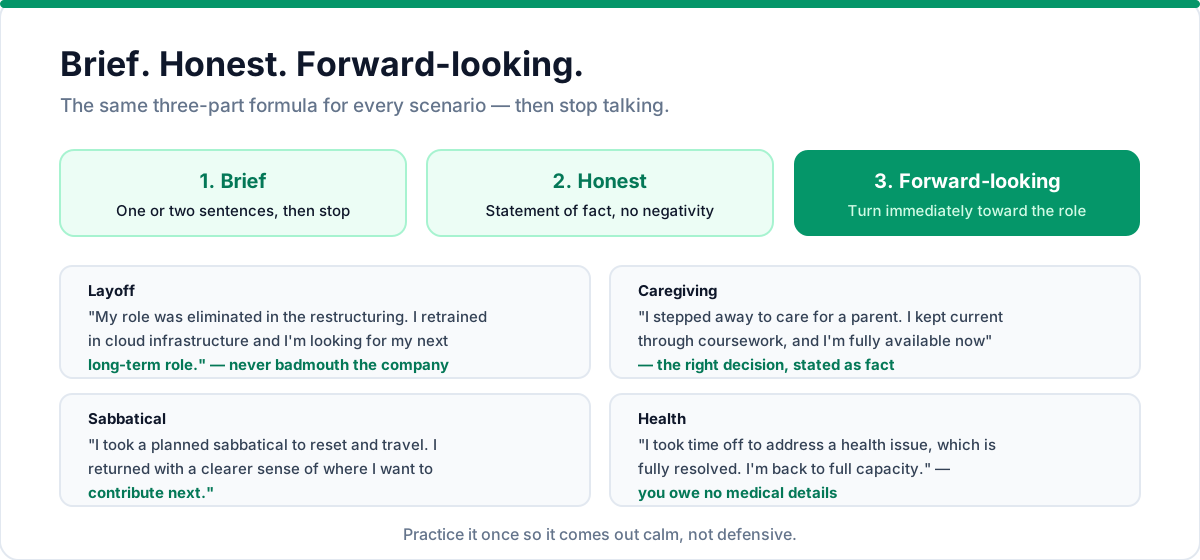
The resume is settled; the interview is where the question might actually come up. The formula is the same: brief, honest, forward-looking.
- Layoff: "My role was eliminated in the restructuring — the team was consolidated. I used the time to retrain in cloud infrastructure, and I'm looking for my next long-term role." (One or two sentences, then stop. Never badmouth the company.)
- Caregiving: "I stepped away to care for a parent. It was the right decision, and I kept current with the industry through coursework. I'm fully available and ready to commit now."
- Sabbatical or travel: "I took a planned sabbatical to reset and travel. I returned with a clearer sense of where I want to contribute next."
- Health: "I took time off to address a health issue, which is fully resolved. I'm back to full capacity." (You owe no medical details, and recruiters shouldn't ask for them.)
The common thread: a brief statement of fact, no negativity, then an immediate turn toward the role. Practice it once so it comes out calm, not defensive. Our common interview questions guide has more answers you can prepare.
Gaps and the ATS: a word on the machines
Applicant tracking systems don't judge gaps — they parse dates and move on. An ATS never reads "oh no, eight months." It reads "Mar YYYY to Dec YYYY," files it, and stores you in the candidate database. The human judgment about gaps happens later, in the interview and the phone screen, not in the software.
What the ATS does care about is your resume formatting and keywords — that's what gets you parsed and surfaced in the first place. So don't spend your optimization energy worrying about how a machine perceives your gap; spend it making sure your resume is found, then handle the human conversation with the formula below.
Sample resume lines for different gap types
Use these as templates, filling in your real details:
Layoff + retraining:
"Operations manager with 12 years in logistics. Rebuilt operations processes after a recent restructuring; completed the Lean Six Sigma Green Belt during the transition."
Parental leave or caregiving:
"Returned after a parental leave. Stayed current through professional courses and now seeking a full-time product role."
Freelance/consulting during the break:
"Independent consultant (most recent year): delivered analytics projects for 4 SMB clients while launching a side business."
Sabbatical with direction:
"Took a planned sabbatical to refocus; returned with a portfolio of 3 published case studies in UX research."
Notice what each one does: names the time, names the activity, and hands the interviewer a positive thing to ask about next.
The mindset shift that matters
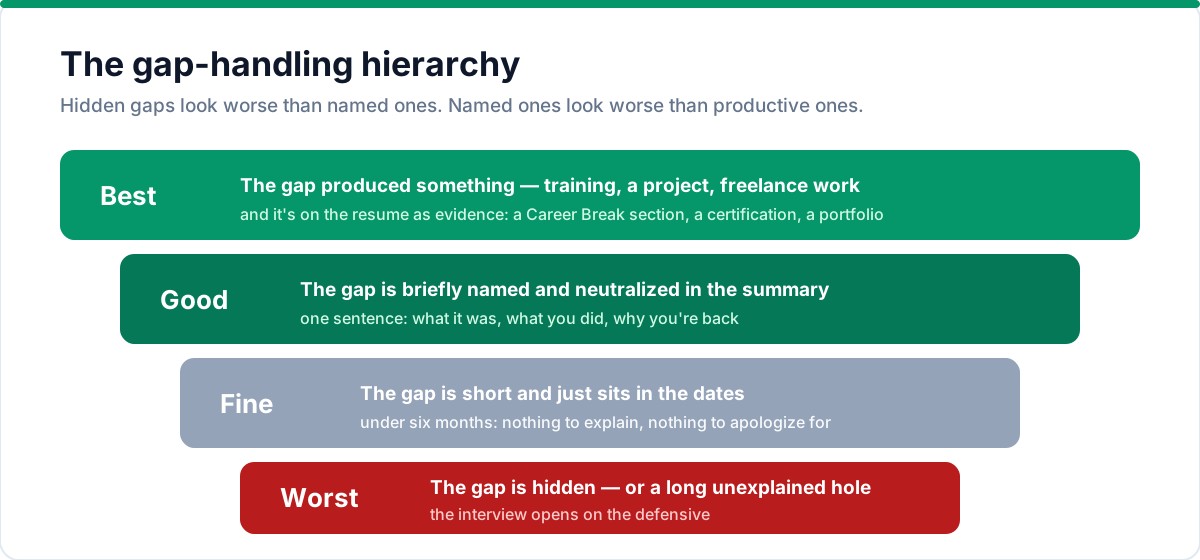
The biggest obstacle isn't the gap — it's the shame attached to it. The market has normalized breaks: mass layoffs across tech, caregiving realities, and the rise of "career breaks" as a deliberate choice. Recruiters evaluate gaps on a spectrum: hidden gaps look worse than named ones, and named gaps look worse than productive ones.
The survey data agrees with the spectrum. The reasons hiring managers accept are exactly the reasons people actually take: 73% accept health-related gaps, 68% staying home with a child, 68% going to school, 67% caring for an elderly parent. What remains is mostly the unexplained gap — and "unexplained" is the one adjective on this list you control.
So the practical hierarchy is:
- Best: the gap produced something — training, a project, freelance work — and it's on the resume as evidence
- Good: the gap is briefly named and neutralized in the summary
- Fine: the gap is short and just sits in the dates
- Worst: the gap is hidden, or the resume has an unexplained long hole that the interview starts with
Your job is to be in categories one through three, and to never be in four.
Frequently asked questions
How far back should I go on my resume? Focus on the last 10–15 years. Older roles can be summarized in a single line or cut entirely if they're not relevant to your target role. The goal is relevance, not completeness.
Should I explain a career gap in my cover letter? Only if the gap is long and recent. A brief mention ("I took time off for family care and returned with new certifications") neutralizes the question before it's asked. Our cover letter guide shows you how.
Can I use "career break" instead of leaving the gap unexplained? Yes — if the break produced something worth showing (training, freelancing, certifications). Label it as a section on your resume with dates and activities. It turns a gap into evidence.
Will a career gap show up on a background check? Background checks verify employers, titles, and dates — they don't evaluate your reasons. Any gap visible there is already visible on your resume, which is exactly why the honest, brief treatment above is the right one. What checks catch is fabrication, not time off.
Do gaps affect my salary negotiations? Gaps don't directly affect salary, but they can affect your leverage if you seem desperate. Focus on the value you bring and the skills you've maintained or developed during the break.
What if I have multiple gaps? Address the most recent and longest one in your summary. For older gaps, the dates speak for themselves. The key is to show a pattern of productive activity, not explain every month.
Should I remove short gaps from my resume? Gaps under six months don't need to be called out — the dates alone tell the story. Don't draw attention to something no one would have noticed.
The bottom line
Career gaps don't sink resumes; defensiveness does. Name short gaps with clean dates, convert productive time into evidence, neutralize long recent gaps with one confident summary sentence, and rehearse a brief forward-looking answer for the interview. Handle it like a professional fact — because to most recruiters, that's all it is.
Keep the rest of your resume strong enough that the gap is a footnote, not the story. Talent & Story helps with that — build a complete, polished, ATS-friendly resume around your real timeline, and let your accomplishments carry the weight. Start free.
Put this into practice with Talent & Story
Build an ATS-friendly resume, get an instant compatibility score, and manage your entire job search in one workspace.
Written by
Talent & Story Team · Career Workspace
We build Talent & Story — the career workspace for building ATS-friendly resumes, writing cover letters, tracking applications, and preparing for interviews. Every guide is written to be practical enough to use the same day.