100+ Resume Action Verbs to Upgrade Every Bullet You Write
The first word of every resume bullet decides whether it gets read. Here are 100+ resume action verbs and power words, with rules - and the verbs to avoid.
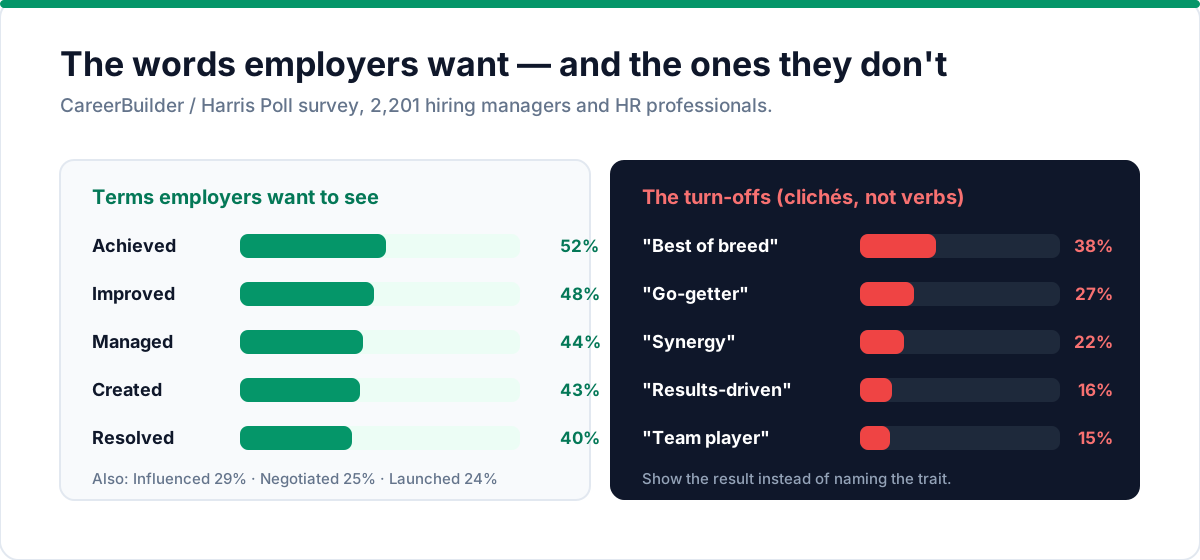
When CareerBuilder and Harris Poll asked 2,201 hiring managers and HR professionals which résumé terms win them over, the winners were verbs: "Achieved" topped the list at 52%, ahead of "Improved" at 48% and "Managed" at 44% — while clichés like "results-driven" and "team player" ranked among the biggest turn-offs (CareerBuilder survey, 2014). Word choice is not decoration; it is the first thing a screener scores.
"Responsible for." "Worked on." "Helped with."
These three phrases are the most common opening words on resumes — and the most wasted. They announce that you did something without showing what you did or how well you did it.
Power words for your resume fix that. The right verb tells the reader instantly whether you built, led, launched, reduced, or persuaded. It changes your resume from a job description into a track record. If you're building your resume from scratch, start with our how to write a resume guide — then come back here to polish every bullet.
This is a reference guide: the rules, the list organized by function, and the verbs to retire. Your bullet structure carries the weight; these verbs give it a spine.
The rules for choosing a verb
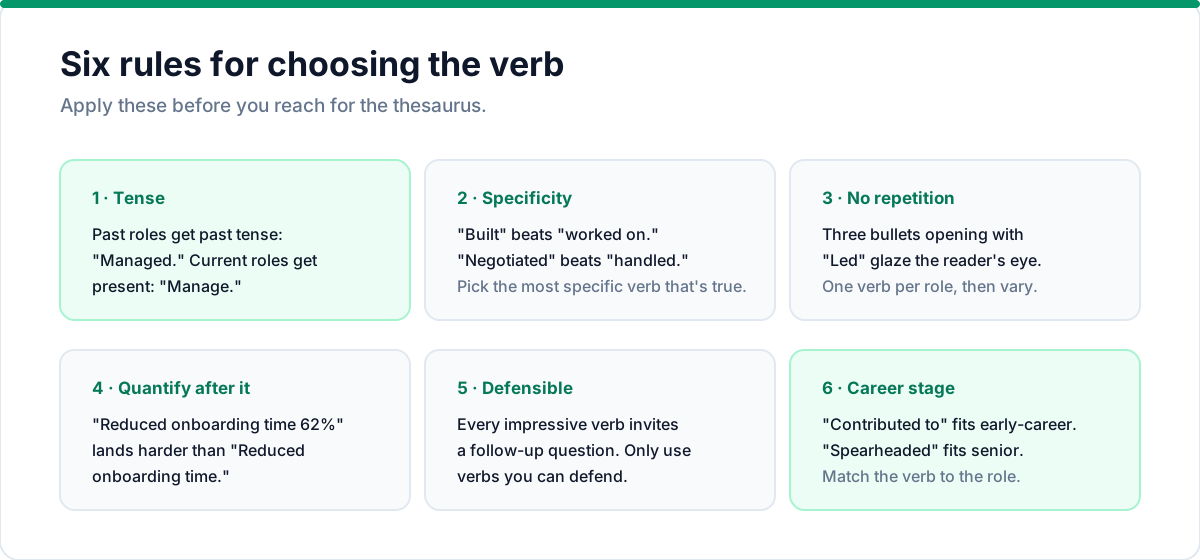
- Use past tense for past roles, present for current. "Managed" vs. "Manage." Consistency signals polish.
- Pick the most specific verb that's true. "Built" beats "worked on." "Negotiated" beats "handled."
- Don't repeat verbs within a role. If three bullets all start with "Led," the reader's eye glazes over.
- Quantify after the verb whenever possible. "Reduced onboarding time 62%" lands harder than "Reduced onboarding time." Our resume keywords guide covers which metrics matter most.
- Only use verbs you can defend. An interviewer will ask about every impressive claim.
- Match the verb to the career stage. "Contributed to" is fine for early-career roles; "Spearheaded" fits senior positions better.
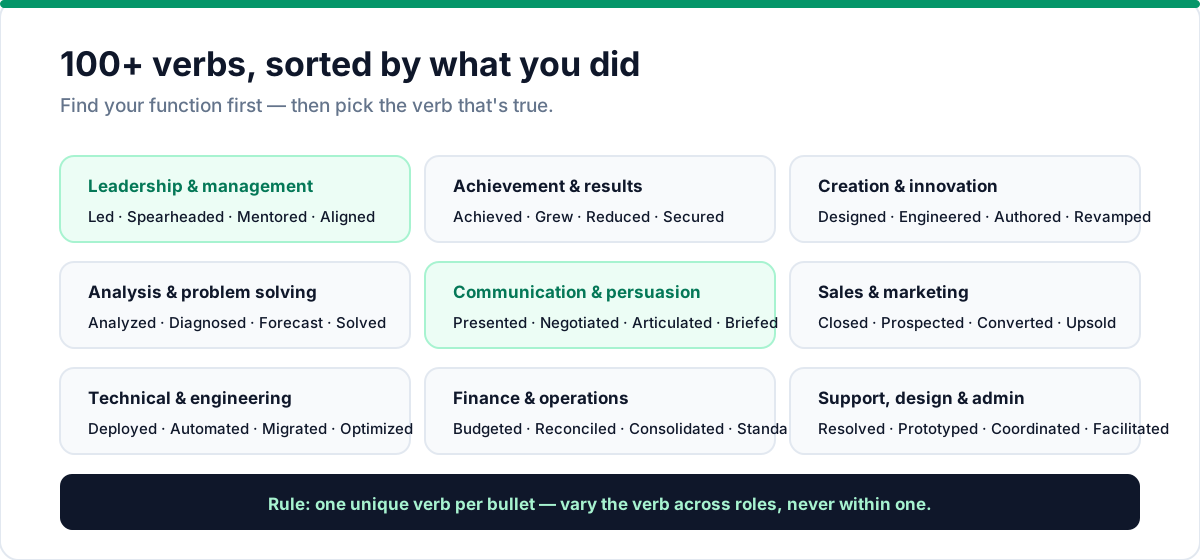
Leadership & management
Use these when you directed people, projects, or programs.
- Led, Directed, Guided, Spearheaded
- Managed, Oversaw, Coordinated, Orchestrated
- Mentored, Coached, Developed, Trained
- Built, Assembled, Recruited, Hired
- Delegated, Empowered, Motivated, Aligned
- Launched, Established, Founded, Championed
- Prioritized, Strategized, Planned, Set vision for
✅ "Led a team of 12 engineers across 3 product lines, shipping 40+ releases on schedule."
Achievement & results
Use these to open bullets that show impact and progress.
- Achieved, Delivered, Produced, Generated
- Exceeded, Outperformed, Beat, Topped
- Grew, Scaled, Expanded, Accelerated
- Increased, Improved, Raised, Boosted
- Reduced, Cut, Lowered, Slashed, Halved
- Saved, Recovered, Retained, Preserved
- Won, Secured, Earned, Received
✅ "Grew annual recurring revenue 34% through enterprise contract expansion."
Creation & innovation
Use these when you made something new: products, systems, content, or processes.
- Created, Designed, Developed, Built
- Engineered, Architected, Constructed, Produced
- Innovated, Pioneered, Invented, Conceptualized
- Authored, Wrote, Drafted, Scripted
- Formulated, Devised, Crafted, Shaped
- Revamped, Redesigned, Rebuilt, Modernized
✅ "Designed a self-serve onboarding flow that lifted activation from 61% to 83%."
Analysis & problem solving
Use these for research, data, and decisions.
- Analyzed, Evaluated, Assessed, Audited
- Researched, Investigated, Surveyed, Gathered
- Diagnosed, Identified, Isolated, Pinpointed
- Forecast, Modeled, Projected, Calculated
- Solved, Resolved, Debugged, Fixed
- Interpreted, Synthesized, Correlated, Drove insights from
✅ "Analyzed churn data across 12,000 customers, identifying the 3 behaviors that predicted downgrade."
Communication & persuasion
Use these when your job involved people, words, and influence.
- Presented, Pitched, Persuaded, Advocated
- Negotiated, Convinced, Influenced, Won over
- Communicated, Articulated, Explained, Clarified
- Collaborated, Partnered, Liaised, Cross-functionally aligned
- Represented, Spokesperson for, Championed
- Reported, Documented, Summarized, Briefed
✅ "Negotiated vendor contracts that cut software spend 18% year over year."
Sales & marketing
Use these for revenue, customers, and growth work.
- Sold, Closed, Quoted, Prospected
- Launched campaigns, Scaled, A/B tested
- Acquired, Converted, Onboarded, Activated
- Targeted, Segmented, Positioned, Messaged
- Increased reach, Generated leads, Grew pipeline
- Retained, Renewed, Upsold, Cross-sold
✅ "Closed $1.4M in new ARR at a 34% win rate across a 90-account territory."
Technical & engineering
Use these for building, operating, and optimizing systems.
- Built, Developed, Programmed, Coded
- Deployed, Released, Shipped, Rolled out
- Automated, Orchestrated, Orchestrated CI/CD
- Migrated, Integrated, Implemented, Configured
- Optimized, Refactored, Streamlined, Overhauled
- Tested, Validated, Benchmarked, Monitored
✅ "Automated the deployment pipeline, cutting release time from 3 hours to 12 minutes."
Finance & operations
Use these for money, efficiency, and process.
- Budgeted, Allocated, Forecasted, Scrutinized
- Streamlined, Optimized, Automated, Standardized
- Managed, Oversaw, Administered, Processed
- Reconciled, Audited, Forecast, Reduced waste
- Increased efficiency, Consolidated, Restructured
✅ "Automated month-end close from 9 days to 4 by consolidating reconciliation."
Customer service & support
Use these for helping customers, resolving issues, and driving satisfaction.
- Resolved, Solved, De-escalated, Troubleshot
- Advised, Guided, Walked through, Supported
- Retained, Recovered, Turned around, Saved
- Improved CSAT, Reduced churn, Drove loyalty
- Educated, Trained, Onboarded, Enabled
- Listened, Diagnosed, Prioritized, Escalated correctly
✅ "Reduced first-response time from 6 hours to 40 minutes while holding a 96% CSAT."
Design & creative
Use these for visual, brand, and product work.
- Designed, Redesigned, Art-directed, Styled
- Prototyped, Wireframed, Illustrated, Mocked up
- Crafted, Shaped, Curated, Concepted
- Branded, Refreshed, Unified, Modernized
- Established guidelines for, Systematized
- Reviewed, Critiqued, Iterated on, Polished
✅ "Redesigned the onboarding flow, lifting completion from 61% to 83%."
Administrative & support
Use these for coordination, logistics, and getting things done reliably.
- Coordinated, Scheduled, Organized, Arranged
- Managed calendars, Prepared, Compiled reports
- Streamlined, Filed, Maintained, Processed
- Supported, Liaised, Facilitated, Triaged
- Documented, Updated, Verified, Reconciled
✅ "Coordinated logistics for 14 regional events, keeping 96% of sessions on schedule."
Pair your verb with a strong context word
A great verb alone is half the job; the right object completes it. Instead of a bare verb, pair it with what you acted on:
- Led → "Led a 12-person team" / "Led the migration" / "Led the Q3 strategy"
- Built → "Built the pipeline" / "Built the reporting process" / "Built the partnership program"
- Reduced → "Reduced cost 18%" / "Reduced cycle time 40%" / "Reduced manual work 6 hours/week"
The pattern: verb + the thing + the result. That single structure — the exact one from our resume bullet guide — turns a list of verbs into a list of achievements.
A before-and-after rewrite
Watch the verbs change a bullet in practice.
Before:
"Responsible for the company's social media and was in charge of content creation."
After:
"Grew organic LinkedIn reach 3.2x in two quarters through a weekly content and engagement program."
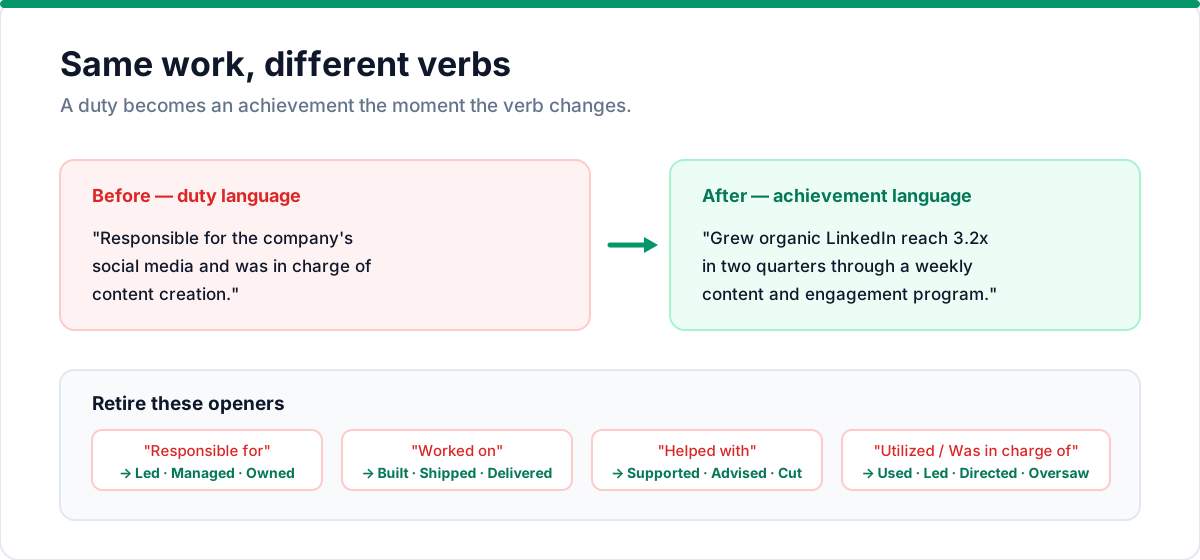
The content is roughly the same; the verbs are not. "Responsible for" and "in charge of" became "Grew," and the bullet gained a metric and a mechanism. That's the entire skill: choose the verb that shows what you changed.
Verbs to avoid (and their replacements)
- ❌ "Responsible for" → ✅ Led, Managed, Owned
- ❌ "Worked on" → ✅ Built, Contributed to, Shipped
- ❌ "Helped with" → ✅ Supported, Advised, Delivered (or cut the bullet)
- ❌ "Handled" → ✅ Managed, Resolved, Processed
- ❌ "Was in charge of" → ✅ Led, Directed, Oversaw
- ❌ "Utilized" → ✅ Used, Applied, Leveraged
- ❌ "Assisted" (when you did more) → ✅ Named what you actually did
If a bullet starts with "Responsible for," it's a duty, not an achievement. Rewrite it with a verb from the lists above and you'll see the difference immediately. These weak phrases are among the 12 resume mistakes that get applications silently rejected.
How to audit your current resume
Grab your resume and check every bullet's first word:
- Circle every opening verb
- Cross out any that are weak (the list above)
- Replace each with a specific verb that matches what you did
- Make sure verbs aren't repeated inside the same role
- Add a metric after your strongest verbs
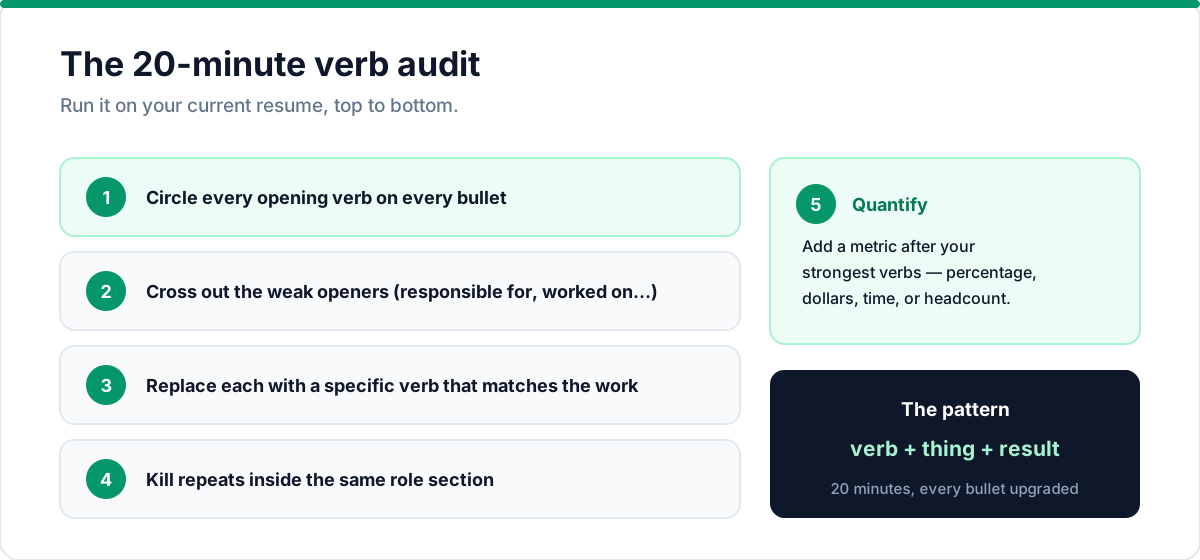
Twenty minutes, and every bullet reads like it was written by someone who knows their worth. If your bullets aren't structured well to begin with, our resume bullet-point guide shows the verb + task + result formula first. Once your bullets are strong, make sure your overall resume format is ATS-friendly before you export.
Frequently asked questions
How many action verbs should a resume have? Aim for one unique, strong verb per bullet — so 10–15 different verbs across a one-page resume. The goal is variety and specificity, not volume. If you're using the same verb twice in one role section, swap one out.
Should I use different verbs for each job on my resume? Yes. Each role should have its own set of verbs that match what you actually did there. Using "Led" in every job section makes your resume feel repetitive. Vary your verbs across roles to show growth and range.
Are power words the same as action verbs? Yes — "power words for resume" and "action verbs for resume" refer to the same thing: strong, specific verbs that show what you did and the impact you made. The term "power words" emphasizes the persuasive quality; "action verbs" emphasizes the grammatical function.
Do ATS systems care about action verbs? ATS systems primarily scan for keywords from the job description, not specific verbs. However, action verbs help your resume read better once a human sees it — and many ATS-friendly formats preserve your verb choices. For a full breakdown of how ATS works, read our what is an ATS guide.
Can I use the same strong verb twice if it really fits? Once per role section is fine. If the same verb fits two different bullets in the same job, choose a synonym from the list to keep the resume varied. Repetition signals lazy writing, even when the verb is strong.
What if I don't have impressive-sounding verbs to use? Start with what you actually did. "Organized" is better than "responsible for." "Updated" is better than "worked on." You don't need impressive-sounding power words — you need accurate, specific ones. The metric after the verb does the heavy lifting. If you're unsure how long your resume should be, check our guide to resume length.
The bottom line
Action verbs are the cheapest upgrade in resume writing. No new experience required, no facts to invent — just the discipline to open every bullet with a verb that shows what you did and how well. Specific verbs, past tense, no repetition, quantified results.
Once your bullets are polished, make sure the rest of your resume is ATS-friendly and tailored to the job. Then prepare your interview stories using the same achievements — everything connects.
Want help finding the right verb for every line? The CV Builder's experience editor shows tips and examples as you write, and achievements from your Career Vault turn into ready-to-use bullets. Build your resume free and polish every line — start free.
Put this into practice with Talent & Story
Build an ATS-friendly resume, get an instant compatibility score, and manage your entire job search in one workspace.
Written by
Talent & Story Team · Career Workspace
We build Talent & Story — the career workspace for building ATS-friendly resumes, writing cover letters, tracking applications, and preparing for interviews. Every guide is written to be practical enough to use the same day.