How Long Should a Resume Be? One Page vs. Two Pages
One page or two? Cut the guesswork. Here is when a one-page resume wins, when two pages earn their keep, and how you should decide for your situation.
"Your resume must be one page." It's the most repeated resume rule in history — and the most misapplied.
The truth is more nuanced and more useful: length is a symptom, not a strategy. Recruiters spend an average of 7.4 seconds on their initial scan, according to the Ladders' 2018 eye-tracking study — they're judging content, not counting pages. One page is right for many people. Two pages are right for many others. What's almost never right is padding a one-pager to a two-pager, or cutting a two-pager's best evidence to force it onto one page. Both are common resume mistakes.
Here's how to decide for your situation.
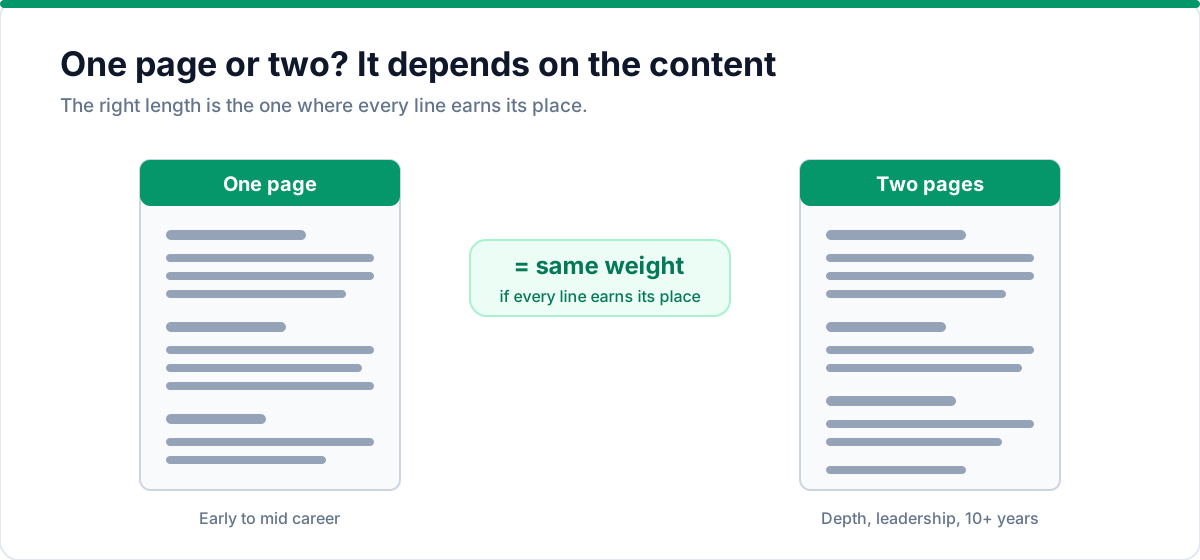
What recruiters actually care about
Recruiters don't count pages — they scan for relevance. A hiring manager deciding between you and 150 other applicants is looking for reasons to say yes in the first third of the document. Whether that document continues onto a second page matters far less than whether the first page is excellent.
The eye-tracking data backs this up: what recruiters skim is layout, job titles, text flow, and keywords. Page count never enters the scan — it's a proxy for something else, namely whether you gave the reader enough relevant material or too little.
The real rules are:
- Every line must earn its place. Length questions dissolve when every section serves the target role. Cut anything that doesn't. Our tailoring guide shows you how in ten minutes.
- The first page must carry the story. For most roles, the recruiter's decision happens on page one. Experience, summary, and top skills belong there.
- Never make the reader work. A two-page resume where the second page holds only "References" or one straggler bullet is worse than a one-pager.
When one page is right
Choose one page when:
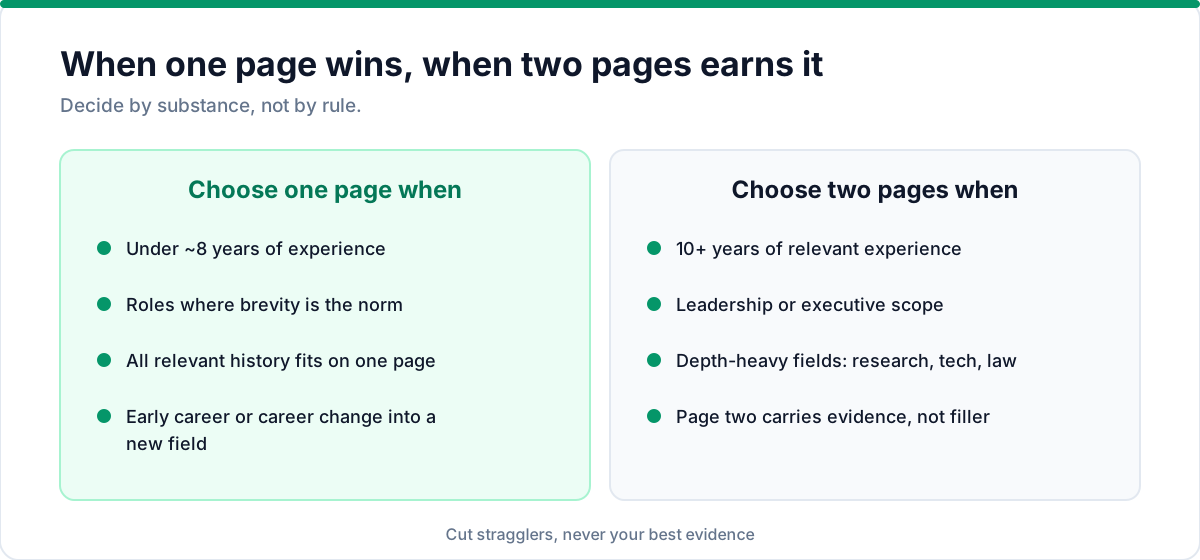
- You have under ~8 years of experience. More than a page would mean padding.
- You're applying to roles where brevity is the norm — most early-career and mid-level positions, startups, and design/creative fields.
- Your most relevant history fits comfortably on one page. If the essentials fit, forcing a second page adds nothing.
A one-page resume isn't a restriction; it's an editorial discipline. It forces you to lead with relevance, which is exactly what gets you read by a recruiter and parsed by an ATS. For early-career candidates, a tight single page beats a padded second page every time — and the outcome data agrees. Jobscan's 2026 analysis of interview results found that entry-level candidates with the shortest resumes landed interviews at 17.9%, against 2.8% for those with the longest — even though what recruiters say they prefer runs the other way. Our how to write a resume guide covers the full process.
When two pages is right
Choose two pages when:
- You have 10+ years of experience and the extra space carries genuinely relevant history, not filler.
- You're in a leadership or executive role, where strategy, scope, and large outcomes need room to breathe.
- Your field rewards depth — technical work with published projects, certifications, and patents; research; consulting; roles where the second page's substance matters.
Two pages is not "more points" — it's deeper points. If you're returning from a career gap, keep the summary forward-looking. If your second page is full of jobs from a decade ago and old awards, it's a burden, not a benefit.
The formula that decides it
Run your situation through this:
- Does everything relevant fit on one page? → One page, done.
- Does the best evidence overflow a single page naturally? → Two pages, and make page one the strongest.
- Is page two only holding stragglers? → Cut page two, not your history — cut the stragglers.
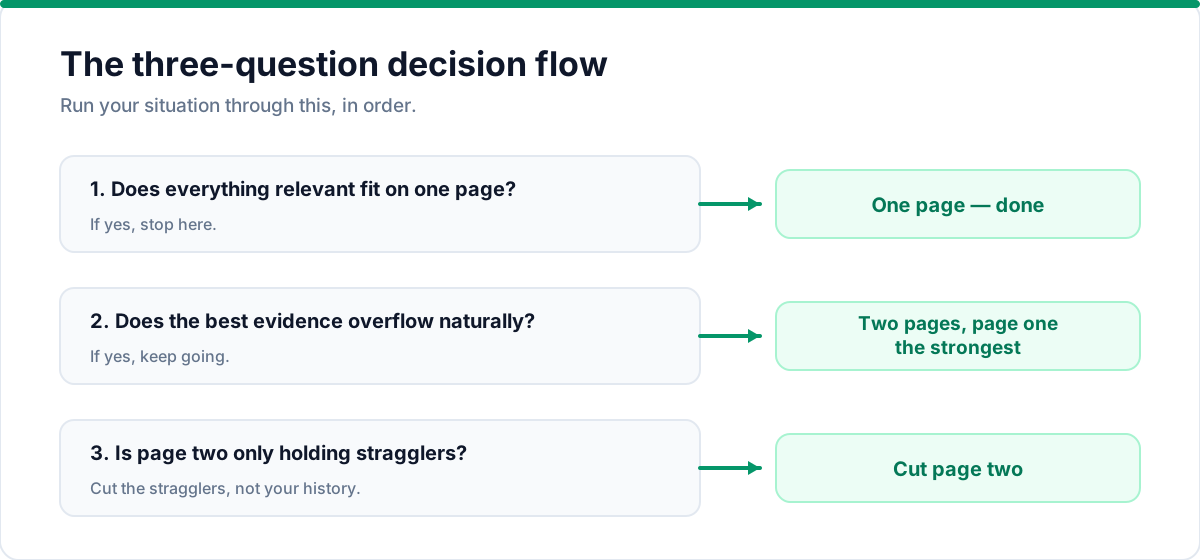
The trap people fall into is deciding by a rule instead of by content. Decide by the substance: if the second page would make you more impressive, use it; if it would make you look padded, don't.
Practical tips for either length
For a one-pager:
- Cut the education section to one line once you have 5+ years of experience
- Merge or remove "Additional Skills" that any applicant has (Microsoft Office)
- Kill "References available upon request" — everyone knows
- Use tight but readable spacing: 11pt font, reasonable margins, no walls of text
For a two-pager:
- Fill page one with your summary, core skills, and your most recent and most relevant roles
- Use page two for older roles, education, certifications, and projects
- End page two cleanly — never let it trail off with a half-line
- Make sure page two looks intentional, with your name and page number in the header
Whichever length you choose, your resume bullets do the real work — length just frames them.
One full page or two — never 1.5
There's a third option people reach for, and it's the worst one: the half-finished second page. In ResumeGo's 2024 survey of 418 hiring professionals, 84% said job seekers should adjust their resume to avoid an irregular page length — shaving the font, tightening spacing, whatever it takes to end cleanly. A resume that stops a third of the way down page two reads as unfinished.
So the practical rule is not "one or two." It's one full page or two full pages. If your content ends mid-page-two, either find evidence that earns the space — a quantified win, a relevant certification, a project — or cut back until it ends at the bottom of page one.
How the ATS treats length
Worth knowing: applicant tracking systems don't care about page count at all. They parse text and store it; a one-pager and a two-pager with the same content are identical to the machine. What the ATS cares about is the same thing a human does — clean formatting and parseable structure.
So don't choose your length to please the software. Choose it to serve the reader, and the software will be fine either way.
A page-by-page breakdown (for the two-pager)
If you've earned two pages, use the real estate deliberately.
Page one — the money page. Your name block, summary, core skills, and your two most recent roles. This is the page a recruiter reads while deciding whether to read anything else. Every argument for why you're the hire should be visible here. It should work even if page two is never printed.
Page two — the evidence page. Earlier roles that add depth, education, certifications, publications, projects, and professional details. This page supports the case page one made. It should never contain your single most impressive achievement — if it does, you've mis-prioritized.
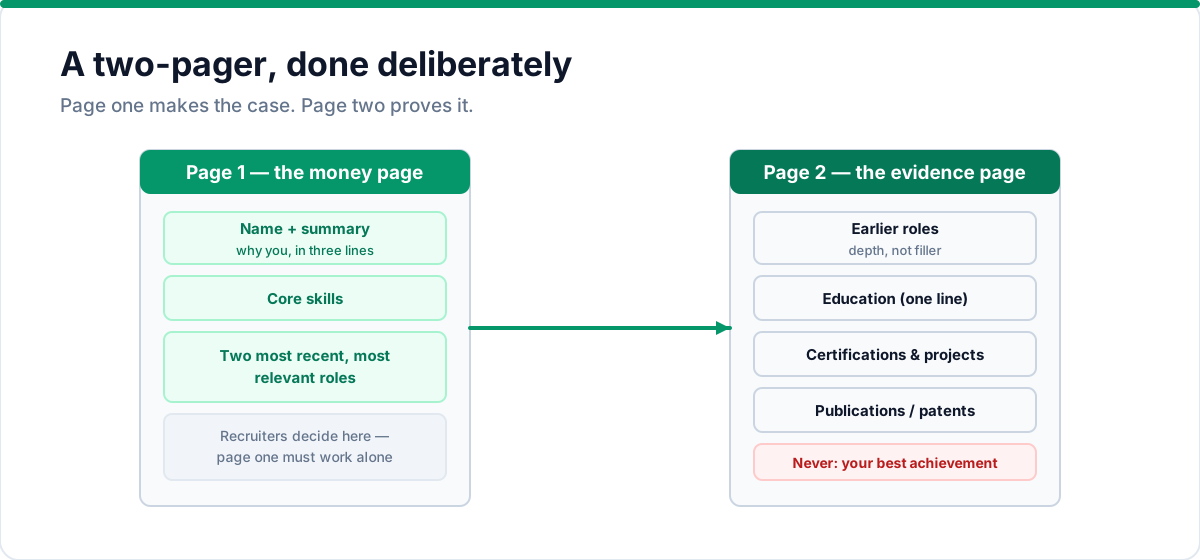
Test your two-pager the way a recruiter reads it: read page one alone. Would you hire the person? If the strongest material lives on page two, reorder.
How long is "too long," then?
Three or more pages is almost always a mistake for a standard job application — no matter how distinguished the career. Long resumes read as unfiltered, and recruiters assume you can't self-edit (a red flag for a working relationship). The exceptions are vanishingly rare: academic CVs, certain government positions, and executive curriculum vitae formats.
The working ceiling for an industry application is two pages. If you're pushing past it, the problem isn't your career — it's editing. Same discipline applies to cover letters, where the range is far tighter.
Length mistakes to avoid
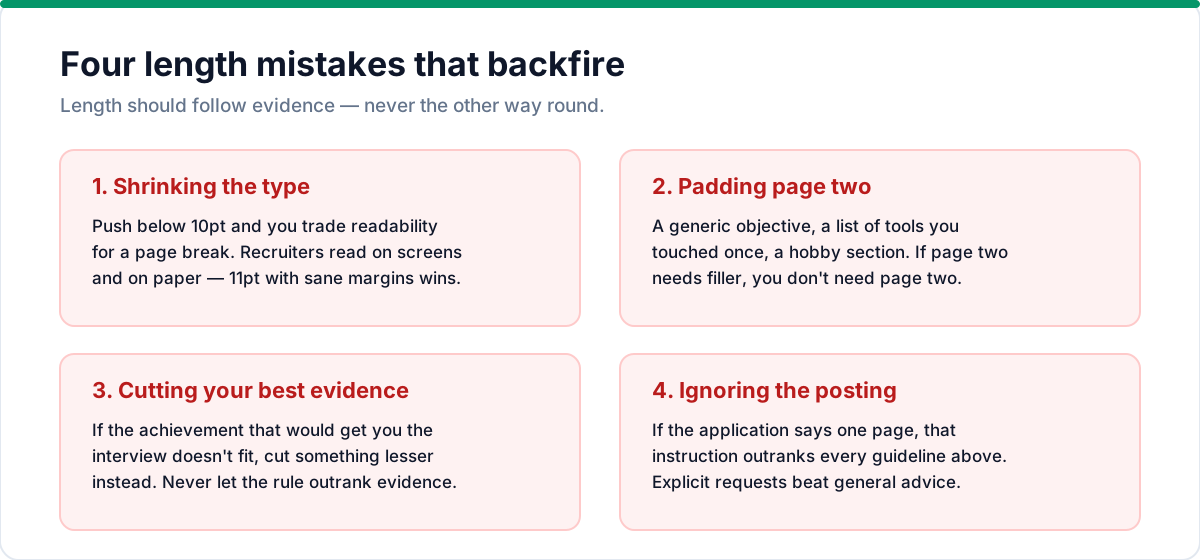
- Shrinking the type to force one page. Push below 10pt and you've traded readability for a page break. Recruiters read on screens and on paper; 11pt with sane margins holds up.
- Padding page two. A generic objective, a skills list of tools you touched once, or a hobby section. If page two needs filler, you don't need page two.
- Cutting your best evidence to hit one page. If the achievement that would get you the interview doesn't fit, cut something lesser instead. Never let the rule outrank the evidence.
- Ignoring what the posting says. If the application asks for one page, that instruction outranks every guideline in this article.
Frequently asked questions
How do I fit 10 years of experience on one page? You don't — if you have genuinely relevant, quantified experience across 10+ years, two pages is appropriate. Focus on the most recent and most relevant roles; cut or consolidate older positions into a single line.
Should my cover letter match my resume length? Not necessarily — cover letters are almost always one page maximum, a far tighter range than a resume's.
Do ATS systems penalize two-page resumes? No. Applicant tracking systems parse text and don't care about page count. What breaks parsing is formatting — tables, graphics, text boxes — not length.
I'm a career changer with 12 years in one field. One or two? Two, but used strategically: page one builds your new direction (summary, transferable skills, relevant wins), page two holds the older context. Let the summary section do the narrative heavy lifting.
What if the job posting says "one page"? Follow it — explicit instructions outrank general advice. Fit the best content onto one page and cut the rest ruthlessly.
Should a student resume ever be two pages? Rarely. Students typically lack the depth that justifies a second page; a tight one-pager that's keyword-rich and accomplishment-led is the stronger play.
Does industry change the rule? Yes. Tech and creative fields skew short. Law, finance, research, and academia tolerate (or expect) more. When unsure, ask someone who works in the field you're targeting.
The bottom line
The one-page rule is a default, not a law. Under 8 years, default to one tight page. With real depth to show, two pages is professional — provided every line on page two earns its keep. Decide by substance, lead with relevance, and make page one so strong that the reader wants a page two.
Talent & Story's preview shows you exactly where your resume breaks across pages as you write, so you control the length deliberately — no surprises at export. Build your resume free from an ATS-safe template and see the exact page count before you send it — start free.
Put this into practice with Talent & Story
Build an ATS-friendly resume, get an instant compatibility score, and manage your entire job search in one workspace.
Written by
Talent & Story Team · Career Workspace
We build Talent & Story — the career workspace for building ATS-friendly resumes, writing cover letters, tracking applications, and preparing for interviews. Every guide is written to be practical enough to use the same day.