How Long Should a Cover Letter Be? (+ a Template That Works)
The ideal cover letter is under 400 words — half a page to one page. Here's exactly why short wins, what to cut, and a ready-to-fill template that works.
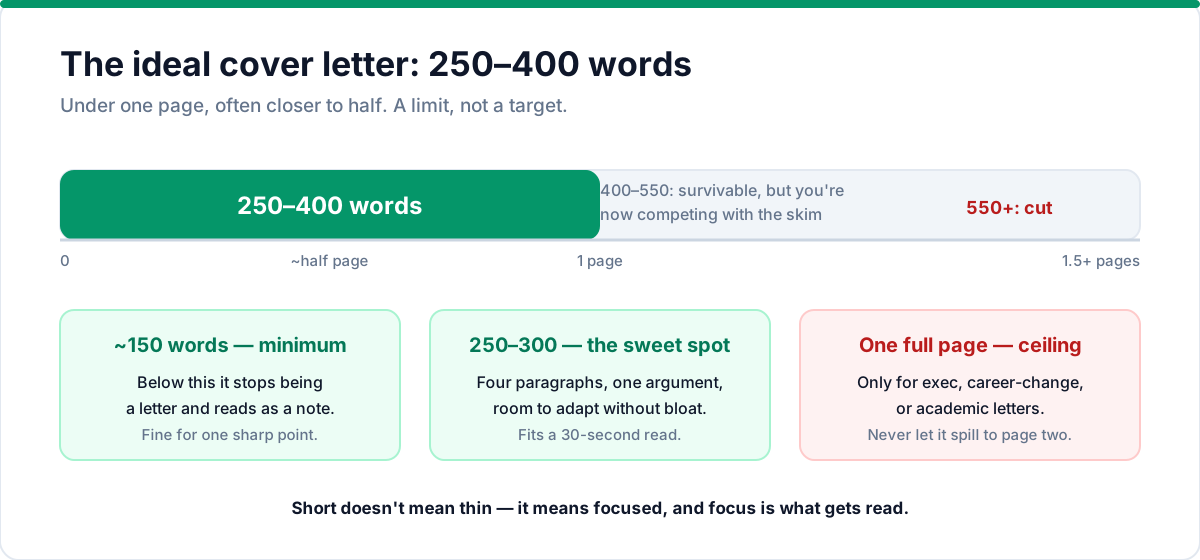
Ask five people how long a cover letter should be and you'll get five answers, from "one page" to "three sentences." The truth is more useful than any of them: the ideal cover letter is 250–400 words — under one page, often closer to half.
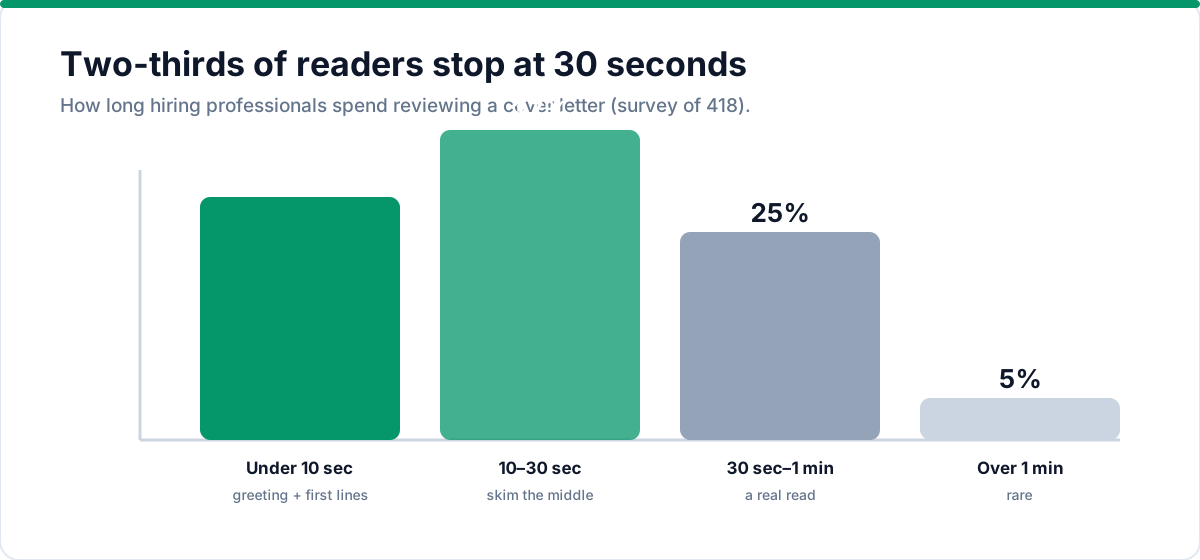
Recruiters skim. In ResumeGo's survey of 236 hiring professionals, 87% said they read cover letters — but in ResumeGo's time-spend survey of 418 more, two-thirds spend 30 seconds or less on each one. A cover letter is read in seconds when it's good and abandoned in seconds when it isn't. Length doesn't signal effort; it signals judgment. Here's how to hit the right length, what to cut, and a template that does the work for you.
Why short wins
The most common cover letter mistake isn't bad writing — it's over-writing. Long letters assume the reader has time and patience. They don't, and here's what that costs you:
- Attention: every sentence past the first two paragraphs competes with the reader's instinct to move on.
- Signal: a tight letter says you can prioritize, structure, and write — the same discipline that makes strong resume bullets. A sprawling one quietly suggests the opposite.
- Coverage: more words usually means repeating the resume, which adds zero information and dilutes the one or two points that actually matter.
The goal isn't to summarize your career — it's to make one argument: I'm the right fit for this specific role. That argument takes three or four paragraphs, not a page and a half.
What a 30-second read actually sees
When a hiring professional gives your letter 30 seconds, they are reading the greeting, the first two lines, and — if those work — skimming the middle before deciding. They are not evaluating your paragraph structure. They are checking two things: are you a plausible fit, and do you clearly want this job.
That makes paragraph order matter more than prose quality:
- Lines 1–2: the role and your one differentiator. If the opening is a greeting ceremony, the reader forms their impression before you've made your argument.
- Middle: the single achievement that matches their top requirement. One, not three. The one that maps directly to the posting.
- Last two lines: the ask. No essay, no apology, no "I hope this email finds you well."
A 300-word letter gives each of these three jobs its proper share. A 700-word letter buries the second job under a page of setup.
The word budget, paragraph by paragraph
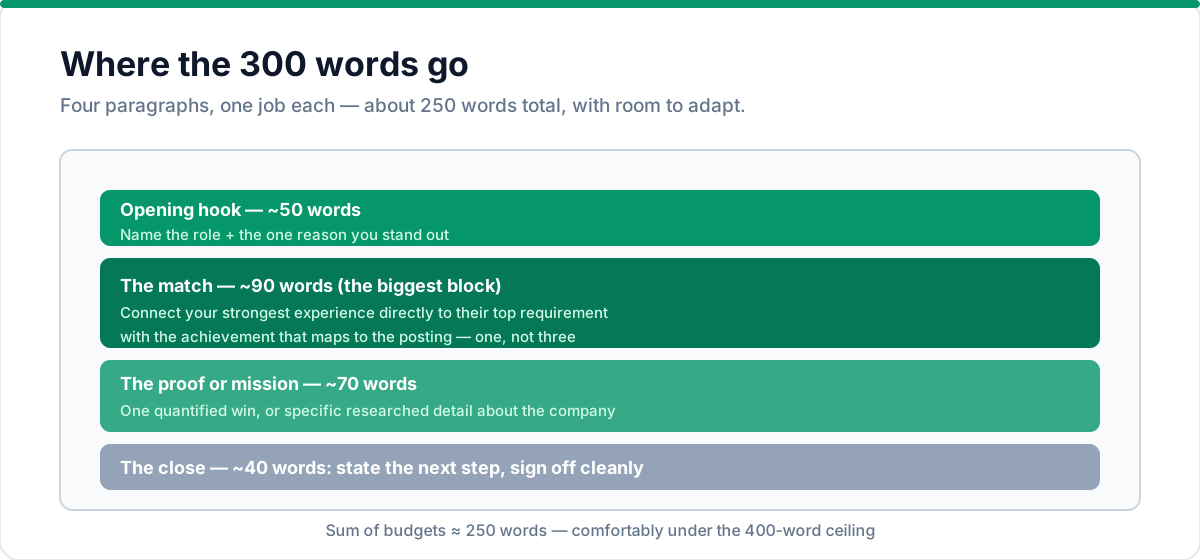
Here's how 300 words should be spent:
| Section | Budget | Purpose |
|---|---|---|
| Opening hook | ~50 words | Name the role + the one reason you stand out |
| The match | ~90 words | Connect your strongest experience to their requirements |
| The proof or mission | ~70 words | One quantified win, or specific company research |
| The close | ~40 words | State the next step, sign off cleanly |
That's roughly 250 words — comfortably under the ceiling, with room to adapt. For a deeper look at how each paragraph should read, our how to write a cover letter guide covers the structure in full. Pair it with a strong resume for a complete application.
What to cut when you're over budget
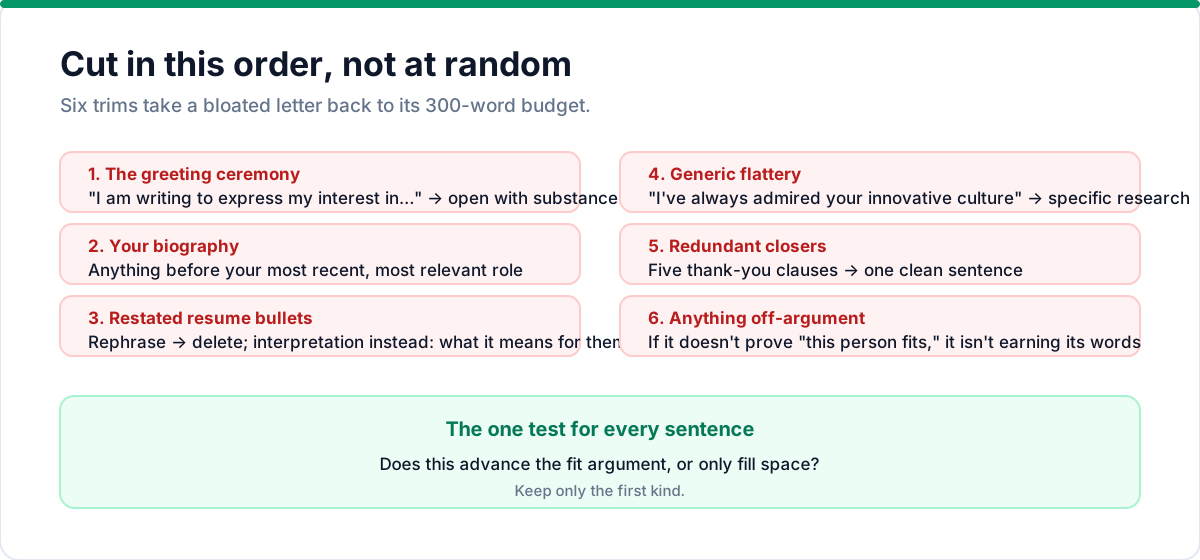
Trim ruthlessly, in this order:
- The greeting ceremony. "I am writing to express my interest in the position of X which I saw advertised on Y." Cut it. Open with substance.
- Your biography. Anything before your most recent, most relevant role probably goes.
- Restated resume bullets. If a sentence only rephrases your resume, delete it. Add interpretation instead: what it means for them.
- Generic flattery. "I've always admired your innovative culture." Specific research beats vague praise.
- Redundant closers. "I appreciate your consideration and look forward to hearing from you at your earliest convenience." One clean sentence replaces all of it.
- Anything that doesn't move the argument. If a sentence doesn't help prove "this person fits," it's not earning its words.
A template that works
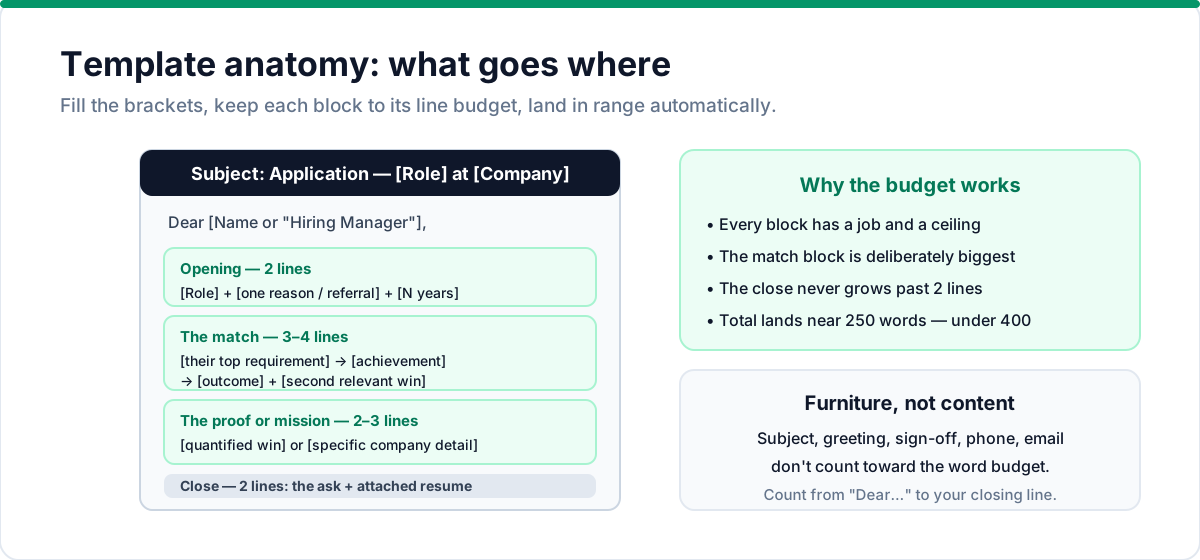
Fill in the brackets. Keep every paragraph to the stated length, and you'll land in the right range automatically.
Subject: Application — [Role Title] at [Company]
Dear [Name or "Hiring Manager"],
Opening (2 lines). I'm applying for the [Role] position at [Company] — [one reason you're excited, or a referral if you have one]. I've spent [N] years doing [relevant thing], and this role is the match I've been looking for.
The match (3–4 lines). Your posting emphasizes [their top requirement]. At [Previous Company], I [specific achievement that directly matches the requirement], which [outcome]. I've also [second relevant achievement], and [how it relates to them].
The proof or mission (2–3 lines). [One option:] One result I'm proud of: [quantified win]. [Or:] What draws me to [Company] specifically is [specific, researched detail about the company or product], and [how your experience connects].
The close (2 lines). I'd welcome the chance to walk you through how I'd approach [their challenge]. My resume is attached — thank you for your time.
Best regards, [Your Name] [Phone] · [Email]
A finished letter you can steal from
The template shows what goes where. Here's what it looks like filled in — a complete marketing manager letter landing near 280 words:
Subject: Application — Marketing Manager at Northwind
Dear Ms. Alvarez,
Opening (~45 words). I'm applying for the Marketing Manager role at Northwind. I've spent seven years leading paid acquisition across B2B SaaS and agencies, and your emphasis on predictable pipeline growth is exactly the work I do best.
The match (~90 words). Your posting emphasizes pipeline predictability over raw lead volume. At Harbor Analytics, I rebuilt the paid program around stage-level attribution and cut cost per qualified opportunity 38% in two quarters while spend stayed flat. Before that, I ran demand generation for a 40-person agency, where I learned to defend every channel decision with pipeline data rather than clicks. I'd bring the same standard to Northwind's mix.
The proof (~65 words). One result worth the space: the nurture redesign I led recovered 22% of stalled opportunities into sales-accepted meetings in 90 days. It came from listening to lost-deal feedback, not a new tool — which is why I think it would transfer to your team's current stage.
The close (~40 words). I'd welcome the chance to walk you through how I'd approach your Q1 pipeline targets. My resume is attached — thank you for your time.
Best regards, Jordan Lee (555) 014-2278 · jordan.lee@mail.com
Count the sections, not the furniture: the body sits comfortably under 300 words, and every paragraph does exactly one job. Swap in your own numbers and the letter is yours.
When one page is actually fine
The 250–400 word guideline fits most situations, but a few deserve a little more room:
- Senior and executive roles, where boards expect more context on strategy and leadership — still keep it under one page.
- Career transitions, where you need extra space to translate your old field into the new one.
- Research or academic positions, where letters are longer by convention.
In every case, the rule is the same: say everything you need in as few words as the reader requires. If you can do it in 250, do it in 250 — nobody subtracts points for brevity. After you send it, follow up within a week.
The length-to-format link
Short letters also need clean formatting: 1-inch margins, 11pt body text, short paragraphs separated by white space, and your name as a header. This isn't just aesthetics — it's the same readability discipline that keeps your resume ATS-friendly. Use the same keywords in your cover letter that appear in your resume. A recruiter should be able to parse your letter's argument in the same seconds it takes to scan your resume.
How to cut a long letter down (before you hit send)
If your draft is running long, don't just delete sentences — restructure. Here's a worked edit.
Before (bloated, ~150 words of this paragraph alone):
"I would like to express my sincere interest in the position of Marketing Manager which I saw posted on LinkedIn. I have always been passionate about marketing and believe that my skills and experience would be a great fit for your team. As a marketing professional with over seven years of experience, I have managed many campaigns and worked with many different clients across a variety of industries, and I feel that this breadth of experience would serve me well in the role you are looking to fill..."
After (the same substance, ~35 words):
"I'm applying for the Marketing Manager role. I've spent seven years leading paid acquisition across B2B SaaS and agencies, and your emphasis on predictable pipeline growth is exactly the work I do best."
The cut version lost zero information and gained all of the reader's attention. The habit to build: for every sentence, ask does this advance the argument or only fill space? — and keep only the former.
Frequently asked questions about length
Should I customize my cover letter for every application? Yes — at least the opening paragraph and the company-specific research. Our tailoring guide applies to cover letters too. The body can stay similar across applications.
Can I use the same cover letter for every job? No — a generic cover letter is worse than no cover letter. At minimum, change the role title and one sentence connecting your experience to their specific needs. It takes two minutes.
Does length depend on the role or industry? A little. Finance, law, and academia tolerate longer, more formal letters. Startups and creative fields reward brevity. When in doubt, shorter.
Is a half-page cover letter too short? No — half a page is fine when it does the three jobs: the role and your differentiator, one matched achievement, and the ask. Around 150–200 words works when every line carries weight. Much below that and you cross into the note territory described in the last question here.
What if a job portal requires a cover letter field? Same letter, same length. Paste your ~300-word letter into the field and move on. Don't feel compelled to stretch it to justify the text box.
Email or PDF? Both should carry the same ~300-word letter. In an email, put it in the body (short is more welcome in email); as an attachment, use a clean PDF matching your resume's header. A referral in the opening line dramatically increases your chances.
Does the word count include my header and signature? No — those are furniture, not content. Count the body text from "Dear [Name]" to your closing line.
What's the absolute minimum that's still professional? About 150 words. Below that it stops being a letter and starts looking like a note. If you genuinely have only one point, make that one point well.
The bottom line
Cover letters don't have a length requirement — they have a length limit. Stay under 400 words, spend your budget on the opening, the match, and the proof, and cut everything that doesn't serve the argument. Short doesn't mean thin; it means focused, and focus is what gets read.
Write yours with the template above, and export a clean PDF alongside your tailored resume. Once you land the interview, our common interview questions guide has you covered. Talent & Story's cover letter builder does exactly that — start free, write from your real experience, and send your complete application kit in minutes.
Put this into practice with Talent & Story
Build an ATS-friendly resume, get an instant compatibility score, and manage your entire job search in one workspace.
Written by
Talent & Story Team · Career Workspace
We build Talent & Story — the career workspace for building ATS-friendly resumes, writing cover letters, tracking applications, and preparing for interviews. Every guide is written to be practical enough to use the same day.