How to Write a Cover Letter That Actually Gets Read
Most cover letters get skimmed in seconds - or never read. Here's the playbook: structure, length, the opening line, full examples, and mistakes to avoid.
A ResumeLab survey of 200 recruiters, hiring managers, and HR specialists found 83% say cover letters are important in making hiring decisions — yet when a posting marks the letter optional, only 35% of candidates send one (survey coverage). That gap is your advantage.
Honest truth about cover letters: they're optional at more companies than ever, and a bad one hurts more than none at all. But when they're read — and when they're good — they're the best tool you have to sound like a human before the interview. Your resume is the evidence; your cover letter is the argument.
The two-minute reality
Recruiters don't read cover letters front to back like essays — they skim. A realistic letter gets somewhere between 15 seconds and two minutes, and in many cases it's read only after your resume passes the first screen.
That changes how you write. Every paragraph competes for attention. The structure must be skimmable: short paragraphs, a strong opening, and the single most important point up front. If your letter is a wall of four-paragraph prose, it's already lost. Your resume format gets you past the ATS; your cover letter gets you past the human.
The structure that works
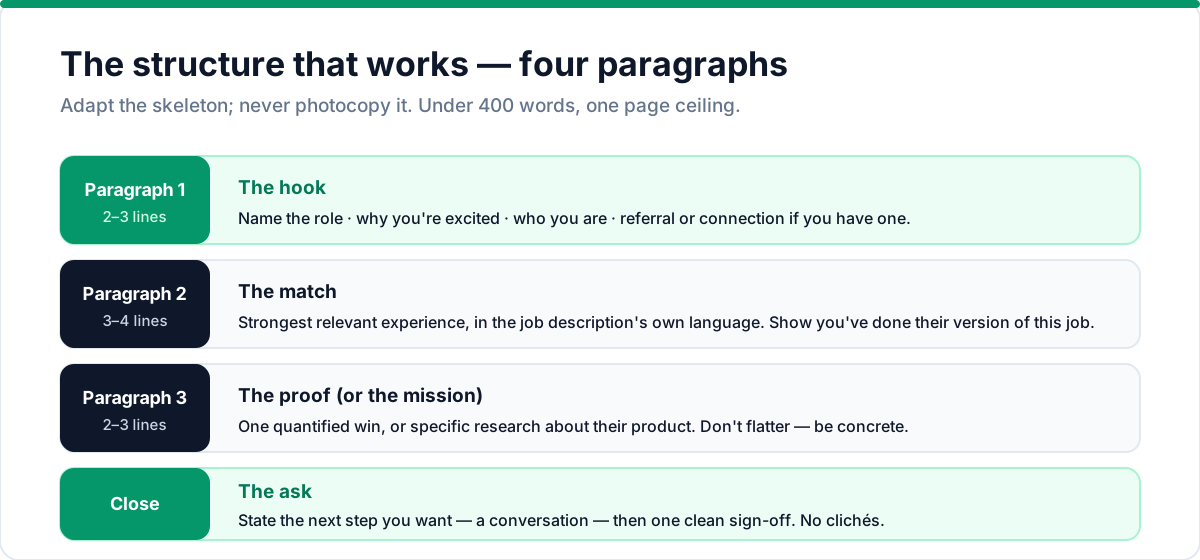
A modern cover letter follows a consistent skeleton. Adapt it, don't photocopy it.
Paragraph 1 — The hook (2–3 lines). Name the role, one line about why you're excited, and one line about who you are. If you have a connection — a referral, a mutual contact, an award the company won — this is where it goes. A referral mentioned in the first paragraph dramatically improves response rates.
Paragraph 2 — The match (3–4 lines). Connect your strongest, most relevant experience to what the job actually asks for. Mirror the job description's language — this is tailoring applied to a letter. Show that you've done their version of this job before.
Paragraph 3 — The proof or the mission (2–3 lines). Either double down on one quantified win, or briefly connect to the company's mission/products in a way that shows you did real research. Don't flatter; be specific. If you've logged accomplishments in your career vault, you have ready-made proof points to pull from.
Paragraph 4 — The close (2 lines). State what you want next (a conversation), reiterate the offer, and sign off professionally. No "I look forward to hearing from you" clichés if you can help it — one clean sentence.
Full cover letter example
Here's a complete cover letter you can use as a model. Notice the structure: hook, match, proof, close — all under 300 words.
Subject: Application — Senior Product Designer
Dear [Hiring Manager's Name],
I'm applying for the Senior Product Designer role — [Name] on your growth team suggested I reach out. I've spent the last 8 years building design systems for B2B SaaS, and I've followed [Company]'s work on [specific product] closely.
Your job description emphasizes design systems and fast onboarding. At [Previous Company], I built the design system used by 40+ product teams and led the onboarding redesign that lifted activation 28% — the exact kind of challenge this role describes. I'm drawn to [Company] because you're solving [specific problem], and that's where I do my best work.
Beyond the resume: I recently gave a talk on design system governance at [Conference], and I write about scalable design processes on my blog. I'd love the chance to walk you through how I'd approach [specific problem at the company].
Thank you for your time — my resume is attached, and I'm happy to connect whenever it's convenient.
Best, [Your Name]
That example runs 260 words — enough to make your case, short enough to get read.
The opening line decides everything
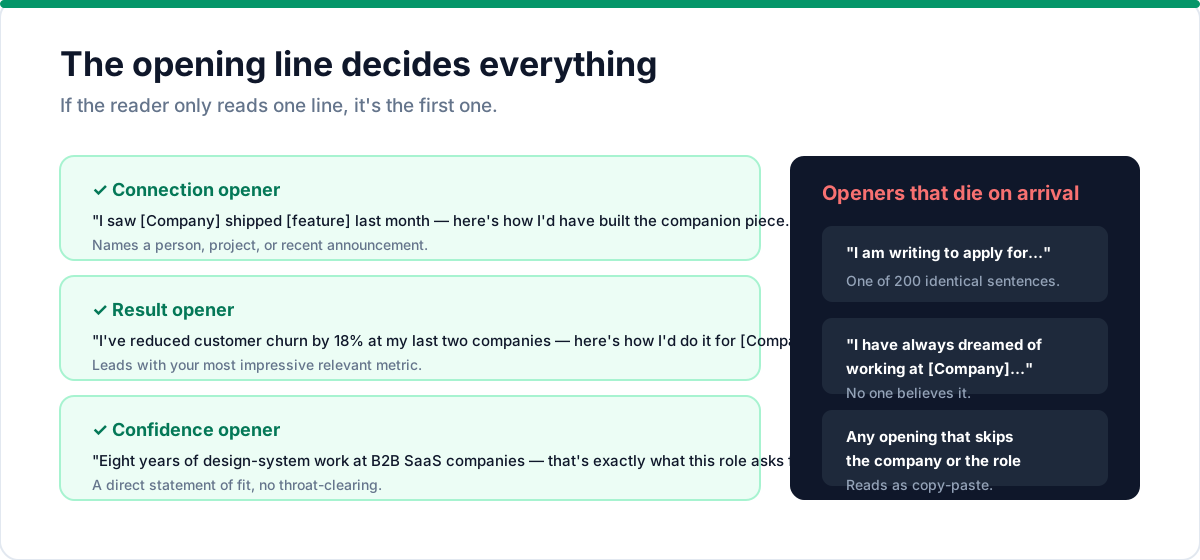
If the reader only reads one line, it's the first. Three opening styles that work:
- The connection opener: name a person, a project, or a recent company announcement. "I saw [Company] shipped [feature] last month — here's how I'd have built the companion piece."
- The result opener: lead with your most impressive, relevant metric. "I've reduced customer churn by 18% at my last two companies — here's how I'd do it for [Company]."
- The confidence opener: a direct statement of fit. "Eight years of design-system work at B2B SaaS companies — that's exactly what this role is asking for."
Openers that die on arrival: "I am writing to apply for…" (you're one of 200 people writing the same sentence), "I have always dreamed of working at [Company]" (no one believes it), and any opening that doesn't mention the company or the role.
Industry-specific cover letter tips
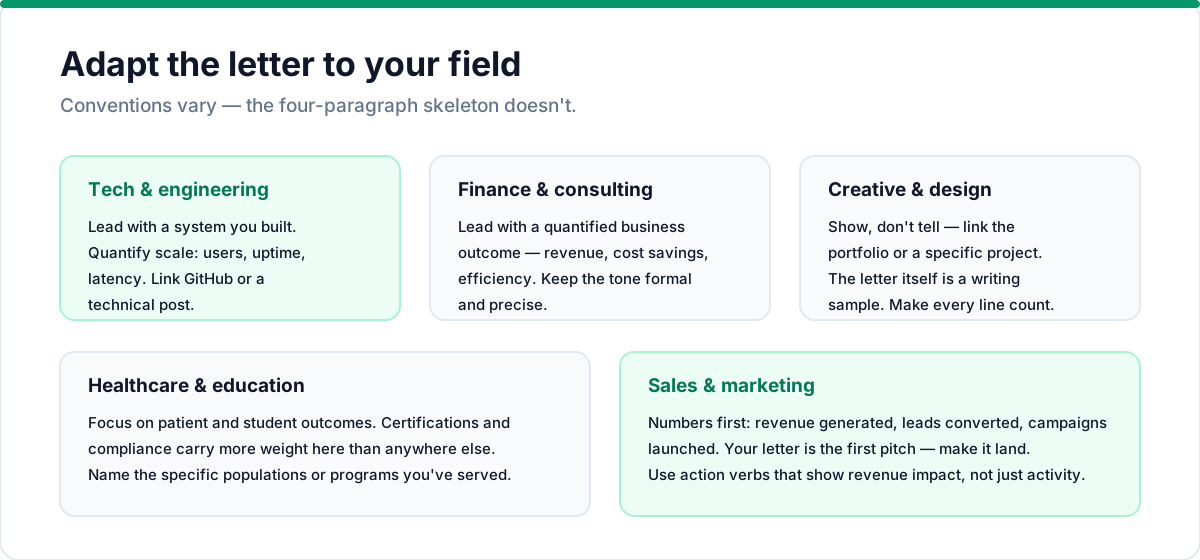
Cover letter conventions vary by field. Here's how to adapt:
Tech and engineering: Lead with a technical achievement or a specific system you built. Quantify scale (users, uptime, performance improvements). Mention your GitHub, open-source contributions, or technical blog. Make sure your resume keywords match the job description's technical terms.
Finance and consulting: Emphasize analytical rigor and client impact. Lead with a quantified business outcome (revenue, cost savings, efficiency gains). Keep the tone formal and precise.
Creative and design: Show, don't just tell. Link to your portfolio or a specific project. The letter itself is a writing sample — make every sentence count.
Healthcare and education: Focus on patient/student outcomes. Certifications and compliance matter more here than in other fields. Reference specific populations or programs you've worked with.
Sales and marketing: Numbers first. Revenue generated, leads converted, campaigns launched. Your cover letter is your first pitch — make it compelling. Use action verbs that show revenue impact, not just activity.
Length: keep it short
The answer to "how long should a cover letter be?" is simple: under 400 words, ideally 250–350. One page is the ceiling; half a page is often ideal. Every additional sentence dilutes the ones that matter.
We've written a full guide on cover letter length with a ready-to-use template — check it before you draft.
Before-and-after cover letter examples
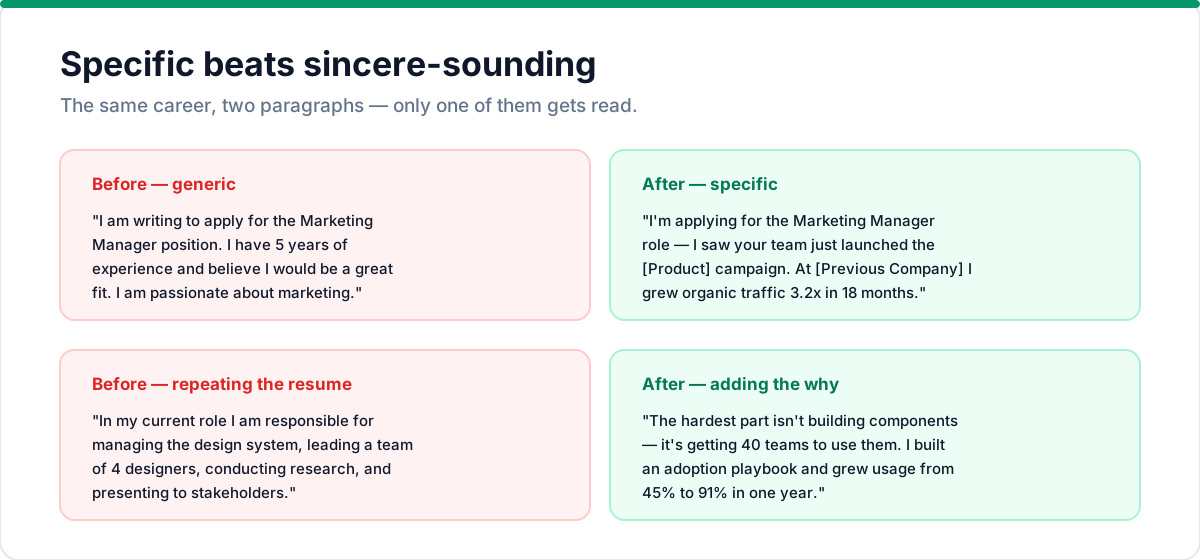
Before (generic):
"I am writing to apply for the Marketing Manager position at your company. I have 5 years of experience in marketing and believe I would be a great fit for your team. I am passionate about marketing and am looking for an opportunity to grow."
After (specific):
"I'm applying for the Marketing Manager role — I saw your team just launched the [Product] campaign, and I'd love to help scale it. At [Previous Company], I led the content strategy that grew organic traffic 3.2x in 18 months, and I'm excited to bring that same approach to [Company]'s growth goals."
The first letter could be sent to any company. The second names a specific product, a specific result, and a specific reason for applying. That's the difference between a letter that gets read and one that gets recycled.
Before (repeating the resume):
"In my current role as Senior Designer, I am responsible for managing the design system, leading a team of 4 designers, conducting user research, creating wireframes and prototypes, and presenting to stakeholders."
After (adding the why):
"As the design system lead, I learned that the hardest part isn't building components — it's getting 40 product teams to actually use them. I created an adoption playbook, ran monthly office hours, and grew system usage from 45% to 91% in one year. That's the kind of adoption challenge I see in this role."
The first version reads like a job description. The second tells a story with a result. Your resume bullets carry the facts; the cover letter carries the narrative.
The mistakes that get you passed over
- The autobiography. "I was born curious about technology and years ago I discovered my passion for…" Your life story isn't the point; your fit is.
- Repeating the resume. If paragraph two just rephrases your bullets, you've wasted the letter. Add why and so what — the resume says what you did; the letter says why it matters for them.
- No research. A letter that could be pasted into any company's application is a letter that got no effort. Name the product, the mission, or a recent win. If you tailored your resume to this job, you already have the research — reuse it.
- Generic flattery. "I've always admired [Company]'s innovative culture." Specific beats sincere-sounding.
- Typos in the company name. Spellcheck won't catch it; a human definitely will.
- Being a wall of text. Four-line paragraphs get skimmed or skipped. Short paragraphs, white space, skimmable.
- No clear next step. Always end with what you want — a conversation, a chance to discuss. Don't leave the reader guessing.
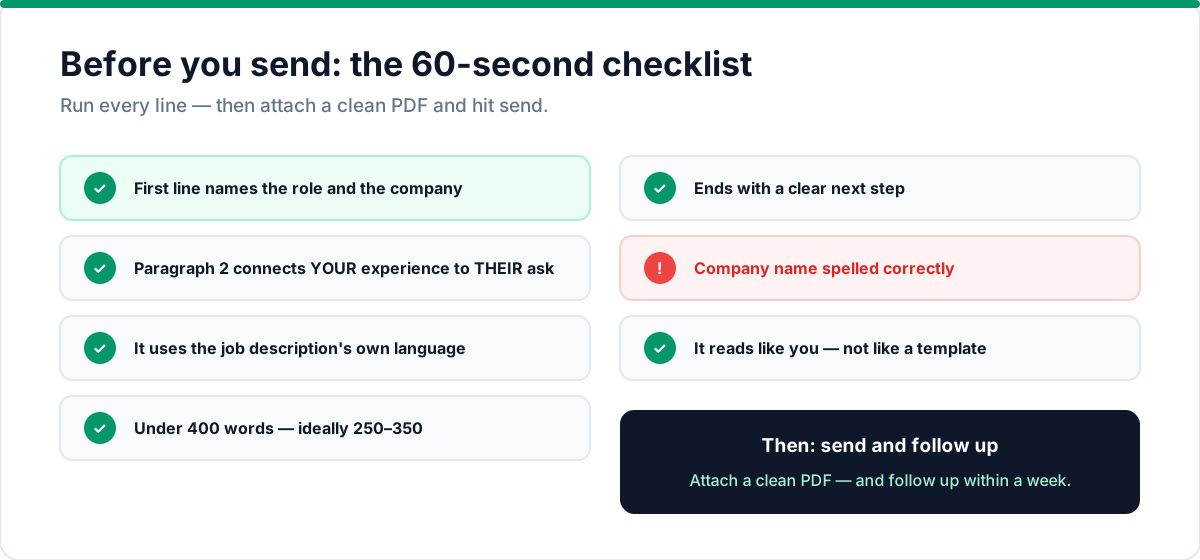
Before you send: the 60-second checklist
- Does the first line name the role and the company?
- Does paragraph two connect your experience to their requirements?
- Does it use the job description's own language?
- Is it under 400 words?
- Does it end with a clear next step?
- Is the company name spelled correctly?
- Does it read like you — not like a template?
When to skip the cover letter
Straight answer: when the application says optional and you have nothing specific to say, it's fine to skip. A mediocre generic letter is worse than none. But if you have a referral, a notable win, or a real reason to connect with this specific company — write it. That's exactly the situation where a letter moves the needle. After you send it, follow up within a week.
Cover letter FAQs, answered
Should I use a template? Yes — but as a skeleton, never as a fill-in-the-blanks final product. The template in our cover letter length guide gives you the bones; the specificity has to be yours. A letter that could apply to any company is the one thing that always fails. Start with a strong resume, then build the letter from it.
Who do I address it to? A named person, always, if you can find one. The hiring manager's name is usually findable on LinkedIn or the company's team page — spend the 30 seconds. "Dear Hiring Manager" is the fallback, not the goal, and "To Whom It May Concern" is the sign of an unedited application.
Does it need a header? Yes, a minimal one: your name, phone, email, and the date. It should match your resume header, and it helps your letter travel as a standalone document.
Should I mention compensation? No. Not in the letter. Salary conversations belong in the process, and raising it up front can end the conversation before it starts.
Email or attachment? If you're emailing directly, a short letter in the email body plus your resume attached works best. If the portal takes attachments, upload a clean PDF. Never paste a full letter into a portal's text box and attach a second one — pick one.
Is AI-written content okay? Use AI as a drafting partner, not a ghost. The final letter should read like you and contain specifics AI can't invent. A letter full of confident claims about your experience that you can't defend is a liability, not a help. Your resume keywords and achievements are the raw material — AI helps you phrase them, not fabricate them.
How many paragraphs should a cover letter be? Four paragraphs is the standard: hook, match, proof, close. Each paragraph should be 2–4 lines. More than four paragraphs risks losing the reader.
Do I need a cover letter if the job posting doesn't mention one? If the posting doesn't mention it, it's usually optional — but submitting a strong one still differentiates you. If you have something specific to say (referral, relevant achievement, genuine interest), write it. If not, a clean resume is better than a weak letter.
The bottom line
A great cover letter is short, specific, and tailored — one clear argument for why you're the right person, written in the company's own language, in under 400 words. It doesn't repeat your resume; it connects your resume to this job. Most letters fail because they're generic; yours will win because it's specific.
Talent & Story's cover letter builder walks you through this exact structure, with a guided editor and deterministic feedback that pulls from your real experience — write, edit, and export a polished PDF in minutes. Start free.
Put this into practice with Talent & Story
Build an ATS-friendly resume, get an instant compatibility score, and manage your entire job search in one workspace.
Written by
Talent & Story Team · Career Workspace
We build Talent & Story — the career workspace for building ATS-friendly resumes, writing cover letters, tracking applications, and preparing for interviews. Every guide is written to be practical enough to use the same day.