25 Most Common Interview Questions (and How to Answer Them)
The 25 most common interview questions - why they are asked, what interviewers really evaluate, and full sample answers you can adapt to your own story.
Interviewers decide fast: 33% of hiring managers say they know within the first 90 seconds of an interview whether they'll hire someone (survey stats). First impressions set the ceiling — your answers have to raise it.
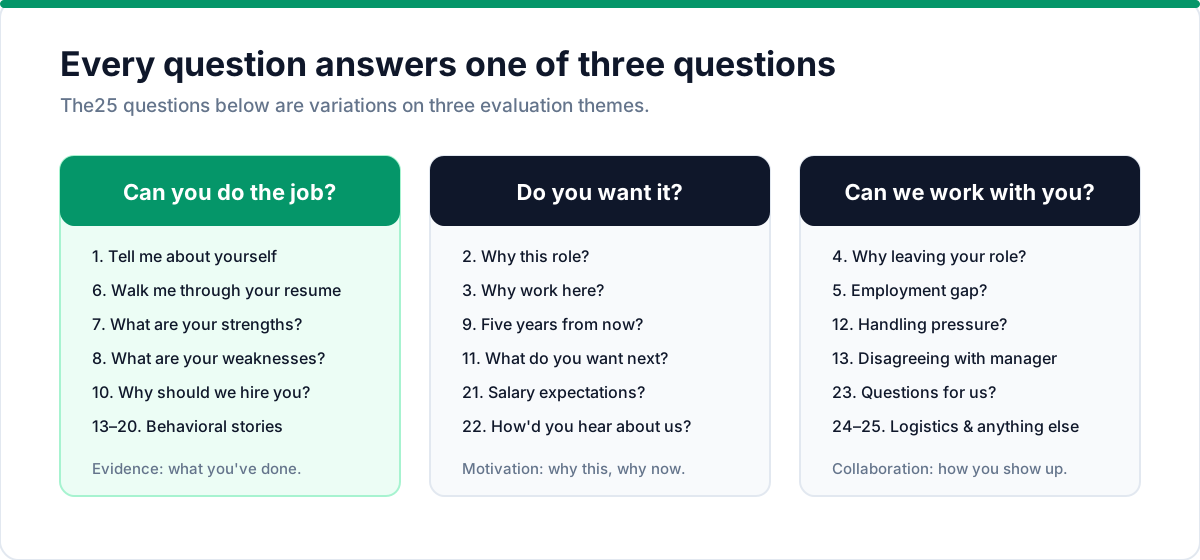
The questions below map directly to what hiring teams are actually evaluating: Can you do the job? Do you want it? Can we work with you? Master these 25 and you'll be ready for the substantial majority of what any interviewer throws at you.
The "tell me about yourself" family
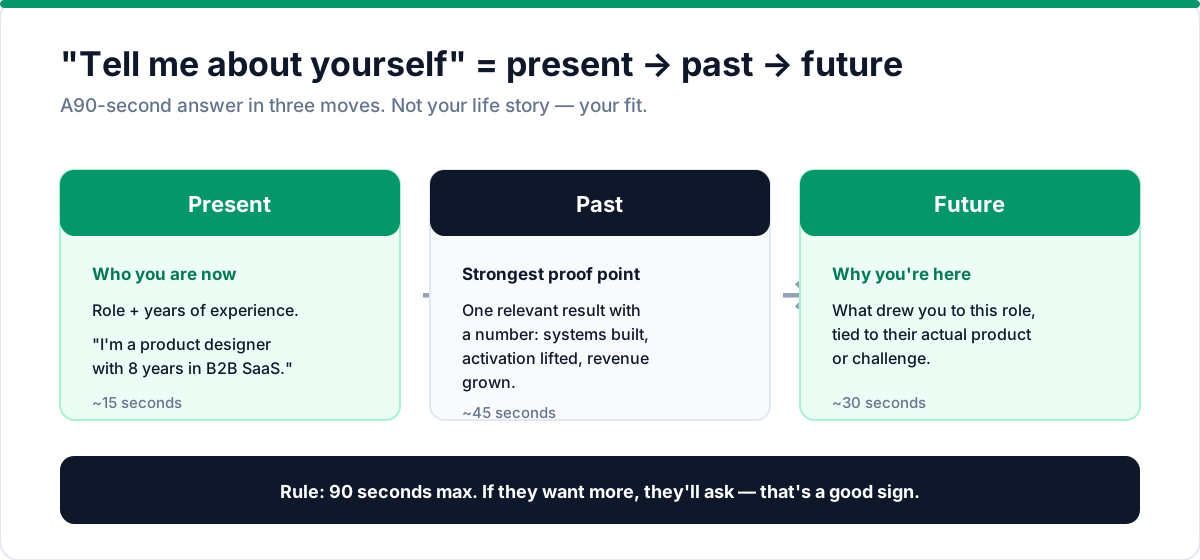
1. "Tell me about yourself." The interviewer isn't asking for your life story — they're asking for a summary of why you're the answer to their problem. Use the present, past, future formula: who you are now (role + years), the strongest proof point (a relevant result), and why you're here (what drew you to this role).
Sample answer:
"I'm a product designer with 8 years of experience in B2B SaaS. At my last company, I built the design system used by 40+ product teams and led the onboarding redesign that lifted activation 28%. I'm here because I want to solve the kind of complex design challenges your team is tackling — especially around [specific product or feature]."
2. "Why are you interested in this role?" Never answer with what the role gives you (salary, growth, learning). Answer with the intersection: what the role involves, what you're genuinely good at, and the match between them. Two specific sentences beats a paragraph of praise.
Sample answer:
"Your job description emphasizes design systems and cross-team collaboration — that's exactly where I've spent the last 5 years. At [Previous Company], I built the system that 40 product teams relied on, and I loved the challenge of making complex tools feel simple for diverse users."
3. "Why do you want to work here?" Do research before the interview and name something real: a product you use, a problem they're solving that matches your experience, a visible cultural value. "Your mission resonates with me" without evidence is a skipped question. If you tailored your resume to this job description, you already know the company well — use that research here.
4. "Why are you leaving your current role?" One clean, honest, non-negative reason: more responsibility, a different direction, growth. Never trash a current or former employer — interviewers hear that and wonder when you'll trash them. If you're pivoting careers, framing the shift in your resume summary is how you tell the story.
5. "Why is there a gap in your employment?" Name it plainly and briefly, then pivot to what you did with the time and what you bring now. The detailed playbook is in our career gap guide.
The "can you do the job" family
6. "Walk me through your resume." This is "tell me about yourself" with more room. Tell the story: where you started, the skills you built, the decisions that shaped your path, and where the trajectory points. Keep it chronological but skip years of irrelevant detail. If you're not sure how to structure the resume itself, our how to write a resume guide walks through the full process.
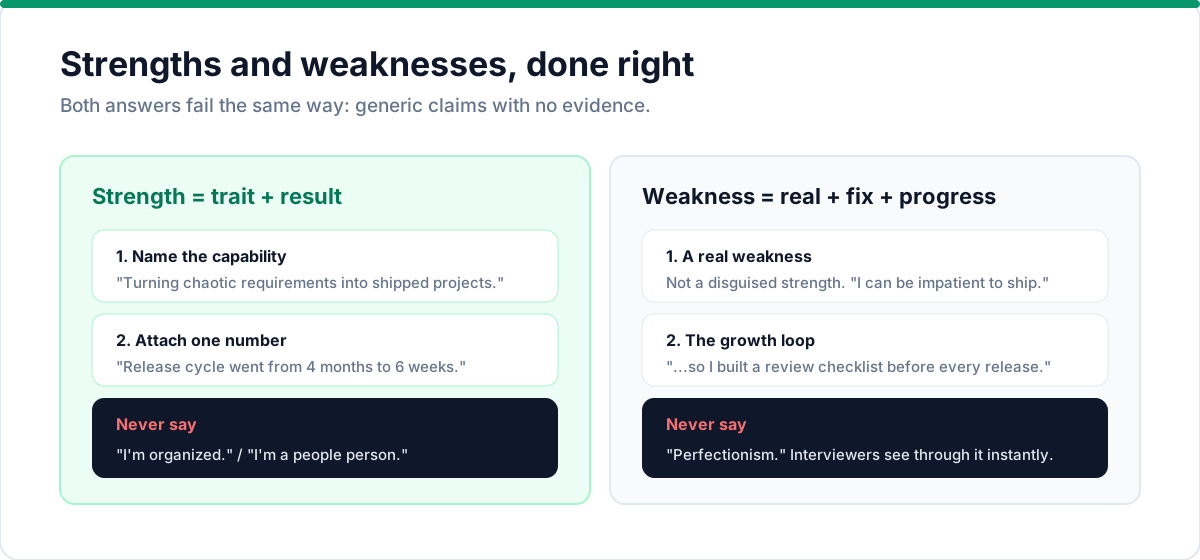
7. "What are your strengths?" Pick two or three, and attach each to a specific result. "I'm strong at turning chaotic requirements into shipped projects — I took our release from 4 months to 6 weeks" beats "I'm organized."
Sample answer:
"Two strengths I'd highlight: first, I'm very good at taking ambiguous problems and turning them into structured plans. I led a project where we had no existing process — I mapped the workflow, built a system, and we shipped in 8 weeks. Second, I communicate across teams easily — designers, engineers, and stakeholders all got aligned because I made sure everyone had the same context."
8. "What are your weaknesses?" The goal isn't to confess — it's to show self-awareness and a growth loop. Choose a real weakness (not a disguised strength), explain what you're doing about it, and show progress. "I can be impatient to ship, so I've built a review checklist..." reads as honest and coached, which it is. Avoid the common resume mistakes of listing "perfectionism" as a weakness — interviewers see through it.
9. "Where do you see yourself in five years?" The safe, true answer: still growing, deeper in a domain you love, ideally here. Interviewers are checking for alignment and commitment, not a flawless career plan.
10. "Why should we hire you?" Summarize your case: the two reasons you're the best fit, grounded in their problem and your results. This is the closest you'll get to a closing argument — make it confident and specific.
11. "What are you looking for in your next role?" Mirror the job: the responsibilities, the team, the kind of work you do best. What you're looking for should sound like what they're offering.
12. "How do you handle pressure or tight deadlines?" Give a real example with a system: how you prioritize, communicate, and protect quality. "I thrive under pressure" is the cliché they hear forty times; "here's how I did it on X project" is the answer they remember.
Sample answer:
"I had a situation where we had two weeks to deliver a major feature and a key engineer went on unexpected leave. I immediately re-scoped the release into a must-have and nice-to-have version, communicated the adjusted timeline to stakeholders, and brought in a contractor for the testing pipeline. We shipped the core feature on time and the rest three weeks later — no quality sacrificed."
The behavioral family
Behavioral interviews are standard practice: 73% of HR professionals use them — second only to structured interviews at 74% (enterprise talent research). The format — "tell me about a time when..." — reveals what you've actually done, not what you say you can do.
For all behavioral questions, use a consistent structure. If you're not already using it, the STAR method is exactly this structure — and the interview is where it pays off.
13. "Tell me about a time you disagreed with your manager." Frame it as respectful, evidence-based disagreement that you raised directly and resolved constructively — whether or not you got your way. The trap is framing yourself as always right or your manager as always wrong.
Sample answer:
"My manager wanted to delay the product launch by a month for additional testing. I believed the existing test coverage was sufficient and the delay would cost us a competitive window. I put together a data brief showing our test pass rates and the competitive timeline risk, presented it in our 1:1, and we agreed on a middle path — we launched on time with a targeted two-week beta for the highest-risk feature. It shipped successfully and we didn't lose the window."
14. "Tell me about a time you made a mistake." A genuine mistake, a short explanation, and — critically — what you did after: how you fixed it, what you changed, and what you'd do differently. Owning the mistake is the answer.
15. "Tell me about a conflict with a coworker." Use the same structure as the mistake answer: what happened, how you approached the person, how you resolved it, what the working relationship looks like now. Never present yourself as faultless.
Sample answer:
"A fellow designer and I had different visions for the checkout redesign. Instead of escalating, I suggested we both present our approaches to the team with user data. My colleague's approach actually tested better for mobile users, so we adopted theirs — and I suggested we A/B test the desktop version with my approach. We ended up shipping a hybrid that outperformed both originals by 15%."
16. "Describe a time you had to handle a difficult customer or client." The structure matters: the situation, your calm and empathetic response, and the outcome where you found a path forward.
17. "Give me an example of a time you showed leadership." Leadership ≠ management. It can be the moment you stepped up on a project, mentored someone, or took ownership when nobody else would. Any real example counts — and if you documented that work in a career portfolio, you have ready-made proof.
18. "Tell me about a time you failed." Related to mistake questions but deeper. Pick a meaningful failure, be honest about your contribution, and show what you built from it. The candidate who can discuss failure candidly signals maturity.
19. "Describe a time you went above and beyond." The story should show initiative with a measurable outcome — a project you took on beyond your scope that produced a real result.
20. "How do you stay current in your field?" Be specific and genuine: a podcast you actually listen to, a course you're mid-way through, a project you build or write. A vague "I love learning" is a missed opportunity.
The logistics and expectations family
21. "What are your salary expectations?" This question is coming; decide how to handle it before the interview. If you can, give a researched range based on market data and your level. If the role's range wasn't shared, it's fair to say you'd like to understand the full compensation picture first — then give a range when you have one. Track these details in your job search tracker so you don't lose sight of compensation across multiple offers.
22. "Why did you apply to this role / how did you hear about us?" A clean, honest answer — whether it's a referral, a job board, or the company site. If a person referred you, name them; it strengthens both of you.
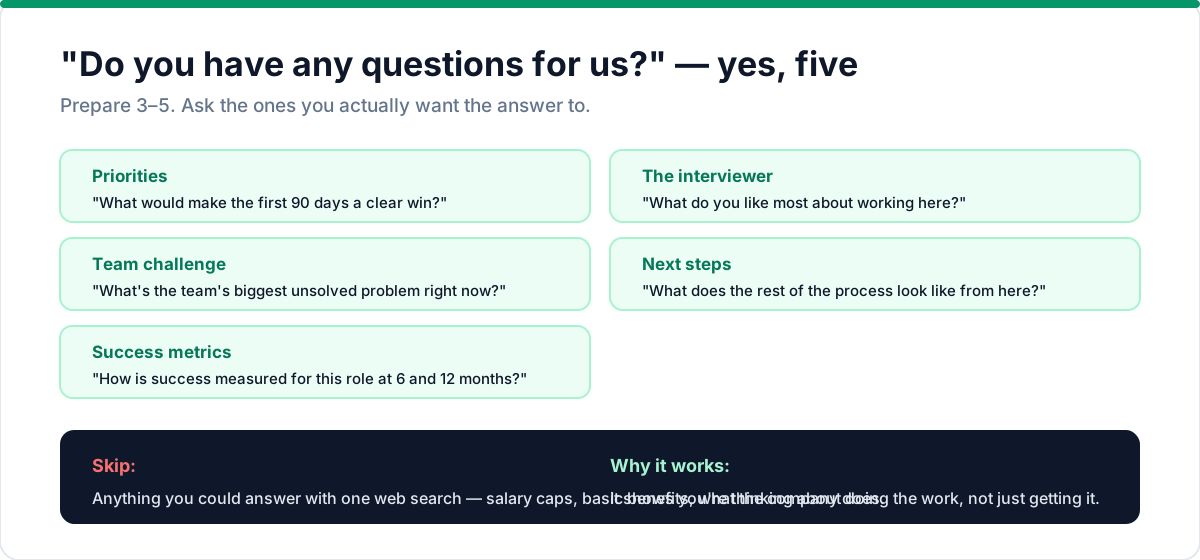
23. "Do you have any questions for us?" The trap is "no." Prepare 3–5 real questions: about the role's priorities, the team's biggest challenge, how success is measured, or what the interviewer likes about the work. Skip questions you can answer with one web search. Good questions show you've tailored your application to this specific role.
24. "What's your availability / when can you start?" Be honest but open. If you have a notice period, name it. Never give a number you can't honor, and don't pretend you can start tomorrow if you can't.
25. "Is there anything else you'd like us to know?" Yes. This is the last-chance question for anything your resume couldn't say — a career change rationale, a situation you'd rather they hear from you, or a final strong point. Have one polished sentence ready.
How to prepare in one evening
Don't rehearse 25 scripted answers — prepare stories and facts you can adapt:
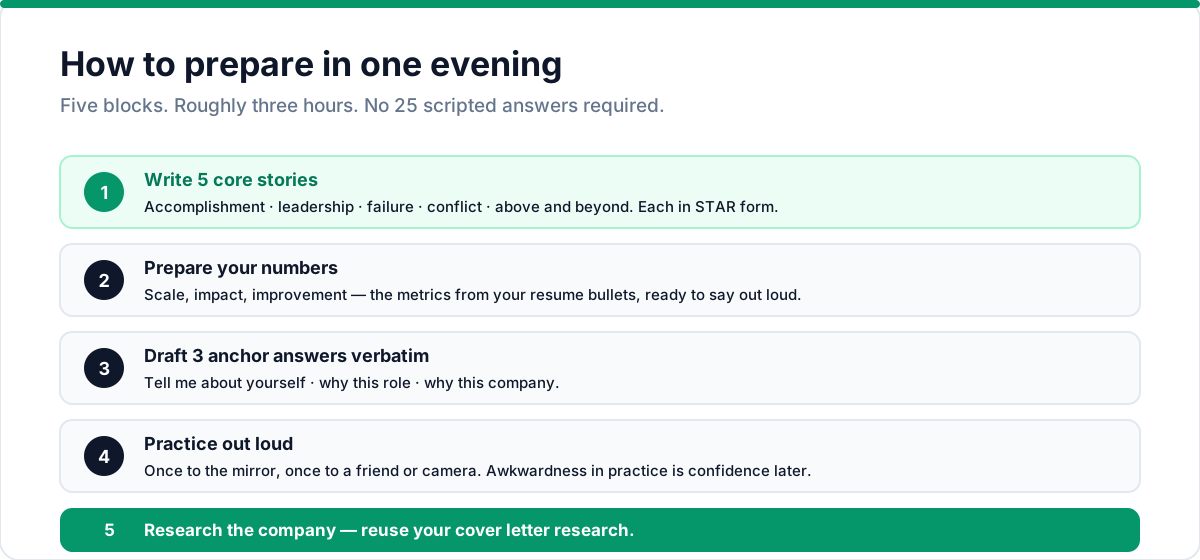
- Write out 5 core stories from your career (one each for: accomplishment, leadership, failure, conflict, going above and beyond). Each in STAR form.
- Prepare your numbers. The metrics from your resume bullets should roll off your tongue — scale, impact, improvement.
- Draft your three big answers verbatim: tell-me-about-yourself, why-this-role, why-this-company.
- Practice out loud — once in the mirror, once to a friend or camera. Awkwardness in practice is confidence in the interview.
- Research the company. Know their recent news, products, and mission. Reference specifics in your "why here" answer. Your cover letter research already covers this — reuse it.
Frequently asked questions
How many interview questions should I prepare for? Focus on the 25 in this guide. They cover 90%+ of what you'll encounter. Beyond these, prepare for 2–3 role-specific technical or scenario questions from the job description.
Should I memorize my answers word-for-word? No. Memorize your key points and stories, not exact phrasing. Over-rehearsed answers sound robotic. The goal is fluency with flexibility — know your material well enough to adapt.
How long should my answers be? Keep most answers between 60–90 seconds. Behavioral stories (STAR format) can run 2 minutes. The "tell me about yourself" answer should be 90 seconds max. If the interviewer wants more detail, they'll ask a follow-up.
What's the best way to practice behavioral interview questions? Use the STAR method framework. Write out 5 stories from your career, then practice telling each one aloud in under 2 minutes. Focus on the Action and Result — that's where your value shows.
How do I handle salary questions without giving a number first? Acknowledge the question, then redirect: "I'd love to understand the full compensation picture — could you share the range for this role?" If pressed, give a researched range based on Glassdoor or Levels.fyi data for your role and location.
What questions should I ask the interviewer? Prepare 3–5 questions about the role's priorities, the team's challenges, how success is measured, or what the interviewer enjoys about their work.
The bottom line
The 25 most common interview questions are all variations on three themes: can you do the job, do you want it, and can we work with you. Prepare five reusable stories, know your numbers, and draft the three anchors — the rest becomes easy variations.
Talent & Story keeps the material you need right next to the job: your metrics in your resume, your story in the cover letter, and the job description you're targeting in Job Match — everything in one place before the interview. Start free.
Put this into practice with Talent & Story
Build an ATS-friendly resume, get an instant compatibility score, and manage your entire job search in one workspace.
Written by
Talent & Story Team · Career Workspace
We build Talent & Story — the career workspace for building ATS-friendly resumes, writing cover letters, tracking applications, and preparing for interviews. Every guide is written to be practical enough to use the same day.