Resume Summary vs Objective: When to Use Each (Examples)
Summary or objective? One shows what you deliver; the other states what you want. Here's when each works, with formulas and examples you can adapt fast.
Two resume openers, one almost always right and one almost always wrong. The first describes you and your value. The second describes what you want from them.
If you've ever wondered which to use — or had a recruiter say "nobody reads objectives anymore" — this guide settles it, with examples you can adapt.
Quick stat: recruiters spend an average of 7.4 seconds on their initial resume scan, according to the Ladders' 2018 eye-tracking study. The summary or objective is the first thing they read — it determines whether they keep scanning or move on.
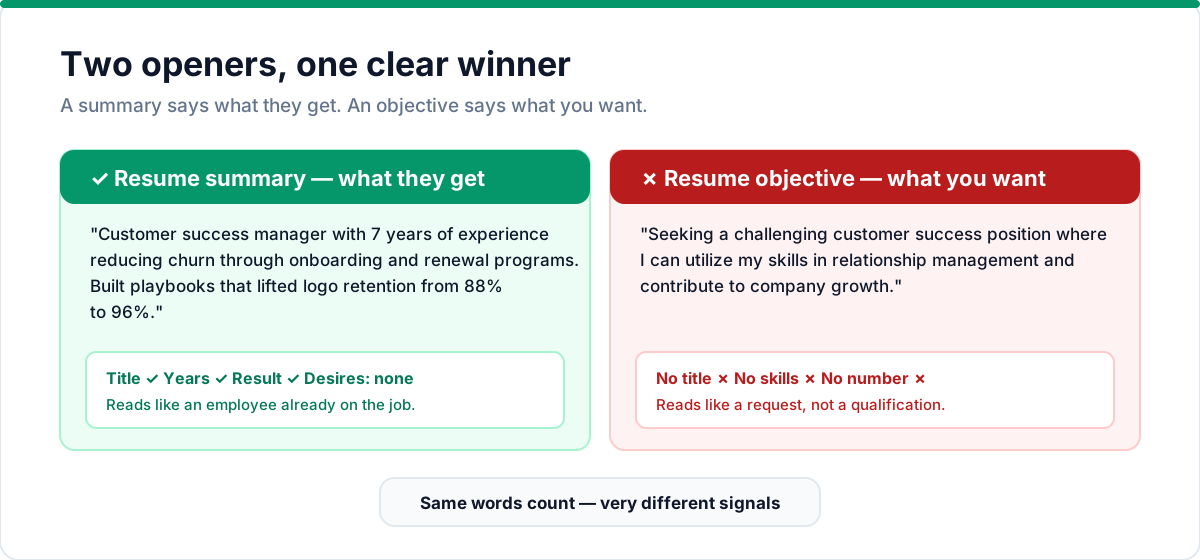
The difference in one sentence
- A resume summary states what you offer: your experience, skills, and the results you deliver. It's written for the role you're targeting.
- A resume objective states what you're looking for: the position you want, the company, and why you'd be a good fit. It's written about your desires.
Here's the gut check: a summary tells the recruiter what they'd be getting. An objective tells them what they'd be giving you. Guess which one the reader cares more about.
Summary: "Customer success manager with 7 years of experience reducing churn through onboarding and renewal programs. Built playbooks that lifted logo retention from 88% to 96%."
Objective: "Seeking a challenging customer success position where I can utilize my skills in relationship management and contribute to company growth."
Read both as a recruiter. The first one already sounds like an employee. The second one sounds like a request.
When to use a resume summary
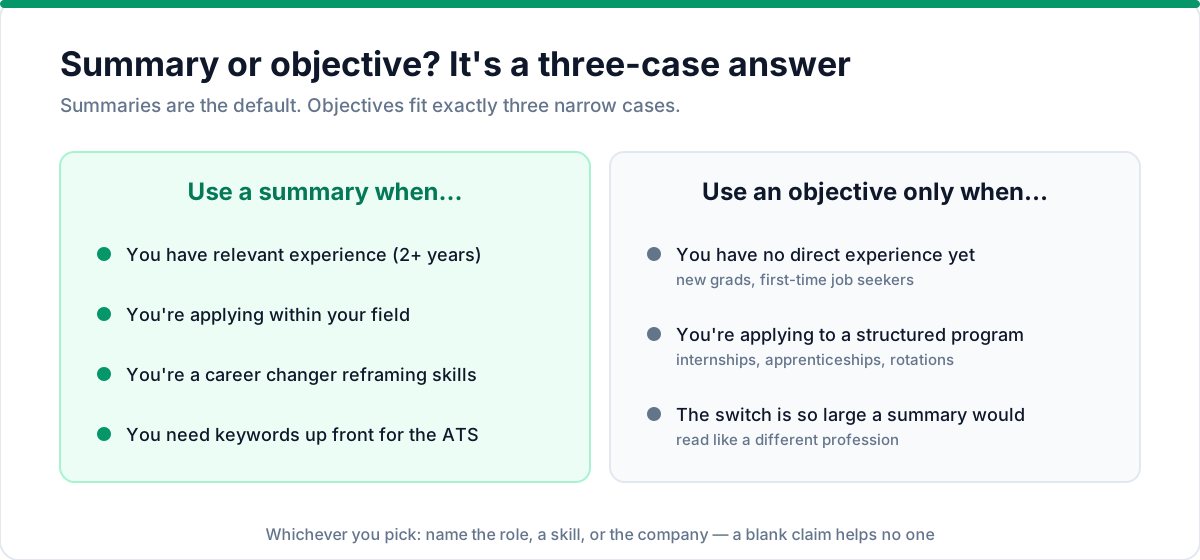
Use a summary in most situations, especially when you:
- Have relevant experience — even two years of focused experience gives you something to summarize
- Are applying within your field — the summary instantly connects your background to the role
- Are a career changer — a summary lets you reframe your transferable skills toward the new direction
- Need keywords up front — the summary is the highest-visibility spot on the page, and it's where ATS keyword placement starts
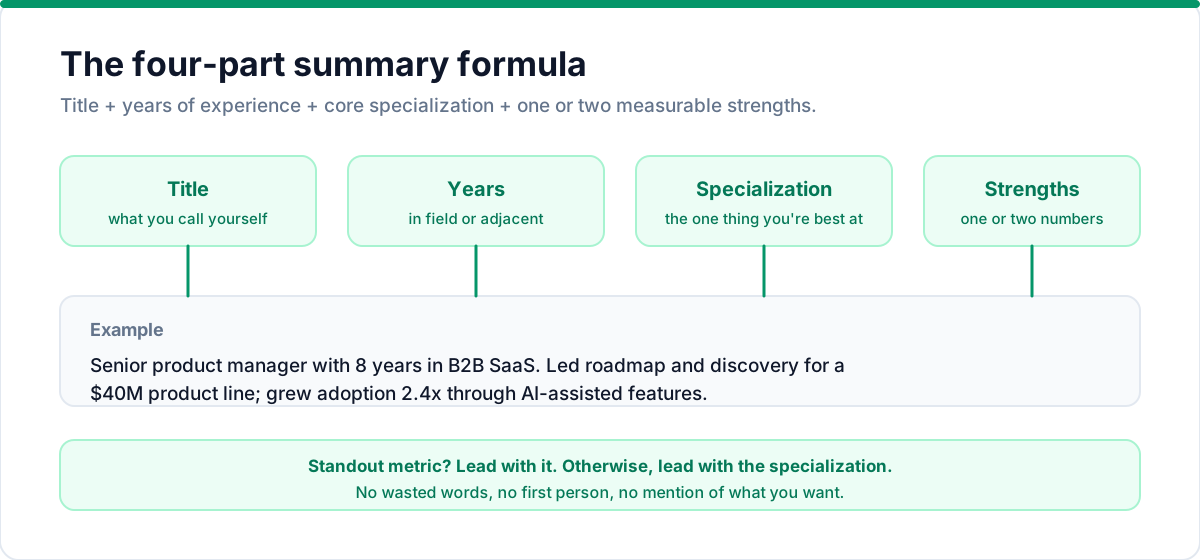
Summary formula
Title + years of experience + core specialization + one or two measurable strengths.
Senior product manager with 8 years in B2B SaaS. Led roadmap and discovery for a $40M product line; grew adoption 2.4x through AI-assisted features and customer-insight programs.
Four elements, no wasted words. If you have a standout metric, lead with it. If not, lead with the specialization.
Summary examples by experience level
Experienced professional:
Operations leader with 12 years in logistics and supply chain. Reduced freight costs 18% by renegotiating carrier contracts and introducing route optimization across a 14-warehouse network.
Mid-career:
Marketing manager specializing in paid acquisition. Scaled customer acquisition cost efficiency 31% across Google, Meta, and LinkedIn channels while managing a $1.5M annual budget.
Career changer:
Teacher transitioning to learning and development, with 9 years designing curricula and delivering training that measurably improved outcomes. Skilled at instructional design, facilitation, and stakeholder collaboration.
Notice the career changer version doesn't hide the old career — it repositions it toward the new one. If you're also explaining a career gap, keep the summary forward-looking and brief.
When to use a resume objective
The objective earns its place in a narrow set of situations:
- You have no direct experience yet. New grads and first-time job seekers genuinely have nothing to summarize. An objective that names the role, the industry, and a relevant skill gives the recruiter a frame.
- You're applying to a specific, well-understood program. Structured internships, apprenticeships, or rotational programs often expect an objective-style statement.
- You're switching into a field so different that a summary would confuse. When your summary would read like a different profession, a short objective can bridge the gap.
Objective formula (for the cases above)
Position + what you bring + what you want to grow into.
Entry-level data analyst seeking to apply strong SQL and Excel skills in a marketing analytics role, with a path toward building end-to-end reporting and insights.
That's specific, skills-forward, and future-oriented — not a plea. It works because it names concrete skills (SQL, Excel) rather than abstract desires.
Objectives that hurt you
The objective gets a bad name because most objectives look like this:
- ❌ "Seeking a challenging and rewarding position with a growing company"
- ❌ "Looking for an opportunity to utilize my skills and grow professionally"
- ❌ "To obtain a position that will allow me to leverage my skills in a dynamic environment"
Every one of those says nothing. No role, no skills, no company. They read as templated — because they are templated, and recruiters see them constantly.
The rule: if your objective doesn't name the role, a specific skill, or the company, delete it. Blank space is better than a generic filler sentence.
What to use instead: a hybrid for your exact situation
Sometimes the clean answer is neither. For job seekers who want structure but don't have years of matching experience, a hybrid works:
"Recent computer science graduate with internship experience in full-stack development, seeking a junior software engineering role focused on web platforms. Strong foundation in React, TypeScript, and AWS."
That's a summary of what you offer (first half) plus the objective's job (second half), merged into one tight paragraph. It's a legitimate modern option — and it's just a summary written with a clearer target.
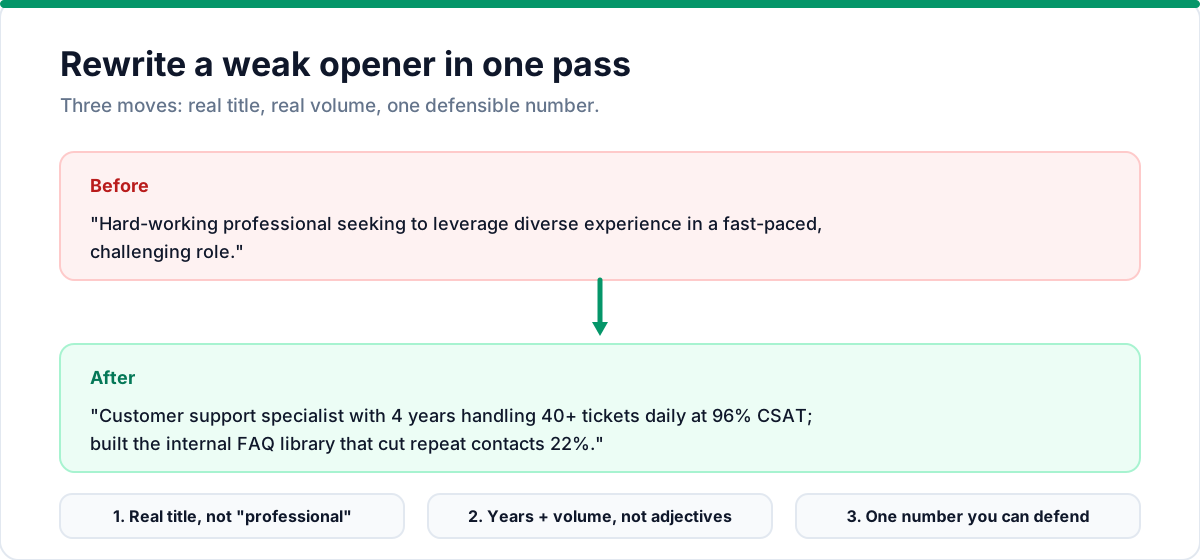
Rewrite a weak opener in one pass
You don't need a new career to fix a flat opener — you need the four formula elements. Watch a generic line turn into a real one:
Before: "Hard-working professional seeking to leverage diverse experience in a fast-paced, challenging role."
After: "Customer support specialist with 4 years handling 40+ tickets daily at 96% CSAT; built the internal FAQ library that cut repeat contacts 22%."
Three moves did all the work: a real title instead of "professional," years and volume instead of "diverse experience," and one defensible number instead of an adjective. Nothing in the After example was invented — it was extracted. If you can't fill in the number yet, use the strongest task-level fact you can stand behind, and keep your bullets carrying the evidence below.
Common resume mistakes to avoid
- Labeling it "Objective" when it's a summary. "Objective" signals the older format; "Professional Summary" (or nothing — the section doesn't strictly need a label) reads modern.
- Going over 4 lines. The opener is a teaser, not a biography. One tight paragraph or 3 bullets.
- Writing in first person. "I have 11 years of experience" is natural in conversation; on a resume, drop the "I" and write "Product designer with 11 years of experience."
- Repeating the rest of the resume. The summary should compress your story, not duplicate the bullets below it.
A worksheet for writing your summary in 5 minutes
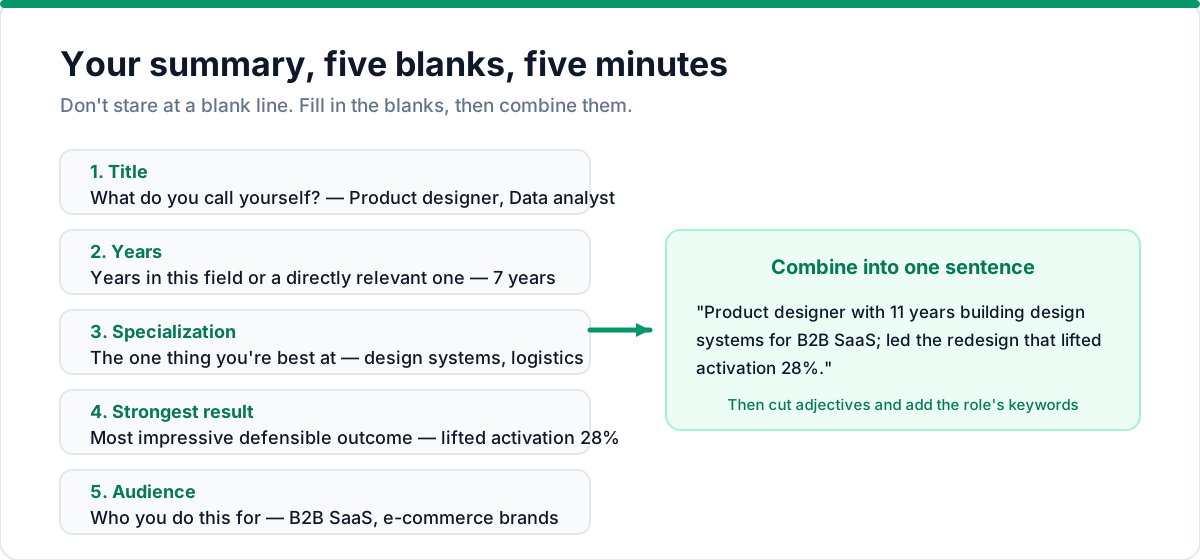
Don't stare at a blank line. Fill in the blanks:
- Title: What do you call yourself? (Product designer, Operations manager, Data analyst)
- Years: How many years in this field or a directly relevant one? (7 years)
- Specialization: What's the one thing you're best at? (design systems, supply chain, marketing analytics)
- Strongest result: What's your most impressive, defensible outcome? (lifted activation 28%; cut freight costs 18%)
- Audience: Who do you do this for? (B2B SaaS, logistics networks, e-commerce brands)
Now write one sentence that combines them:
"Product designer with 11 years building design systems for B2B SaaS; led the redesign that lifted activation 28%."
Then refine. Cut adjectives, tighten, and make sure the two or three most important keywords for the role appear naturally. This is also where resume keyword placement starts — the summary is the highest-visibility real estate on the page.
Summary examples by field
Different fields lead with different strengths. Adapt these templates:
Engineering: "Backend engineer with 6 years building distributed systems on AWS. Rebuilt the payments API, cutting checkout failures 41% across 50k daily requests."
Sales: "Account executive with 5 years in B2B SaaS, consistently exceeding quota by 20%+. Built a 90-account territory to $1.4M ARR at a 34% win rate."
Healthcare: "Registered nurse with 8 years in acute care and a certification in emergency nursing. Led a 12-bed unit and a team of 18 during peak census."
Finance: "Financial analyst with 6 years in FP&A, specializing in forecasting and cost modeling. Reduced reporting cycle time 40% through automation."
Notice what every example does: title, years, specialization, one concrete result — and no mention of what the candidate wants.
Frequently asked questions
What is the difference between a resume summary and an objective? A summary describes what you offer — experience, skills, and results — written for the role you're targeting. An objective describes what you want from the employer. A summary answers "what do they get?"; an objective answers "what do I get?", which is why summaries win in almost every case.
Are resume objectives outdated? Mostly, yes — recruiters rarely expect them, and generic objectives actively hurt you. The exceptions are narrow: candidates with no experience to summarize, structured internship or rotational programs, and switches into fields so different that a summary would mislead.
How long should a resume summary be? One tight paragraph of three to four lines — roughly 40 to 60 words. It's a teaser for the rest of the page, not a biography. If it runs longer, you're writing the paragraph that belongs in your cover letter.
Where should the summary go on a resume? Directly under your contact block, above experience — it's the first thing a recruiter reads after your name. That position is also why the strongest keywords for the target role belong in it.
Do recruiters actually read the summary? The ones who keep reading do — it's the first content on the page, and the initial scan lasts seconds. A summary that names the role, a specialization, and a number earns the next line; a vague one loses the reader before your experience section.
Will a summary or objective confuse the ATS? Neither — the ATS parses your text the same way regardless of which opener you use. What matters is that your opening section survives clean parsing: plain text, no tables or text boxes, real keywords from the posting.
The bottom line
The resume summary is the default and the stronger choice for almost everyone — it sells what you deliver, not what you want. Use an objective only when you have no experience to summarize or you're entering a totally new field, and even then, keep it specific: name the role, a skill, or the company. If your opener doesn't do one of those three things, rewrite it.
Still staring at the blank line? Talent & Story's guided builder helps you draft a professional summary from your own experience, with hand-written examples and a live preview — you approve every word before it lands on your resume. Build your resume around a strong opener, free — start with an ATS-safe template or open the builder.
Put this into practice with Talent & Story
Build an ATS-friendly resume, get an instant compatibility score, and manage your entire job search in one workspace.
Written by
Talent & Story Team · Career Workspace
We build Talent & Story — the career workspace for building ATS-friendly resumes, writing cover letters, tracking applications, and preparing for interviews. Every guide is written to be practical enough to use the same day.