What Is an ATS? How Applicant Tracking Systems Work
An ATS stores, searches, and ranks your applications — it doesn't hire anyone. Learn how applicant tracking systems work and how to get your resume seen.
You polish your resume for an hour, hit submit, and then… silence. Three weeks later the job is filled and you never heard a word.
Sound familiar? If so, you've almost certainly met an ATS — the applicant tracking system sitting between your resume and a human recruiter.
Here's the good news: an ATS isn't a wall you have to break through — it's a tool you can work with. This guide explains what an ATS actually does, how resume scoring really works, and what that means for your resume.
What is an ATS?
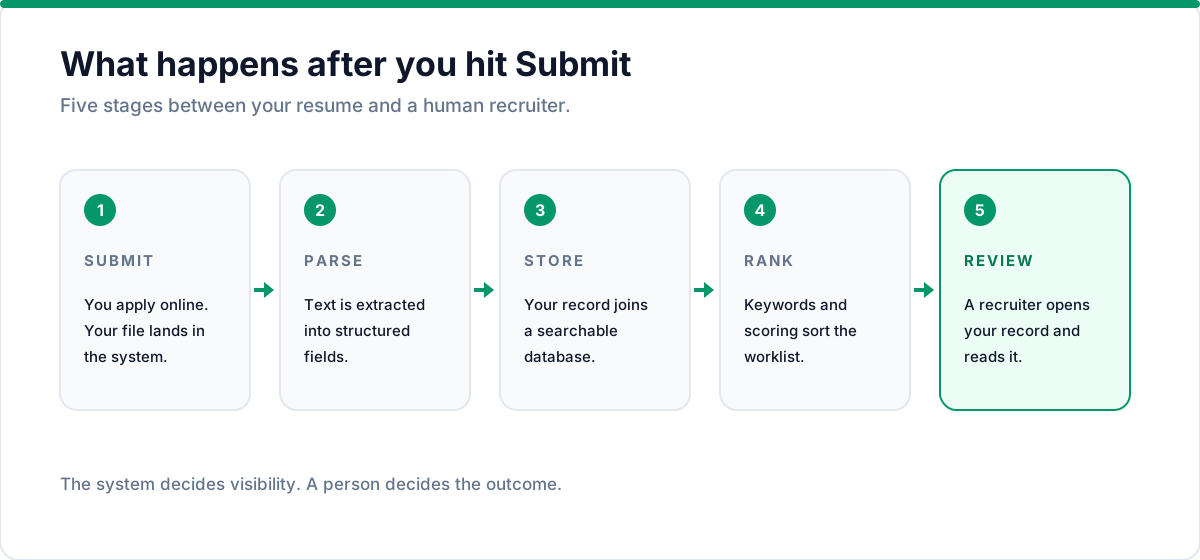
An applicant tracking system (ATS) is software that companies use to manage the flood of job applications they receive. Instead of reading resumes out of an inbox, recruiters work inside an ATS where every application is:
- Received automatically from job boards, career pages, and LinkedIn
- Parsed (text extracted) and stored in a searchable database
- Ranked, tagged, and moved through a hiring pipeline
- Shared with the right people on the team
That's it. An ATS is a database plus a workflow tool. It is not an AI judge that rejects you for being 2.5% less relevant than someone else.
Why companies use an ATS
The math is simple. A single opening at a large company can pull in hundreds or even thousands of applications. No recruiter can read them all, and no hiring manager wants to. An ATS lets teams:
- Store every candidate in one searchable place, not lost inboxes
- Collaborate — recruiters and hiring managers see the same pipeline
- Comply with record-keeping requirements around hiring
- Build talent pools to search again for future roles
- Filter obvious mismatches so humans focus on plausible candidates
Keep that last point in mind. The ATS is not deciding who gets the job. It's deciding whose resume gets human eyes.
How an ATS processes your resume
When you upload a resume, the ATS runs it through three stages.
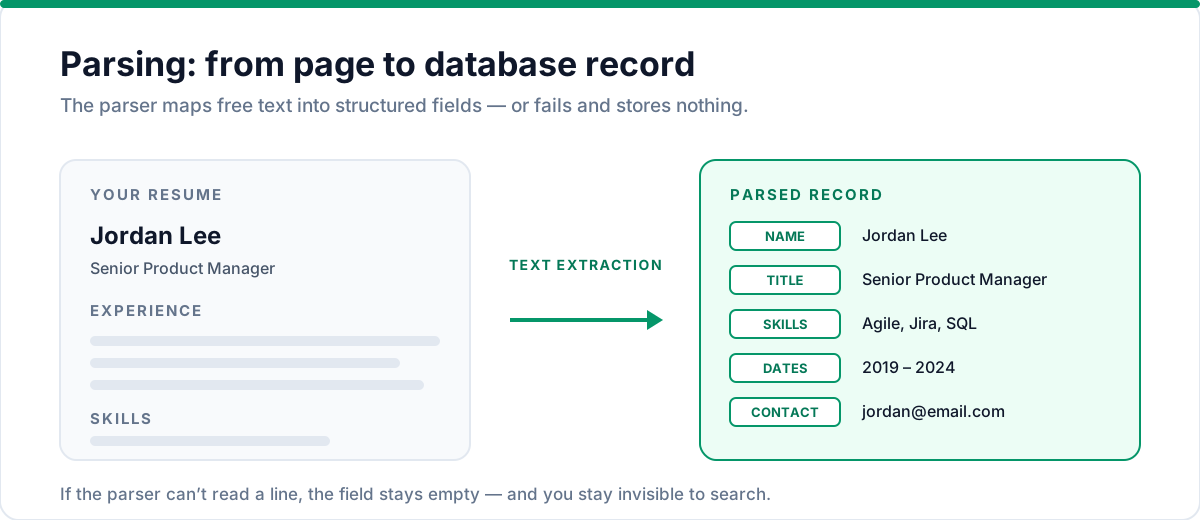
1. Parsing
The ATS extracts the text from your file and maps it to fields: name, email, phone, work history, education, skills, certifications. If the parser can't read your text, it stores nothing useful — and you become effectively invisible, even if a human would love your resume.
Parsers improve every year, but the core rule holds: the easier your text is to read, the better it parses.
2. Storage and search
Once parsed, your resume lives as searchable records. Recruiters search the database the way you'd search Google — with keywords, filters, and boolean queries.
Search query:
("project manager" OR "scrum master") AND (AWS OR "cloud infrastructure") AND location:Chicago
That's why keywords matter so much. A recruiter can only find candidates whose records match their search terms. If your resume never contains the phrase "scrum master," you won't show up for a search for "scrum master" — no matter how experienced you are.
3. Ranking and routing
Many ATS platforms include scoring or ranking features. Some score resumes against the job description automatically; some rely on simple keyword matching; some are AI-assisted. Either way, ranking feeds a recruiter's worklist — it doesn't issue verdicts.
How ATS resume scoring works
There is no universal "ATS score" — every vendor implements scoring differently. Recruiters control the criteria: as SHRM has reported, they set requirements like skills and experience, and the software ranks candidates by signals such as skill strength and job-title similarity.
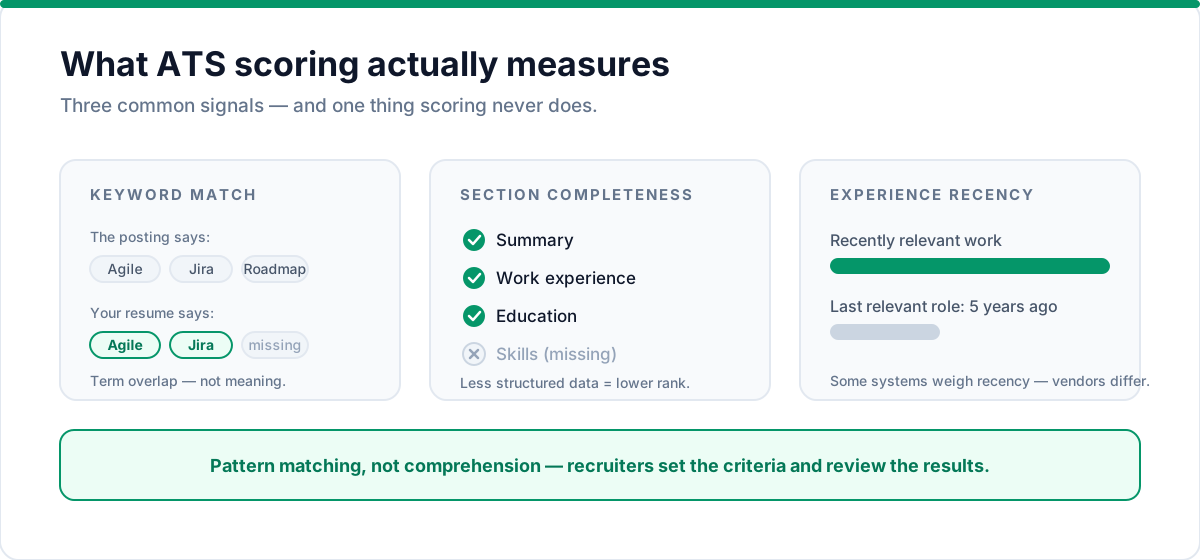
Most systems lean on three signals:
Keyword matching
The most common signal is how closely your resume's language matches the job description. If the posting calls for "project management," "Agile," "Jira," and "stakeholder communication," a resume containing all four matches more terms than one that lists a single term.
This isn't a secret algorithm — it's string matching. Our tailoring guide shows a repeatable 10-minute method for pulling the right terms from any posting.
Section completeness
Some platforms weight whether your resume has standard sections — summary, work experience, education, skills. A resume missing them ranks lower not because the system judges you, but because it has less structured data to work with.
Experience recency and relevance
Some systems consider how recently you held relevant roles — someone currently in a similar role may rank differently than someone last in the field five years ago. Not every ATS does it, and weighting differs across vendors.
What scoring is not
- It doesn't "understand" your resume. It's pattern matching, not comprehension.
- It doesn't use one universal formula. Each vendor implements scoring differently.
- It doesn't make hiring decisions. Recruiters set the criteria and review the results.
- It doesn't reject you permanently. A low score means you weren't surfaced as a top match — not that you're blacklisted.
Common ATS myths, debunked
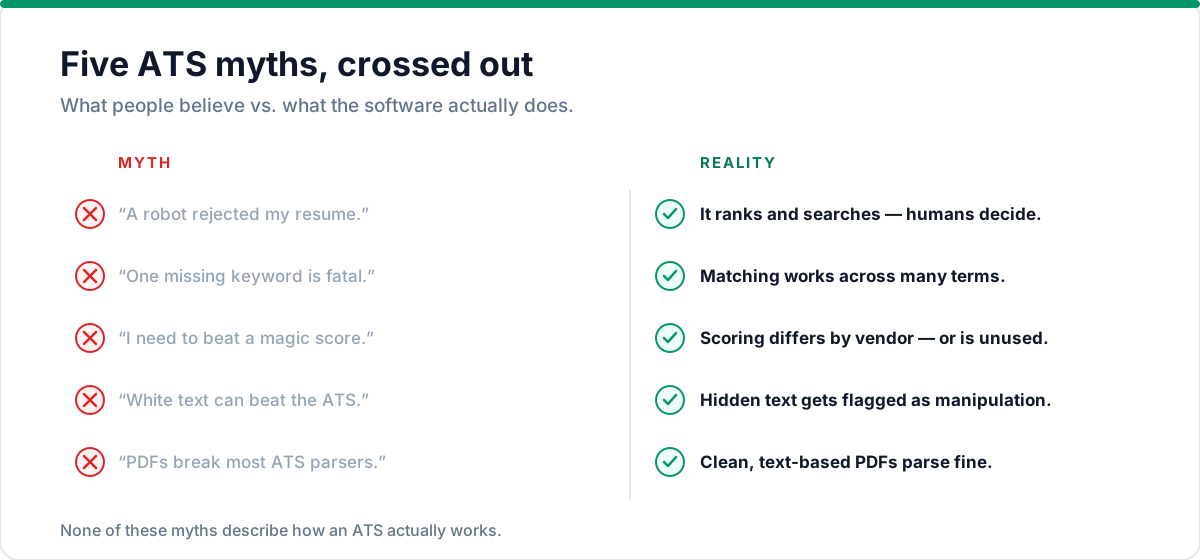
"A robot rejects my resume before a human ever sees it." Mostly false. An ATS rarely rejects — it ranks and searches. What it really does is determine visibility: a poorly formatted, keyword-poor resume may never surface in a search, which effectively removes you. But nobody "rejected" you.
"One missing keyword is fatal." No. Recruiters search with a mix of terms, and ranking isn't pass/fail. A strong resume missing one keyword still ranks well; a weak resume with perfect keywords still loses.
"There's a magic ATS score I need to beat." No. Some companies don't score at all — recruiters search manually. Others weight it differently. Focus on clear structure and keyword alignment instead of chasing a number.
"White text on white background will beat the ATS." Some people still try to hide keywords in white font or tiny text. Modern parsers flag this as a manipulation attempt, and some reject the file outright. Don't do it.
"Applying with a PDF will break the ATS." A clean, text-based PDF parses fine in nearly every modern system. What breaks parsers is text-as-image, graphics, and complex layouts — not the file type.
The real rules that get your resume seen
After all the parsing talk, the practical takeaway is simple:
- Make your text readable. One column, standard fonts, no tables or graphics. Text should flow top to bottom like a document, not a poster.
- Match the job description's language. If the posting says "customer success manager," use that phrase — not "client happiness consultant."
- Use plain bullet points. Standard bullets and dashes, not custom glyphs or images. Open each with a strong action verb.
- Stick to standard section names. "Work Experience," "Education," "Skills" — recognizable sections parse reliably.
- Include your essentials clearly. Contact info at the top, dates in consistent formats, everything as selectable text. Keep it to the right length — one page for most applicants, two for senior roles.
For the full formatting playbook, read our complete ATS-friendly resume guide. Once you've written it, run it through our 15-point ATS resume checklist before you submit — or paste it into the free ATS Resume Checker to see exactly where you stand.
What recruiters actually see on their screen
Inside the ATS, a recruiter sees a list of applications with parsed fields: name, current title, company, location, years of experience, and a resume thumbnail. They can open a record to read the full parsed resume, view the original file, and move the candidate through pipeline stages.
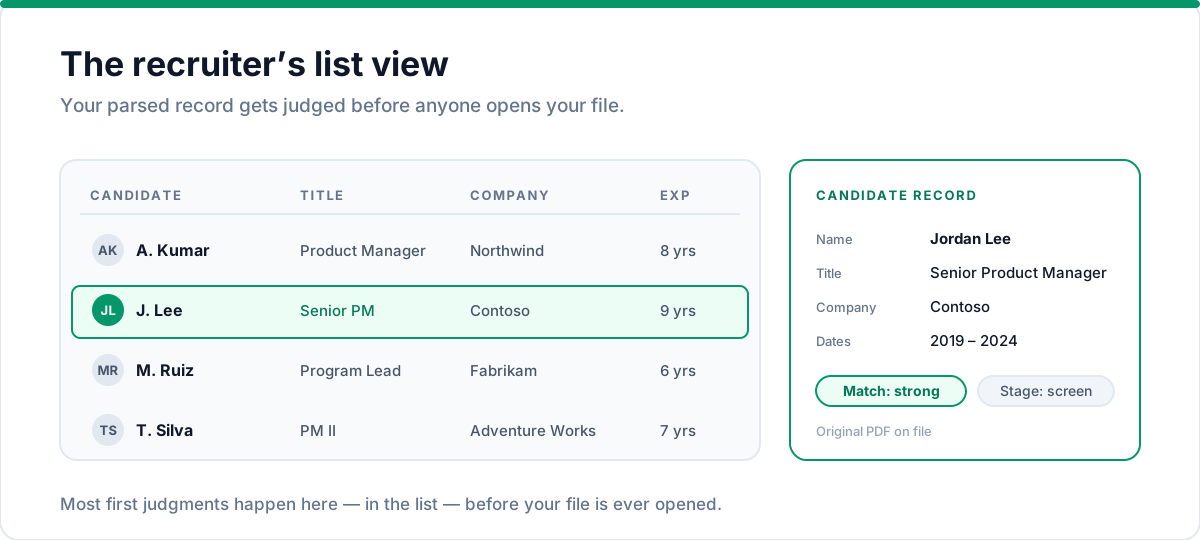
Two practical implications for you:
- The thumbnail decision is real. Many recruiters judge from the parsed record alone — before they ever open your file. If title, company, and dates sit in the right fields, you look organized before you're even read.
- You're searchable after you apply. ATS databases are long-lived. A recruiter sourcing a new role next quarter can find you — if your keywords and job titles match their search terms. Your application isn't a one-time event; it's an entry in a talent pool, which is a strong reason to use the right keywords even in applications you consider long shots.
The modern ATS landscape: parsing, ranking, and AI
The word "ATS" covers a spectrum of tools, and knowing the differences explains a lot of conflicting advice you'll read:
- Classic ATS platforms (the majority) — Workday, Greenhouse, Lever, iCIMS, Taleo — focus on storage, search, and pipeline management. The rules in this article keep you safe in all of them.
- Recruiting suites with CRMs add sourcing, engagement, and analytics on top of the same parsing layer. Same rules apply.
- AI-enhanced features are now common: automatic skills extraction, summary generation, and candidate scoring against a job description. These features rank, they don't reject — but they make well-structured, keyword-rich text even more valuable, because that's what the AI reads.
The takeaway: the specifics differ, but the strategy doesn't. The more cleanly your text parses and the better it matches the role's language, the more visible you are in every system.
Do they even use an ATS? (And why it doesn't matter)
Some candidates spend energy worrying about whether a specific company uses an ATS, as if they could opt out. In practice:
- Almost every mid-size to large company uses one. HR.com's 2025 Future of Recruitment Technologies report found that 78% of HR professionals use an ATS — by far the most widely adopted recruiting technology.
- Many small companies and startups don't — and they read every resume, so yours still needs to look good to a human.
- You can't reliably tell from the outside, and it doesn't change your best move.
The optimization is identical either way: clean format, strong content, real keywords. That's the intersection of "what the software can read" and "what a human wants to read."
How this changes your resume strategy
Here's the mindset shift that matters: you're not writing a document for a machine to judge — you're writing searchable text that a machine will index and a human will read. Both matter. The best resume does nothing if the ATS never surfaces it; the most keyword-perfect resume does nothing if a human opens it and sighs. That's why common resume mistakes like poor formatting and keyword stuffing hurt twice.
So optimize for both audiences. Lead with clear, standard formatting, use the exact language of the job description, and under that clean surface tell a real story with measurable results.
Frequently asked questions
What percentage of resumes are filtered out by ATS?
There's no reliable public pass rate — every company's funnel differs and most don't publish theirs. What's consistent is that strong applicants get screened out by formatting and keyword gaps, not by a fixed quota. The controllable factors are parsing and keyword alignment, not a magic percentage.
Can an ATS reject my resume outright?
Rarely. Most ATS systems rank and filter rather than auto-reject; a human makes the final decision. What the ATS does is determine visibility — if your resume doesn't parse well or lacks key terms, it may never surface in a search, which has the same effect as rejection.
Do ATS systems read cover letters?
Some do, some don't. Many platforms let you upload a cover letter but don't parse it for keywords. Always check the application instructions — if one is requested, write one.
How do I know if my resume passed the ATS?
You usually won't know directly. An interview invitation means you passed. Silence after two weeks usually means you didn't — but that can be volume, not ATS failure. The prevention is an ATS-friendly format and consistent keyword placement.
Should I send my resume as PDF or DOCX?
Both parse well in modern systems when they're text-based, not image-based. DOCX is slightly safer across older systems, but a clean PDF is fine. Check the portal's preferences — some allow both, some specify one.
Do ATS systems rank resumes automatically?
Both workflows exist. Some companies work from ranked queues the system generates; others rely on recruiters searching the database manually. You can't control which — which is why parseable formatting and the right keywords work in either case.
Do ATS systems work differently at small companies?
Smaller companies may use simpler tools or none at all, but the same principles apply: clean formatting, standard sections, and relevant keywords make your resume readable for both software and humans. Optimizing for ATS is really just optimizing for clarity.
The bottom line
An ATS is a database, a search engine, and a pipeline — not a hiring robot. It exists to help companies manage volume, and its practical effect on you is simple: it decides whether your resume is visible. Understand how it parses and searches, format accordingly, mirror the job's language, and you've done 90% of the work.
Want to know how you're doing right now? Build your resume in Talent & Story's guided builder, then run it through the built-in ATS analyzer to see a compatibility score and exactly what to fix — start free before you hit submit.
Put this into practice with Talent & Story
Build an ATS-friendly resume, get an instant compatibility score, and manage your entire job search in one workspace.
Written by
Talent & Story Team · Career Workspace
We build Talent & Story — the career workspace for building ATS-friendly resumes, writing cover letters, tracking applications, and preparing for interviews. Every guide is written to be practical enough to use the same day.